

IHRE HERAUSFORDERUNG
Fragmentierte Daten und Verkaufshindernisse
Für die Go-to-Market-Teams (GTM) von MongoDB war die Vorbereitung auf ein Kundengespräch noch nie eine einfache Rechercheaufgabe. Dazu mussten Informationen aus Salesforce, Besprechungsprotokollen, E-Mails und Dokumenten zusammengetragen und anschließend in Kundenpläne, Fragen zur Bedarfsermittlung und Folgeaufgaben umgesetzt werden. Dazu mussten Informationen aus Salesforce, Besprechungsprotokollen, E-Mails und Dokumenten zusammengetragen und anschließend in Kundenpläne, Fragen zur Bedarfsermittlung und Folgeaufgaben umgesetzt werden.
Die Informationen waren zwar vorhanden, aber die Vertriebsmitarbeiter mussten sie selbst miteinander verknüpfen. Der Wechsel zwischen verschiedenen Anwendungen erforderte ein wiederholtes Sammeln von Kontextinformationen, und allgemeine KI-Tools lieferten oft Antworten, denen das Verständnis für die Geschäfts- und Vertriebsmethodik von MongoDB fehlte, was eine manuelle Überprüfung erforderlich machte. Tatsächlich verbrachten die Kundenbetreuer von MongoDB durchschnittlich 4 bis 6 Stunden pro Kunden- bzw. Geschäftszyklus mit Verwaltungsaufgaben. Eine Reduzierung dieser Zeit und die Möglichkeit für die Mitglieder des GTM-Teams, ihre Zeit und ihre Bemühungen auf die Kundenzufriedenheit zu konzentrieren, könnte weitreichende Auswirkungen haben.
Um dies jedoch effektiv umsetzen zu können, benötigte MongoDB eine Möglichkeit, relevante Kundenkontexte direkt in die Arbeit selbst einzubinden, anstatt es jedem Vertriebsmitarbeiter selbst zu überlassen, die Lücken zwischen den Systemen zu schließen.
UNSERE LÖSUNG
Entwicklung eines Handlungssystems mit Atlas Agent Engine
MongoDB hat Atlas Agent Engine verwendet, um Holly zu erstellen, einen internen KI-Assistenten, der Account-Intelligence mit alltäglichen Vertriebs-Workflows verbindet.
Zur Vorbereitung von Meetings führt Holly relevante Informationen zusammen, um maßgeschneiderte Briefings zu erstellen und offene Fragen aufzudecken. Nach Gesprächen hilft es Vertriebsmitarbeitern, Erkenntnisse aus Transkripten zu erfassen und Salesforce-Datensätze zu pflegen. Account- und Opportunity-Briefings unterstützen die fortlaufende Planung, während Recherche- und Korrespondenztools Teams bei der Vorbereitung einer zielgerichteten Kontaktaufnahme helfen.
Abbildung 1. Hollys Agentenarchitektur.
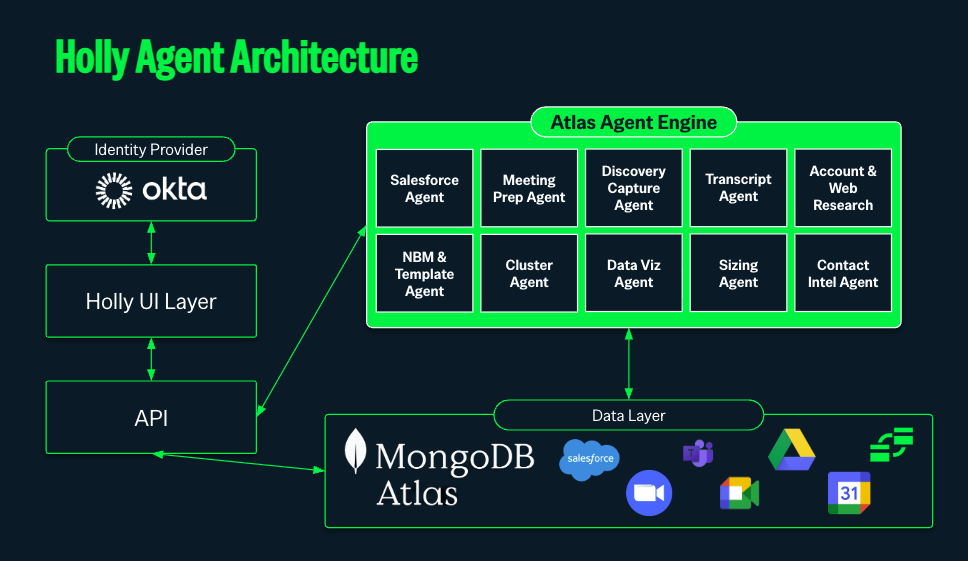
Diese Funktionen decken zusammenhängende Phasen der Vertriebsarbeit ab: den Kunden verstehen, Wissenslücken identifizieren und Informationen erfassen, die die nächste Interaktion unterstützen. Holly verankert diese Arbeit im MongoDB-spezifischen Geschäftskontext, anstatt jede Anfrage als allgemeine Recherchefrage zu behandeln.