Full stack development in an end-to-end workflow
To illustrate the power and versatility of full stack development, let's walk through a typical end-to-end workflow for building a web application.
Planning and design
The full stack web developer starts by gathering requirements and understanding the project scope. They collaborate with stakeholders to define the desired features and technical specifications.
Front end development
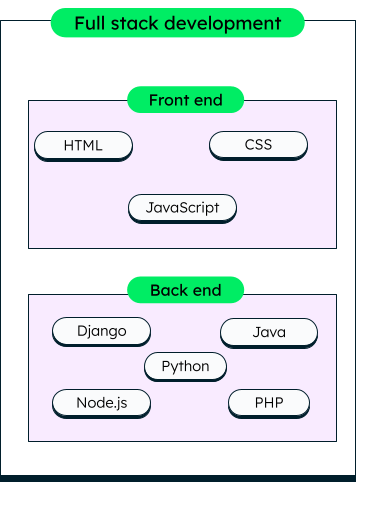
With the design in place, the full stack developer shifts their focus to the front end. They begin by setting up the project structure and choosing the appropriate technologies, such as HTML, CSS, and JavaScript frameworks like React or Angular. They implement the user interface, ensuring responsiveness, accessibility, and adherence to design guidelines.
The developer creates reusable components, handles user interactions, and integrates with backend APIs to fetch and display data dynamically.
Back end development
As the front end takes shape, the full stack developer is simultaneously building and integrating the back end. They select a server-side language like Node.js, Python, or Ruby and set up the necessary development environment. They design the database schema, choosing a suitable database management system like MySQL, PostgreSQL, or MongoDB.
The full stack web developer implements the server-side logic, creates RESTful APIs, and handles data retrieval, manipulation, and storage. They ensure the security and scalability of the back-end system, implementing authentication, authorization, and data validation mechanisms.
Testing and integration
Before launching into implementation and production, the full stack developer creates a comprehensive test plan. They define unit tests, integration tests, and end-to-end tests that address the desired functionality and application edge cases. By writing tests ahead of time, they establish clear goals and requirements for the required features.
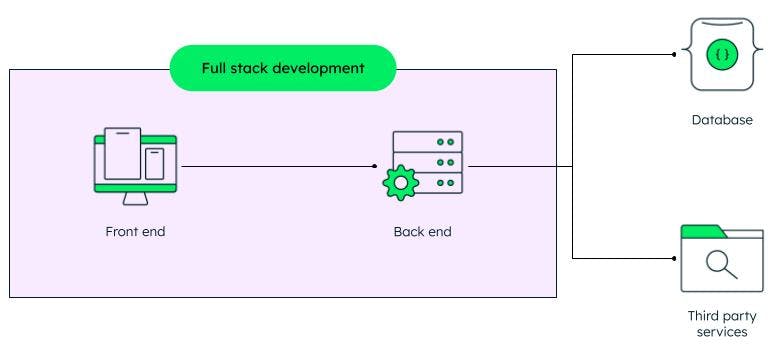
Once the front-end and back-end components are in place, the full stack developer focuses on integrating them seamlessly. They establish communication between the client side and server side, ensuring smooth data flow and error handling. And the developer conducts thorough testing across a range of relevant devices, browsers, and scenarios to identify and fix any bugs or performance issues.
By following best practices like writing tests at the beginning of the project, the full stack developer ensures the application is reliable, maintainable, and meets the required specifications.
Deployment and maintenance
Once the web application is fully developed and tested, the full stack developer prepares it for deployment. They configure the necessary server environments, set up continuous integration and continuous deployment (CI/CD) pipelines, and ensure the application is optimized for production. They handle tasks such as database migrations, server provisioning, and scaling to accommodate user traffic.
After deployment, the developer monitors the application's performance, addresses any issues that arise, and provides ongoing maintenance and updates.
Throughout this end-to-end workflow, the full stack developer demonstrates their versatility and expertise in multiple technologies and domains. They seamlessly switch between front-end and back-end tasks, ensuring a cohesive and efficient development process. Their ability to handle the entire stack enables them to make informed decisions, optimize performance, and deliver a high-quality web application. What is a full stack developer and what do they do?