Asset downtime and unplanned maintenance continue to impact manufacturing operations. According to Siemens, every unproductive hour in the automotive sector now costs $2.3 million[1]. The cost impact extends beyond immediate throughput loss, as a single equipment failure can also trigger contractual penalties and force costly expedited logistics. Most manufacturers have invested in condition monitoring and basic failure prediction, but predictive maintenance is not one single step, but a series of steps that include prediction, root cause identification, work order creation, and scheduling.
Existing systems typically operate in isolation, and because of that, mean equipment recovery times have increased from 49 to 81 minutes per incident [1]. A persistent workforce shortage compounds the problem as the Manufacturing Institute reports that the sector will need around 3.8 million new employees in the next 10 years, with 26% of the existing workforce expected to retire by 2030 [2]. Every workflow that depends on institutional knowledge becomes a point of failure when the people who hold that knowledge have left the floor.
These pressures are not mutually exclusive. An equipment failure has a larger impact when no one is available to repair it in time. Traditional approaches such as periodic risk reviews and manual workflows are no longer sufficient. Manufacturers need a system of action that agents can use to run flexible workflows and resolve disruptions at a faster pace. We believe this is a role that multi-agent systems are designed to fill, and MongoDB is the right database to build a scalable multi-agent platform for manufacturing operations.
From agents to multi-agent systems in manufacturing
An AI agent is an operational application that attempts to achieve a goal by observing the world and acting upon it using the data and tools it has at its disposal. Unlike a traditional chatbot, an AI agent operates through a workflow defined via a large language model (LLM) that includes reasoning, planning, and taking action.
In manufacturing, the tools an agent accesses can include connections to manufacturing execution systems (MES), supervisory control and data acquisition (SCADA) systems, or Internet of Things (IoT) sensor streams. A single agent in manufacturing has limited utility as the workflows rarely map to a single domain. A multi-agent system is a coordinated group of AI agents, each with their own specialized role, that collaborate to solve complex tasks. Each agent operates within its own guardrails and has its own set of tools, but they share context through a common data layer and communicate through a common orchestration pattern.
It is important to note that in manufacturing, not every operational problem benefits from an agent. Deterministic workflows that follow a fixed sequence are better served with traditional automation logic. The workflows that benefit the most from agentic systems are the ones where rich context is needed to arrive at a decision, or workflows that involve adapting to changing conditions on the shop floor. Figure 1 maps four core agent capabilities to practical manufacturing applications.
Figure 1. Use cases of AI Agents in manufacturing.
.png)
Deploying agents in industrial environments presents challenges that go beyond typical enterprise software deployments. Integration with Brownfield OT systems speaking industrial protocols like Modbus and PROFINET is complex. Therefore, the following is required:
Real-time observability with a human-in-the-loop for critical decisions
Industrial environments that demand strict security policies and governance models
LLM latency constraints limit which use cases are viable for fast-response scenarios
Agents require flexible data storage that can handle profiles, memory, and time series sensor data simultaneously
Technical debt accumulates quickly as the number of tools and platforms increases
Industrial environments demand near-zero downtime, making system resilience essential [3].
Why use MongoDB for multi-agent systems in manufacturing
An agent needs to read a stream of operational data in real time, take action, generate a memory of that action, and record the action taken back into that operational database. It also needs to understand user intent, translate it into a search query, and perform semantic search over unstructured data.
Most agentic architectures today get built on a patchwork of specialized databases. For example, that could be a vector database for embeddings, a relational database for structured records, or a time series database for sensor telemetry. In manufacturing, this fragmentation creates a big hurdle in deploying agents in production. It directly undermines the goal of increasing operational resilience by introducing cross-system collaboration issues, thus recreating the same problem the agents were supposed to solve.
MongoDB addresses this issue by providing a unified data platform where operational data, vector embeddings, time series telemetry, agent memory, and agent outputs all live in the same database, queryable through the same interface [11]. In addition to the database, MongoDB offers tools for the agent, such as vector search, full-text search, and stream processing, which the agent can use to transform and search across both structured and unstructured data.
A document model is a natural fit for agent data
AI agents work with diverse, semi-structured data. This includes agent profiles, conversation histories, tool call metadata, sensor readings, supplier records, and work orders. Relational databases struggle with this diversity because each new data shape requires a schema redesign or forces adding a new specialized database. MongoDB's document model handles it naturally [4]. An agent's session, including its messages, tool calls, and referenced data, can all be stored and read as a single JSON document:
The document model provides the storage foundation for agent data, but the real architectural advantage of MongoDB is how it can transform a scattered system of record into a unified system of action. In a typical manufacturing plant, production data lives in MES, inventory and procurement data lives in ERP, equipment health data in a central maintenance management system (CMMS), and an array of PDF files and spreadsheets stored in various file systems also exist. Agents cannot reason over such a vast data estate. MongoDB is the converged data store that sits between the existing systems of record and the AI agents that act on that data.
Figure 2. MongoDB is a closed-loop operational layer that converts data into decisions and actions.
.png)
Using hybrid search with MongoDB
Agents in manufacturing need to do more than query structured fields. When a maintenance agent receives an alert about abnormal vibration on a spindle bearing, it needs to find similar historical failure patterns, relevant sections from equipment manuals, and past maintenance reports that describe analogous symptoms. Some of this retrieval is a semantic search problem, and some requires a keyword search, such as finding a specific alarm code, part number, or defect classification exactly.
MongoDB supports both search modes and allows them to be combined within the same query against the same data [4]. MongoDB Vector Search enables semantic retrieval by storing vector embeddings alongside the operational data they represent. MongoDB full-text search complements this by using traditional keyword-based retrieval with autocomplete and faceted search features included.
Time series collections for ingesting sensor telemetry at scale
Manufacturing agents depend on high-frequency sensor data. Vibration, temperature, pressure, current draw, and acoustic emission data flow continuously from equipment on the factory floor. MongoDB's time series collections are purpose-built for this workload. They use a columnar storage format optimized for time-stamped data, delivering efficient compression and fast range queries [5]. A predictive maintenance agent monitoring a fleet of machines can query the last 24 hours of vibration data for a specific spindle, compute trends, and compare them against baseline thresholds.
Change streams for event-driven apps
Multi-agent systems cannot rely solely on polling or scheduled queries. When a sensor reading crosses a critical threshold, agents need to react immediately. MongoDB change streams allow an agent to subscribe to a collection and receive real-time notifications whenever a document is inserted or updated [5]. This event-driven architecture ensures agents activate only when relevant events occur, which is both more efficient and more responsive than periodic batch processing.
Voyage AI embedding models and rerankers
Vector search requires embedding models to convert text and documents into numerical vectors. In restricted or air-gapped environments where external API calls are not permitted, MongoDB's Voyage AI offers voyage-4-nano, an open-weight embedding model designed for local deployment [6]. Voyage Nano runs entirely on local infrastructure without requiring connectivity to any cloud service, making it suitable for secure operational environments. It can be used to generate embeddings for maintenance logs, shift notes, equipment manuals, and work orders at ingest time, and to embed agent queries at search time, all within the facility's own network boundary.
Agent memory: short-term and long-term
Anthropic research found that multi-agent coordination breaks down without sophisticated memory distribution across agents [7]. A predictive maintenance agent that cannot remember what it diagnosed yesterday will repeat the same analysis, miss new patterns, and lose the trust of its users. MongoDB supports both short-term and long-term agent memory. Short-term memory, typically implemented through a checkpointing technique, maintains context within a single conversation thread so the agent remembers what it asked, what tools it called, and what the user said earlier in the session [8]. Long-term memory allows agents to retain and retrieve knowledge across sessions. This means a supply chain disruption agent can remember that Supplier X had a two-week delay last quarter and that the backup supplier for Component Y requires a six-week lead time. These memories are stored as documents in MongoDB, indexed for fast retrieval, and can be shared across agents in a multi-agent system through a shared memory namespace.
Use case: Multi-agent predictive maintenance
The architecture shown in figure 3 demonstrates how to build a multi-agent predictive maintenance system using MongoDB.
Figure 3. High-level architecture of a multi-agent predictive maintenance system.
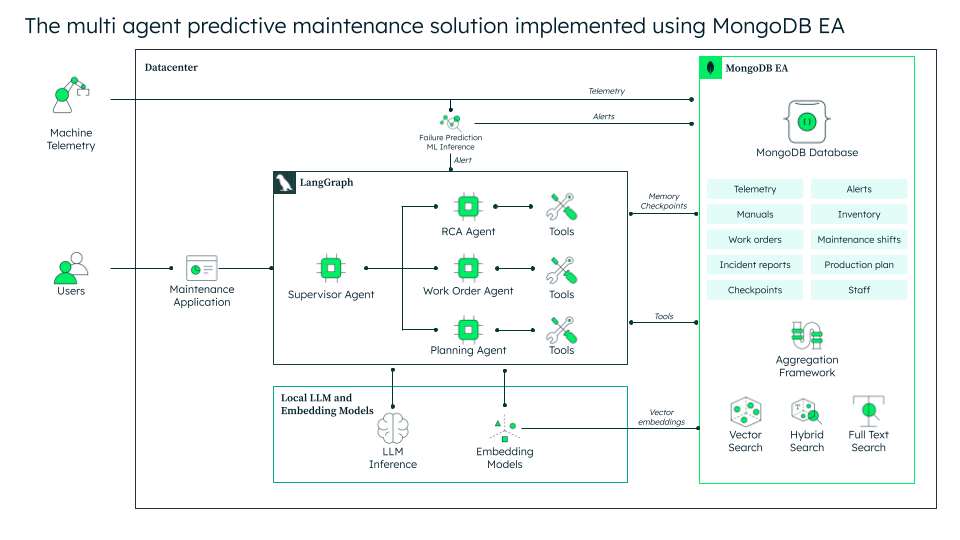
The architecture follows a supervisor-agent pattern using MongoDB Enterprise Advanced as the agentic data layer and LangGraph for agent orchestration. The supervisor coordinates tasks and delegates to three specialized agents:
A root cause analyst (RCA) agent who generates incident reports
A work order agent (WOA) that drafts maintenance work orders
A planning agent (PA) that identifies the optimal time slot for the maintenance task based on availability and production constraints [9]
The process begins with an alert, something unusual in the machine data or logs that could point to a potential failure. The supervisor agent then notifies the RCA agent that generates a concise incident report and shares it with the supervisor agent, which then moves the workflow forward.
The WOA receives the incident report and drafts a comprehensive maintenance work order. It pulls from previous similar tasks to estimate time requirements, identify the necessary materials, and ensure the right skill sets are listed. This step includes a human-in-the-loop checkpoint; technicians or supervisors can review and modify the draft before it is finalized.
Once the work order is approved, the PA schedules the maintenance activity. The agent queries the production calendar, checks staff shift schedules, and verifies inventory availability for required materials to find the most efficient time slot.
This entire workflow can run on a single MongoDB Enterprise Advanced deployment as the same database stores the sensor telemetry, the agent memory, the equipment knowledge base, the work order history, and the production schedule. This architecture can also be extended to other use cases, such as spare parts procurement or production scheduling.
Deployment considerations for secure environments
MongoDB Enterprise Advanced is designed for self-managed deployments where organizations require full control over their infrastructure, data, and security posture. For secure and regulated environments, several characteristics are particularly relevant. MongoDB EA runs entirely on-premise or within an organization's own data center with no dependency on external cloud services. All data, including sensor telemetry, agent memory, vector embeddings, and operational records, remains within the facility's network boundary.
Voyage Nano, the open-weight embedding model, runs locally and generates embeddings without any external API calls, which is essential for air-gapped or network-restricted environments [6]. MongoDB EA includes enterprise-grade security features such as LDAP and Kerberos authentication, encryption at rest and in transit, field-level encryption, and comprehensive audit logging.
Because all the capabilities described in this document, such as the document model, vector search, full-text search, time series collections, change streams, and agent memory storage, exist within a single MongoDB deployment, organizations avoid the operational complexity and security surface area that comes with managing multiple specialized databases. One platform means one security model, one set of access controls, and one audit trail.
Next Steps
Ready to build agentic systems on infrastructure you control? Learn more about MongoDB Enterprise Advanced.
References
[1] Siemens, "The True Cost of Downtime 2024," Senseye Predictive Maintenance: https://assets.new.siemens.com/siemens/assets/api/uuid:1b43afb5-2d07-47f7-9eb7-893fe7d0bc59/TCOD-2024_original.pdf
[2] Deloitte & The Manufacturing Institute, "Taking charge: Manufacturers support growth with active workforce strategies" (2024): https://www.deloitte.com/us/en/insights/industry/manufacturing-industrial-products/supporting-us-manufacturing-growth-amid-workforce-challenges.html
[3] LangChain, "2026 State of Agent Engineering": https://www.langchain.com/state-of-agent-engineering
[4] MongoDB, "Building Intelligent AI Agents with MongoDB Atlas: A Bidirectional Data Flow Architecture": https://dev.to/mongodb/building-intelligent-ai-agents-with-mongodb-atlas-a-bidirectional-data-flow-architecture-2obl
[5] MongoDB, "Building Gen AI-Powered Predictive Maintenance with MongoDB": https://www.mongodb.com/company/blog/innovation/building-gen-ai-powered-predictive-maintenance-mongodb
[6] MongoDB, "Voyage AI: Embedding Models and Rerankers": https://www.mongodb.com/products/platform/ai-search-and-retrieval
[7] Anthropic, "Building a Multi-Agent Research System": https://www.anthropic.com/engineering/built-multi-agent-research-system
[8] MongoDB, "Powering Long-Term Memory For Agents With LangGraph And MongoDB": https://www.mongodb.com/company/blog/product-release-announcements/powering-long-term-memory-for-agents-langgraph
[9] MongoDB, "Unlock Multi-Agent AI Predictive Maintenance": https://www.mongodb.com/company/blog/innovation/unlock-multi-agent-ai-predictive-maintenance