It’s a busy Wednesday evening in Munich. A new Alpenmarkt retail store has just opened its doors at Marienplatz, with POS terminals coming online and customers beginning to flow through. Deep in the network infrastructure, however, a subtle queue-scheduling collision is quietly building pressure. In less than a minute, this issue will push POS latency beyond the agreed SLA threshold, potentially disrupting transactions and customer experience. At the same moment, thousands of miles away, a network planning engineer at US Mobile sits at their desk and poses a question through a chat interface: “What happens to our NYC and LA cells if we raise prepaid downlink speeds from 7.2 to 20 Mbps this Saturday evening?”
Neither scenario requires phone calls, manual ticket creation, or hours spent looking over spreadsheets. Instead, intelligent AI agents, grounded in a unified database platform, deliver complete, evidence-based answers and recommended actions for both situations in real time. Relying on legacy manual workflows creates operational bottlenecks and slow response times as systems scale. Transitioning to autonomous networks represents a significant leap forward in how communications service providers (CSPs) and large enterprises manage modern infrastructure - agentically translating intent to action.
This post explores how CSPs can achieve highly autonomous networks that reach TM Forum’s Level 4 autonomy using MongoDB Atlas. The featured framework combines Intent-Based Networking (IBN) and Digital Network Twins (DTW) to convert business goals into automated configurations and safely simulate network changes before deploying them to live production systems.
Figure 1. Convert business intent into automatic workflows.
The long journey toward autonomous telecom networks
The telecommunications industry has long pursued the vision of intelligent, autonomous networks. IBN closes the gap between high-level business objectives — such as delivering flawless customer experiences or launching new services rapidly — and underlying network behavior. It translates natural language intents into automated, continuously assured configurations. At the same time, DTW gives planners virtual replicas of their live infrastructure. These representations enable them to safely test and simulate changes before any modification touches their production systems. Many CSPs have set ambitious targets to reach Level 4 autonomy in key domains by 2027, following the TM Forum’s widely adopted Autonomous Networks framework. To get there, they need to leverage AI for closed-loop automation, predictive maintenance, and optimized resource allocation. Yet, progress remains challenging as most operators still operate at Level 2 to 3 autonomy.
At these levels, networks provide helpful assistance and partial automation such as alerts, basic analytics, and scripted responses. However, human experts must still interpret data, open tickets, validate plans, and manually approve or execute changes. This manual workload leads to slower reaction times, higher operational overhead, and a greater risk of errors during complex scenarios like network violations or capacity upgrades. In contrast, Level 4 autonomy enables AI agents to interpret high-level intents, orchestrate end-to-end responses, run sophisticated what-if simulations, and execute closed-loop actions with minimal human oversight.
For instance, AI agents can automatically translate a business request like “prioritize POS traffic with 40ms latency” into feasible plans, continuous assurance, and self-healing networks via IBN. This automation enables planners to use conversational queries in real time to receive accurate impact projections and mitigation plans. CSPs still remain at lower levels because they lack a sophisticated operational data layer capable of unifying real-time telemetry, historical knowledge, customer intents, simulation models, and institutional memory. Without this foundation, advanced AI pilots struggle to scale into production because fragmented systems prevent the retrieval and reasoning needed for Level 4 operations with IBN and DTW frameworks.
Turn reactive firefighting into proactive excellence with AI agents
In this environment, a flexible, multi-model data platform like MongoDB Atlas provides the critical operational memory layer to accelerate CSPs’ path to more autonomous operations. MongoDB unifies diverse data types and enables sophisticated AI-driven queries. For example, features such as Atlas Vector Search with high-quality embeddings from Voyage AI, graph traversals, and time series handling translate directly into faster issue resolution, reduced risks, lower operational costs, and better service quality.
.png)
Figure 2. Build a unified data layer to build agentic systems of action.
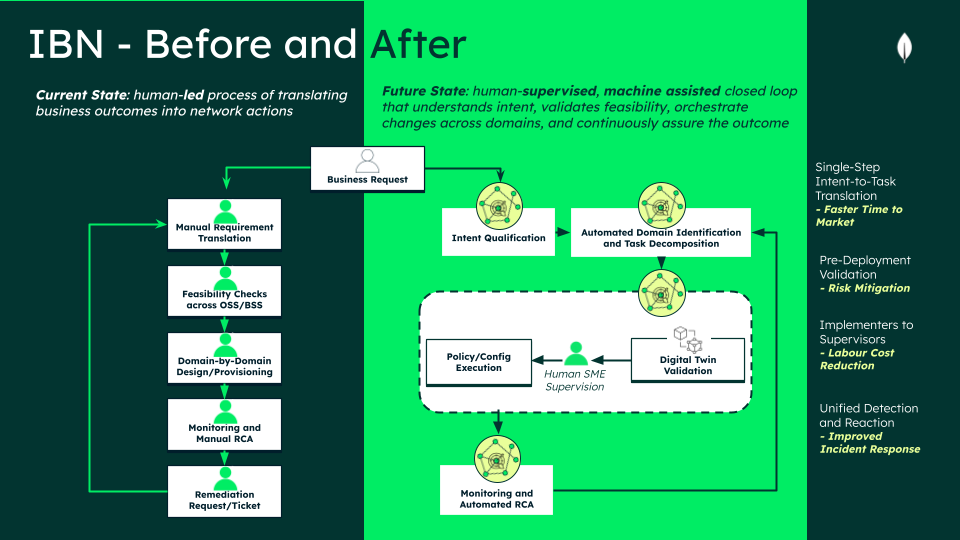
In the realm of IBN, the automation process works as follows:
- First, an engineer or operations team member requests a business need in natural language, such as prioritizing POS traffic for a new flagship store. This request also requires strict guest segmentation, reliable camera uplinks, and latency under 40 milliseconds.
- Then, specialized AI agents manage the entire lifecycle without constant human intervention. Agents parse the intent, check for feasibility against current inventory and resources stored in MongoDB, outline a concrete plan, and continuously monitor once activated. Telemetry data flowing into time series collections allows real-time compliance evaluation.
- When a violation occurs — like the POS latency spike in our Munich example — the system doesn’t merely generate an alert. It uses institutional knowledge to perform a sophisticated diagnosis. It uses a single aggregation pipeline that combines semantic vector search to find similar past incidents, structured filters to boost relevance, and geospatial constraints to improve accuracy. This hybrid approach identifies the most likely root cause and proven remediation steps, enabling guided recovery.
This framework provides clear business results, such as fewer outages, stronger SLA adherence, improved customer satisfaction, and significantly reduced manual effort in day-to-day operations.
Figure 3. Automation framework for Intent-Based Network.
.png)
For capacity planning and change management, DTW offers equally compelling advantages as follows:
- On-site planners can query the system conversationally about potential modifications, such as upgrading QoS profile in major markets or enabling new roaming plans.
- The twin models map network topology through graph structures, subscriber behaviors via detailed traffic models, and dependencies across elements—from cells to core components.
- When simulating a change, the system performs graph traversals to identify all affected parts, projects utilization impacts using time-windowed data, and cross-references historical simulations via Vector Search for similar lessons learned.
This framework allows teams to spot bottlenecks, assess risks, and refine plans before any production impact.
Turn fragmented tools into a living memory
The underlying shared architecture makes these scenarios particularly powerful. A ReAct-style orchestrator coordinates specialized services, while MongoDB Atlas serves as the persistent memory across short-term workstreams, long-term extracted insights, and user preferences. MongoDB also enables the following capabilities:
- Vector search, enhanced by Voyage AI’s precise embeddings, ensures agents retrieve contextually relevant knowledge even when queries vary in phrasing.
- Graph capabilities reveal hidden dependencies naturally.
- Time series collections with change streams keep dashboards live and responsive without polling overhead.
All data shapes coexist in one platform, queryable through unified pipelines. This architecture eliminates the traditional integration tax that slows many CSP initiatives, and enables the AI to grow smarter over time as it accumulates and refines operational memory.
Figure 4. Structure agentic memory layers in MongoDB.
.png)
From a broader industry perspective, these patterns address core challenges CSPs face today. As networks become more dynamic and AI-driven workloads increase complexity, fragmented tools and stale data slow down decision-making and increase risks. Operators pursuing autonomy consistently cite unified data foundations and effective retrieval mechanisms as key enablers for moving beyond pilots. MongoDB Atlas delivers exactly that: a single source of truth for real-time operations, institutional learning, and safe experimentation.
Ready to build?
The networks of the next decade will not be managed through dashboards and tickets. They will be operated through conversation, with AI agents that hold context, recall history, and act — grounded in a data layer that is always current and always queryable.
MongoDB Atlas provides that data layer. Whether the use case is intent-based assurance, what-if simulation, or the next operational challenge your team is facing, the architectural pattern is the same: put the data, the memory, and the retrieval in one place, and let the agents do the work.
Sign up for MongoDB Atlas to start building.