European power companies are operating one infrastructure stack while their business has moved to another. Renewables now dominate new power generation. Settlement happens every fifteen minutes, and on intraday contracts every five. Regulators ask questions that look five years back. Trading desks want decision support that reads the live book and the regulation in the same breath.
The systems running today's trading floors, asset registries, and settlement engines were largely built for a different world. They handle the volume. They struggle with the shape.
This is where MongoDB Atlas comes in. Its flexible architecture is well-suited to the complexity and pace of modern energy markets. This article explores three propositions that make that case concrete.
The operational data problem
There are five forces that simultaneously affect utility and IPP data platforms:
- Telemetry volume is an order of magnitude higher than a decade ago. Smart meters, SCADA feeds, inverters, EV chargers, and connected HVAC systems all produce time-series data at second- or minute-level cadence. A single 200 MW wind farm can generate millions of data points per day across turbine controllers and forecast revisions alone.
Market cadence is compressing. European electricity markets now settle every fifteen minutes, and intraday contracts trade down to the five-minute block. The window between "forecast the position" and "settle the imbalance" is narrower than the batch windows many legacy systems were designed around.
The regulatory surface keeps expanding. REMIT, the Electricity Balancing Guideline, CACM, RED III, and national TSO rules each demand different, often overlapping records of what happened and when, typically retained for five years or more.
Data shapes are heterogeneous by nature. A meter reading, a wind forecast revision, a weather alert, a flexibility dispatch signal, and a P&L snapshot have almost nothing in common structurally. Forcing them into a single relational schema produces either a tangled join graph or a pile of JSONB columns that defeats the point of the relational model.
AI is no longer optional. Traders and operators expect decision support that understands their portfolio, regulatory context, and market conditions—and they expect it fast enough to act on.
A document data platform with flexible schema, native time-series support, change streams, vector search, and a hybrid transactional/analytical story addresses those five forces under a single operational contract. That is the role MongoDB Atlas plays as the operational data layer for this industry.
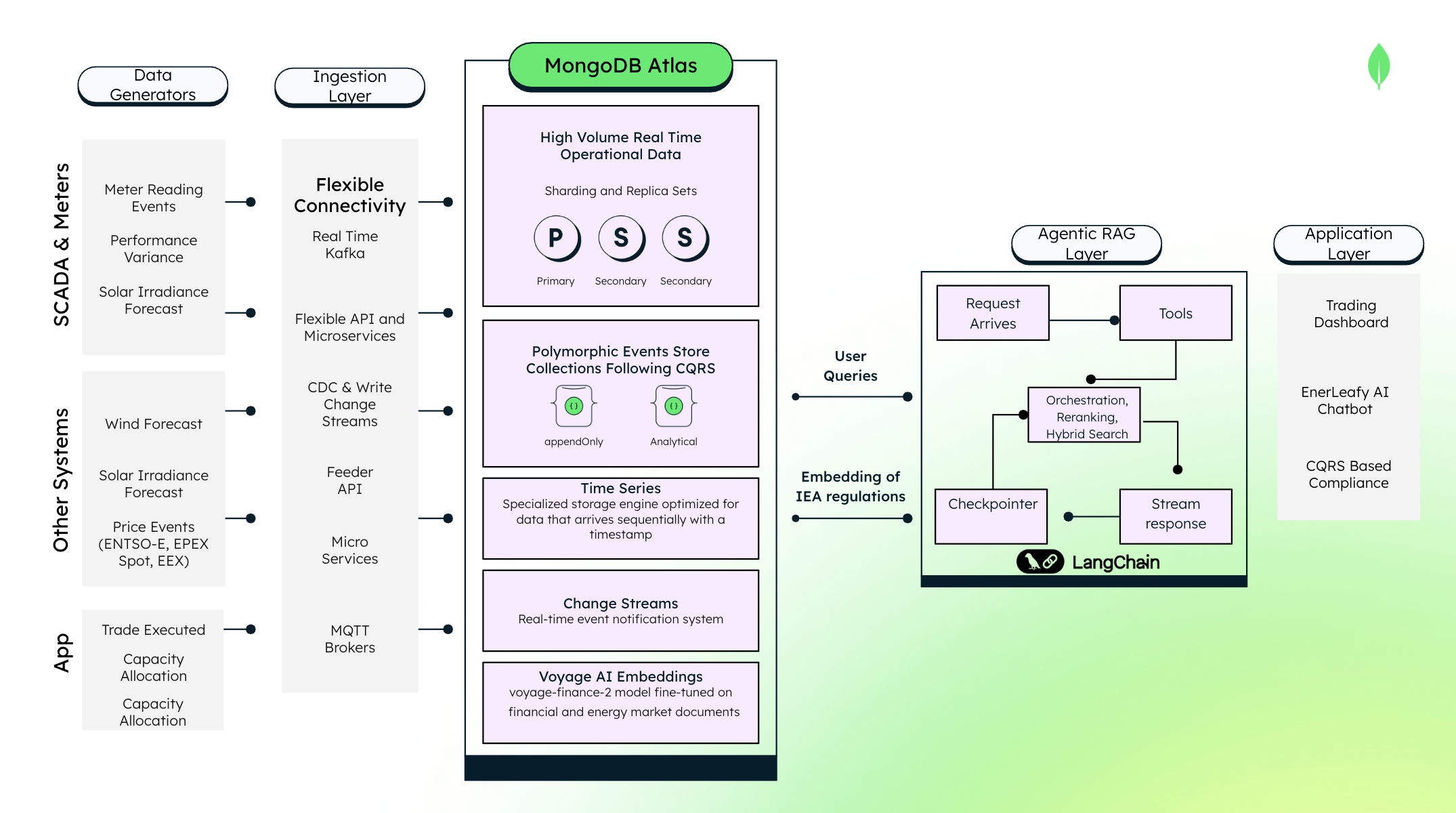
Figure 1. Overview of an operational data layer built with MongoDB Atlas for the energy trading industry.
An event-driven core that scales with the grid
Energy businesses increasingly need to treat every state change—a meter reading, a forecast revision, a weather alert, a trade, an imbalance settlement—as an event that is captured, fanned out, and acted on in near real time. That is the architectural shift from the batch-driven utility of the 2000s to the event-driven one of the 2030s. The business case is straightforward: the faster state changes propagate through the platform, the tighter the feedback loop between forecast, position, dispatch, and settlement, and the narrower the gap between expected and realized P&L.
MongoDB Atlas's document model maps directly onto this. A single append-only collection can hold any event type the business defines, each with its own payload shape, without schema migrations every time the business adds a new market or asset type.
Change Streams fan events out to downstream consumers inside the same cluster, without a separate message broker in the critical path. That one capability alone typically removes an entire Kafka deployment from the architecture diagram—with the licensing, ops overhead, and failure modes that come with it.
The managed surface means a small platform team can run a trading-grade data layer that would otherwise require a dedicated infrastructure group. The business outcome: faster reaction to market and grid conditions, fewer moving parts in the platform, and a write path that is ready for whatever new workload the business adds next quarter.
Compliance as a by-product of the architecture
REMIT requires five-year retention of every order and trade. The Electricity Balancing Guideline requires reconstructable evidence of every fifteen-minute imbalance settlement period, with disputes resolvable years after the fact. CACM imposes auditability on cross-border capacity allocations. Directive 2019/944 has spawned a category of flexibility-baselining disputes that can only be settled by replaying raw meter data exactly as recorded.
Conventional CRUD systems struggle here. An UPDATE overwrites the previous value. Canceled orders are typically soft-deleted. A meter correction replaces the original reading. By the time a regulator asks for the state of a contract at 14:00:00 on December 15, the answer is forensic, expensive, and often partial.
An event-sourced data layer inverts this. Every state change is a new immutable document. Nothing is ever updated in place. The state of any asset, instrument, or portfolio at any point in its history can be reconstructed by replaying events up to a specific version. The audit trail is not a separate system that has to be kept in sync with the operational one; the audit trail is the operational one.
For an IPP, the implications are commercial. Dispute resolution with TSOs and counterparties moves from weeks of reconciliation to a point-in-time query. REMIT surveillance responses to ACER on suspected spoofing become straightforward to produce because the canceled orders that make the pattern visible are still in the event store. Internal audit costs fall. The compliance team works with fewer systems and understands them better.
Atlas adds the controls that make this defensible to a regulator. MongoDB Atlas Queryable Encryption protects sensitive fields in use, not just at rest. Client-side field-level encryption, database auditing, and role-based access controls satisfy the operational requirements that compliance officers ask about. Atlas Online Archive tiers cold events to low-cost storage, which keeps the long tail of a seven-year retention window economical without making the data unavailable. SOC 2, ISO 27001, and GDPR-ready controls are maintained by MongoDB. The customer's compliance roadmap absorbs less work than it would otherwise.
The result is that compliance stops behaving like a separate subsystem. It becomes a property of the write path.
Production-grade AI where the data already lives
The AI conversation in energy has moved quickly from "can we try this?" to "when is it in production?" The use cases are concrete: a trading advisor that reads live portfolio state, market prices, and regulatory context and suggests positions; an operations co-pilot that reads telemetry, weather, and runbooks and supports control-room decisions; a settlement assistant that investigates imbalance disputes by replaying event streams against the applicable regulation.
What separates a working production agent from a demo is where the data lives. A retrieval-augmented agent that calls out to a separate vector database, a separate document store, and a separate conversation-memory backend spends most of its latency budget on network hops, and most of the platform team's time reconciling those systems when they drift out of sync. The same agent is built on a data layer that already holds the operational data, the policy documents as embeddings, and the conversation state runs faster, costs less to operate, and is materially easier to evaluate.
That is the architectural advantage Atlas brings to agentic AI in energy: MongoDB Atlas Vector Search, full-text search, operational data, and agent state all in the same cluster, addressable through the same query language.
Conclusion
The operational data problem in energy is a shape problem, not just a volume problem. The data is heterogeneous, the workloads are mixed, and the regulations demand history. A document data platform with native support for events, time-series, change streams, vector search, and hybrid workloads addresses those that shape directly and reduces the number of systems the platform team has to run.
Compliance and audit are cheaper when they are a consequence of the architecture rather than a separate subsystem. Event sourcing on an immutable document store is the cheapest form of regulatory insurance an IPP can buy, because the audit trail is the write path.
AI agents are now a feasible production capability for trading support and compliance operations, provided the data platform can serve live operational state, vector search, and conversation memory on the same system. MongoDB Atlas does exactly that.
Next Steps
If you are evaluating MongoDB Atlas for an energy workload, leafy-energy-markets is the fastest way to see what the data layer looks like when it is built following the concepts described above.
If you are evaluating MongoDB Atlas for trading, settlement, or compliance operations, Francesco Baldissera (francesco.baldissera@mongodb.com) and Muhammad Atif (muhammad.atif@mongodb.com) are your fastest paths to production. They work directly with utilities and IPPs on REMIT-ready systems, real-time market integration, and agentic AI workflows.