Disclaimer: This post is for informational purposes only and does not constitute legal advice. Organizations should work with qualified legal counsel to interpret the DPDPA and determine how its requirements apply to their specific circumstances.
India’s digital economy depends on applications that collect and process personal data every day, from payments and lending to healthcare, retail, and public services. As organizations prepare for the operational impact of the Digital Personal Data Protection Act (DPDPA), the challenge they face is no longer about policy interpretation. Organizations must now also tackle how teams implement privacy, security, and governance controls in the systems that handle personal data.
This post looks at the kinds of technical capabilities organizations may consider when building DPDPA-aligned applications and data architectures, and how MongoDB’s capabilities support those efforts.
India's data governance framework, and why organizations should act now
Made law in 2023 and brought into force in 2025, the Digital Personal Data Protection Act (DPDPA) establishes a legal framework for the collection, processing, storage, and protection of digital personal data in India. For many organizations, the practical impact of the law will extend beyond policy updates. It will require decisions about how consent is captured, how personal data is governed, how access is controlled, and how privacy-related requests are handled across applications and operational systems.
Rather than treating privacy as a downstream compliance task, many organizations are moving toward a privacy-by-design approach. In practice, that often means building controls for notice, consent, access, security, retention, and deletion into application and data-layer workflows from the start.
Failure to comply with DPDPA can result in significant penalties for certain violations, and the legislation raises the standard for how organizations manage personal data.
For business and technology teams, this means privacy readiness is not only a legal matter—it is also an operational and architectural issue that can have a real financial impact. As a result, systems should be designed so that privacy controls can be implemented consistently, evidenced clearly, and maintained as applications evolve.
Key DPDPA entities and essential IT capabilities
The DPDPA defines a set of key concepts and roles that shape how accountability is assigned across the personal data ecosystem:
Personal Data: Personal data means any data about an individual who is identifiable.
Data Principal: The individual to whom the personal data belongs. The Act grants individuals rights over their personal data, including rights related to access, correction, updating, and erasure, subject to applicable provisions.
Data Fiduciary: The organization or entity that determines why and how personal data is processed. It remains accountable for ensuring that processing is carried out in line with applicable obligations, including where certain functions are handled by third parties.
To comply with DPDPA, Data Fiduciaries will need the practical capabilities to capture, govern, protect, and manage personal data throughout its lifecycle. Some of these capabilities can be built into existing applications. Others may require supporting services or changes to the underlying data architecture.
Consent and notice management
Data Fiduciaries will need a reliable way to capture a Data Principal’s consent, associate it with a purpose, maintain a history of changes, and reflect withdrawals or updates across relevant systems. Depending on the use case, applications may need to support age-related checks or guardian consents.
Data Fiduciaries may have some or all of the following obligations:
Recording consent status together with purpose and relevant metadata
Maintaining an auditable history of consent changes
Tracking renewals, updates, and withdrawals over time
Propagating consent changes to downstream applications and services
Support for Data Principal requests
Data Fiduciaries need workflows that allow individuals to view, correct, update, or request the deletion of a Data Principal’s personal data, subject to applicable legal and operational constraints. In practice, that often means reducing fragmentation so teams can identify relevant records, make consistent updates, and retain appropriate evidence of the action taken.
Why relational data models make DPDPA compliance harder
Many enterprise applications were not originally designed with modern privacy requirements in mind. In traditional architectures, customer information, consent records, preferences, and audit data are often spread across multiple tables, services, and applications. That makes it harder to answer basic operational questions, such as whether valid consent exists, where personal data is stored, or which downstream systems need to be updated when a privacy preference changes.
The same challenge appears when Data Fiduciaries need to respond to correction or deletion requests. They may have to locate data across multiple systems, coordinate changes across application boundaries, and maintain a reliable record of what was changed and when. As application estates grow, those workflows can become complex, more error-prone, and more expensive to operate.
Simplifying DPDPA compliance with MongoDB
Meeting DPDPA-related technical obligations often involves bringing data, consent state, security controls, and operational workflows closer together.
MongoDB’s capabilities—such as its flexible document model, change streams, in-use encryption, and MongoDB Search—can help consolidate privacy-relevant data and context, making it easier to implement and operationalize workflows for consent management, data access, correction, deletion, and auditability.
Figure 1. The foundation of a DPDPA-compliant ecosystem.
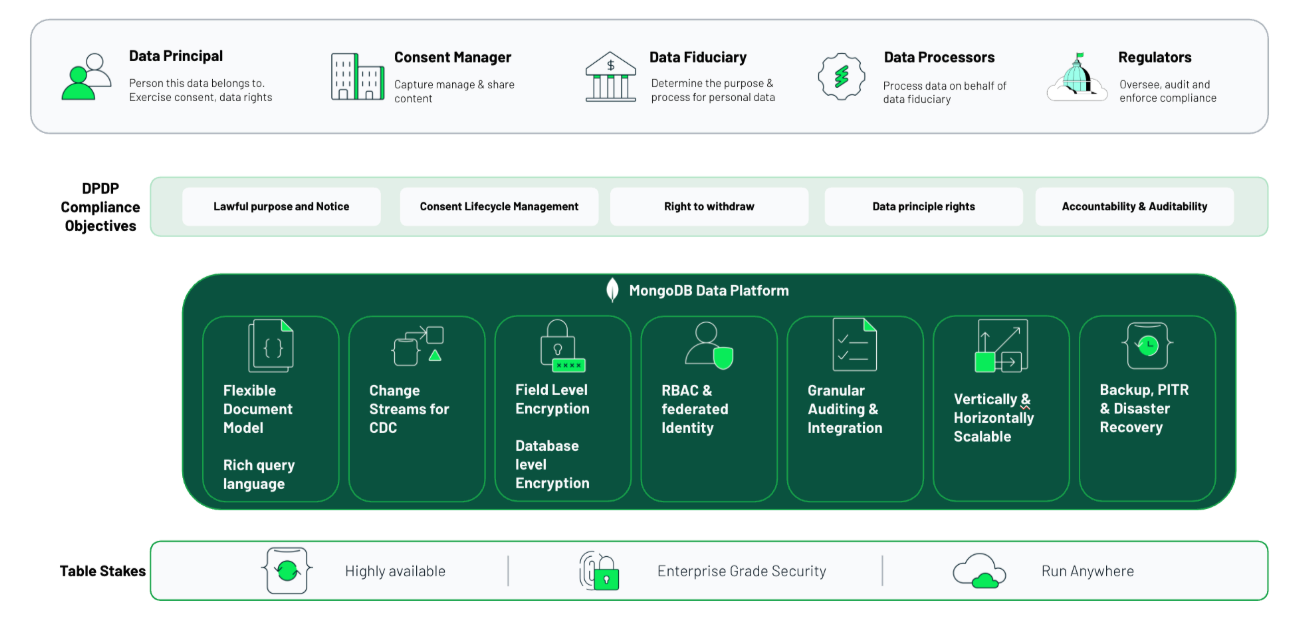
MongoDB also offers different enterprise-ready deployment models depending on operational, residency, and control requirements. For example:
MongoDB Atlas is MongoDB’s fully managed intelligent data platform. It provides managed operations, scaling, security features, monitoring, backup options, and deployment flexibility across major cloud providers.
MongoDB Enterprise Advanced is MongoDB’s self-managed commercial offering for Data Fiduciaries that want to run MongoDB in their own environment, including on-premises, private cloud, or hybrid architectures, with enterprise support and management tooling such as Ops Manager.
How MongoDB can help achieve DPDPA compliance
Table 1 below summarizes MongoDB capabilities that Data F,iduciaries may evaluate when designing systems to support DPDPA compliance. The exact implementation approach will depend on the application, deployment model and regulatory interpretation.
Prepared for compliance, built for trust
For most organizations, DPDPA readiness will come down to execution. Data Fiduciaries need to know where a Data Principal’s personal data lives, decide which controls belong in the application versus the data layer, and show that those controls can be operated consistently over time. MongoDB can help support that work by reducing data fragmentation and giving Data Fiduciaries a flexible foundation for building consent, security, resilience, and governance workflows into the systems they already run.
Organizations building digital services in India need a data infrastructure that can handle population-scale workloads, satisfy DPDPA compliance obligations, and enforce privacy controls without sacrificing agility.
MongoDB Atlas provides a flexible, secure, intelligent data platform with native capabilities like client-side field-level encryption, real-time change streams, and in-region deployment to simplify privacy-by-design architectures.
Next Steps
Start building a DPDPA-compliant data architecture today by deploying a free MongoDB Atlas cluster in an India region or reviewing our enterprise security and privacy whitepaper.