As artificial intelligence evolves from simple query-response systems to sophisticated autonomous agents, a critical architectural challenge emerges: traditional data architectures weren't designed for AI systems that need to perceive, reason, and act continuously. Most organizations approach this challenge by retrofitting AI capabilities onto existing systems, creating fragmented architectures where structured business data lives separately from unstructured AI insights.
This architectural disconnect becomes particularly evident in data-intensive industries like insurance. When a major storm generates 100,000+ damage photos overnight, traditional systems process these images through one pipeline while policy data flows through another, creating bottlenecks that transform what should be intelligent automation into expensive manual reconciliation.
The solution lies in a fundamental shift: building converged datastores that unify structured and unstructured data into cohesive intelligence platforms. Just as the human brain seamlessly integrates memories, sensory input, and decision-making into unified cognition, modern data architectures must converge diverse data types to support truly agentic AI systems.
The case for unified intelligence infrastructure
Consider an insurance claims system that doesn't just store data—it understands it. When a policyholder uploads storm damage photos, an AI agent immediately analyzes images, cross-references policy coverage, calculates estimates, and routes claims to appropriate specialists while maintaining complete audit trails and regulatory compliance.
This transformation requires more than new tools; it demands a new approach to data architecture. By combining MongoDB's flexible document model with vector search capabilities and event-driven processing, organizations can build systems where AI agents don't just query data—they inhabit it, maintaining persistent memories across interactions and leveraging semantic understanding to provide contextual intelligence.

The business impact is transformative: claim processing times drop from days to minutes, accuracy improves through cognitive decision-making with human-in-the-loop, and customer experiences become remarkably responsive and intelligent.
Cognitive data architecture: Core principles
The cognitive memory architecture represents a fundamental shift in data system design for AI applications.

This approach integrates traditionally separate data concerns into a unified intelligence framework based on five core principles:
Unified context: Business entities serve as memory anchors, enriched with embeddings, conversation history, and behavioral patterns. Rather than scattering related information across multiple systems, all context remains accessible within cohesive document structures.
Semantic intelligence: Atlas Vector Search enables meaning-based retrieval that mirrors human associative memory. AI agents can find relevant information based on semantic similarity rather than exact keyword matches.
Autonomous reasoning: Event-driven architectures allow agents to perceive data changes and initiate actions without human prompting. Systems become proactive rather than reactive.
Persistent state: Unlike stateless large language models, agents maintain memories and context across interactions, enabling sophisticated multi-turn conversations and long-term relationship building.
Tool integration: Seamless connections to external systems enable agents to act on their decisions, completing end-to-end workflows autonomously.
Architecture overview
The converged datastore architecture centers on MongoDB Atlas as the cognitive core, supporting four primary layers that enable truly agentic AI systems:
Data integration layer
Multiple input channels: Mobile applications, IoT sensors, document uploads, and external APIs feed data into the system.
Unified ingestion: Common processing pipeline normalizes formats and ensures consistency.
Real-time processing: MongoDB Atlas Stream Processing empowers you to ingest and transform diverse data streams into actionable operational business entities—enhanced with AI-driven enrichments—all in real time.
MongoDB Atlas - Converged datastore layer
Document collections: Store rich business entities with embedded context and semantic relationships.
Vector search engine: Enable semantic retrieval across billions of embeddings with co-located storage alongside business entities, hybrid search capabilities, semantic caching for optimized response times, and real-time synchronization for agent-driven meaning-based queries.
Agent memory store: Maintain persistent conversation state, learning history, and contextual intelligence.
Tool registry: Provide a secure access catalog for business systems and external services.
Semantic intelligence: Transform raw data into actionable insights through integrated AI capabilities.
Agentic AI layer
Domain-specific agents: Specialized AI agents for claims processing, customer service, and compliance monitoring.
Autonomous decision making: Agents analyze semantic intelligence and persistent context to make independent decisions.
Action execution: Direct integration with business tools enables agents to complete end-to-end workflows.
Continuous learning: Agents update their memory and improve decision-making based on outcomes.
Business systems layer
Intelligent applications: Claims processing, customer service, and workflow automation receive intelligent actions rather than raw data.
Business outcomes: Consolidated results from agent actions drive measurable business value.
System integration: Seamless connectivity with notifications, analytics, and external enterprise systems.

This architecture delivers sub-second response times for vector searches across billions of embeddings, supports thousands of concurrent agent sessions, and maintains ACID compliance for critical business transactions. The key innovation lies in how AI agents operate directly on the converged datastore, eliminating the traditional complexity of integrating separate systems for structured data, vector storage, and application logic.
Schema architecture for agentic AI
The fundamental shift from relational to document-based data architecture represents more than a technical upgrade—it's an architectural revolution that aligns data structures with the way AI agents naturally process and reason about business information. This transformation enables organizations to move from fragmented, table-based data models to consolidated business entities that serve as the foundation for intelligent automation.
Root domain entity design
MongoDB's document model transforms the traditional relational approach of spreading business entities across multiple tables into consolidated, rich business objects that serve as root domain entities. This architectural shift proves particularly advantageous for agentic AI workflows where agents require comprehensive access to complete business contexts.
Access pattern optimization
In relational systems, a single insurance claim might span multiple tables, requiring complex joins and multiple database round-trips. For AI agents that need to reason across complete business contexts, this fragmentation creates performance bottlenecks and incomplete data views. MongoDB's document model consolidates these fragments into a single, rich business object:

Performance benefits for AI workloads
This consolidated approach delivers significant advantages for agentic systems:
Single database operation: Agents retrieve the complete business context in one operation rather than executing multiple conditional joins.
JSON-native processing: AI tools natively consume JSON, eliminating transformation overhead.
Real-time consistency: Multiple agents can access and update the same root entity with immediate consistency.
Reduced latency: Fewer network hops and database calls accelerate agent decision-making cycles.
Unified security model
Security is extended to both business logic as well as AI data and AI pipelines. MongoDB's field-level security ensures that agent access permissions align with business requirements. Vector embeddings, agent memories, and workflow configurations inherit the same security model as the root business entity, creating a unified security posture that spans traditional data and AI-generated insights.
Enterprise root domain entities
Considering, as an example for insurance organizations, four core root domain entities serve as the data processing engines that power agentic workflows:
Customer: Complete customer profiles, including interaction history and AI-derived insights.
Policy: Comprehensive policy documents with embedded coverage rules and agent configurations.
Claim: Rich claim objects containing structured data, unstructured evidence, and agent analysis.
Submission: Underwriting submissions with risk assessments and agent recommendations.
These root domain entities provide the stable foundation upon which autonomous agents can operate while maintaining the flexibility to evolve as AI capabilities advance.
Intelligent workflow automation
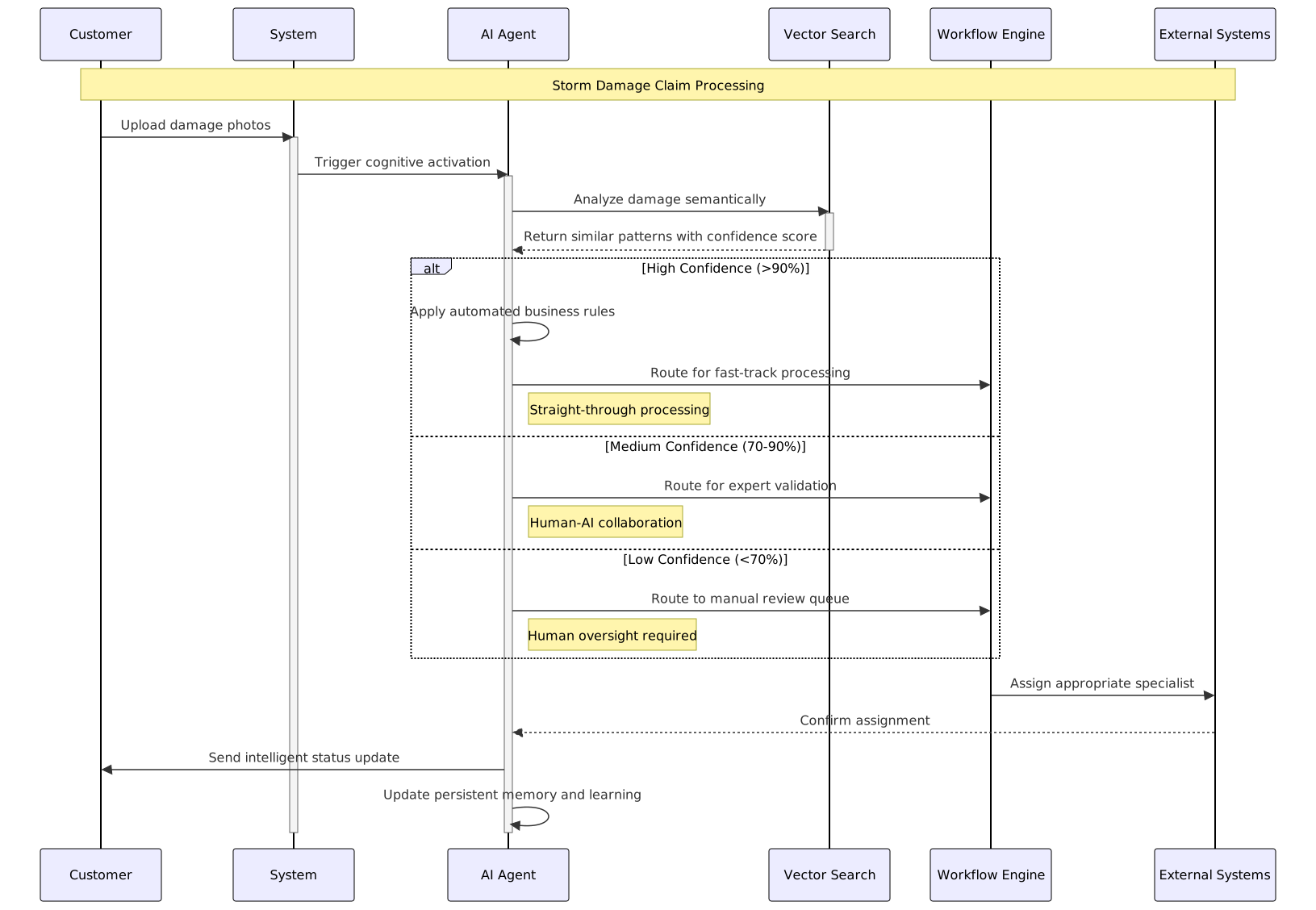
AI agents navigate complex decision paths autonomously. When new damage photos are uploaded:
Immediate detection: Atlas Streams trigger agent activation upon data changes.
Semantic analysis: Vector search compares damage patterns against historical claims.
Business rule application: Agents apply policy coverage rules encoded in documents.
Intelligent routing: The workflow engine assigns claims based on complexity and expertise requirements.
Continuous learning: Agent decisions inform future processing through feedback loops.
Performance optimization
The system employs several strategies to maintain performance at scale:
Compound indexing: Optimize for both structured queries and vector searches.
Intelligent caching: Agent memories cached near processing layers reduce latency.
Parallel processing: Image analysis and entity enrichment occur simultaneously.
Dynamic scaling: MongoDB sharding distributes load across multiple nodes as data volumes grow.
Strategic outlook and future developments
The convergence of data architectures and AI capabilities represents just the beginning of a broader transformation:
Short-term:
Multi-modal agents processing voice, image, and text
Automated regulatory compliance checking
95% straight-through processing rates
Medium-term:
Predictive claim prevention systems
Cross-industry agent collaboration
25% reduction in claim frequency through proactive intervention
Long-term:
Autonomous insurance ecosystems
Self-healing policy structures
Industry-wide transformation toward prevention-focused models
Getting started
The transition from traditional data silos to cognitive architectures begins with understanding that agentic AI requires fundamentally different data patterns. Organizations can start by:
Evaluating current architecture: Assess how well existing systems support AI agent requirements.
Piloting converged approaches: Implement small-scale projects using MongoDB Atlas vector search.
Building agent capabilities: Develop AI agents with persistent memory and tool access.
Scaling intelligence: Expand successful patterns across broader business processes.
MongoDB Atlas provides the foundation for this transformation with its unified data platform supporting document storage, vector search, real-time processing, and enterprise-grade security.
Conclusion
The future belongs to organizations that recognize data architecture as the nervous system of artificial intelligence. By building converged datastores that support truly agentic AI systems, companies can transform from reactive data processors into proactive intelligence platforms.
The tools are ready, the patterns are proven, and early adopters are already realizing significant competitive advantages. The question isn't whether this transformation will happen, but whether your organization will lead or follow in the age of agentic AI.
The shift from static systems to cognitive architectures starts with a single choice: build for tomorrow’s intelligent agents, not yesterday’s data silos. Start transforming your AI applications with MongoDB Atlas—deploy vector search in minutes, integrate intelligent workflows effortlessly, and future-proof your data strategy. Read more on Agentic Workflows.