MongoDB
Build once. Run anywhere.
MongoDB makes it easier for organizations to manage data across public and private clouds, on-premises data centers, and air-gapped environments with less application rework while strengthening control over where data resides and who can access it.
.svg)
Choose control that fits the workload
Build resilience across cloud providers
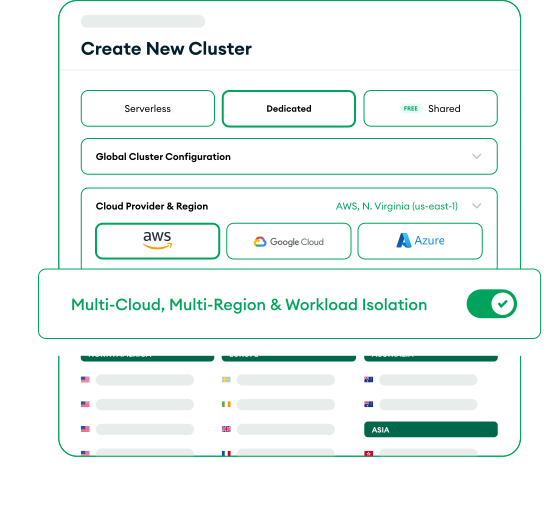
Many databases use "multi-cloud" to describe separate deployments on different cloud providers. MongoDB Atlas lets you run a single cluster across AWS, Microsoft Azure, and Google Cloud, which helps you design for resilience across cloud providers from one managed cluster.
Protect sensitive data within defined boundaries
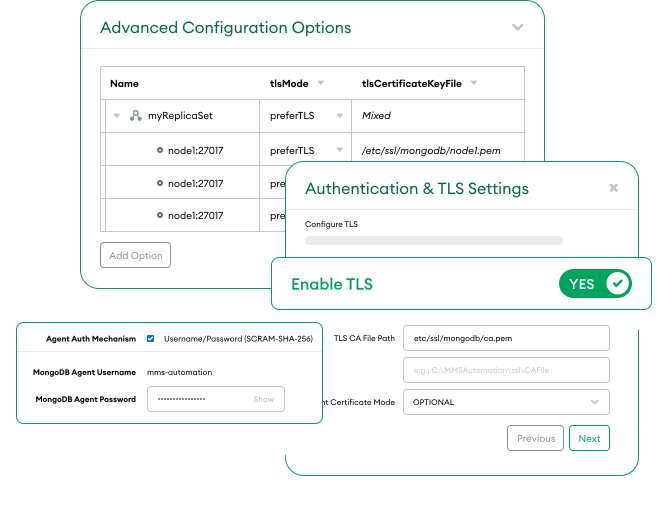
Some workloads require enhanced control over where sensitive data resides and how it is protected. MongoDB helps better align data placement to geographic or jurisdictional requirements through multi-region deployment and sharding, while Queryable Encryption keeps sensitive fields encrypted even during queries.
Maintain leverage as conditions change
MongoDB's modern data platform helps your team move quickly today while keeping a credible path to change deployment posture later. Atlas, Enterprise Advanced, and Community Edition share the same core database, which makes future deployment changes materially easier and can help preserve leverage as cloud costs, contracts, and business requirements evolve.
_1.svg)

Director of Architecture, Manulife
Director of Architecture, Manulife

Principal Engineer and Technical Lead, Nationwide

Secure Mobile Development Expert, ANFSI

CTO, Comercia Global Payments

Principal Engineer, Macquarie Bank


“Freedom to run anywhere” means MongoDB gives customers a more consistent data platform across Atlas, Enterprise Advanced, and Community Edition, making it materially easier to change deployment posture across managed and self-managed environments as needs evolve. Capabilities and operational responsibilities still vary by edition and environment.
Yes. MongoDB provides capabilities that can help organizations strengthen control over data location, protection, and access, including Queryable Encryption, customer-managed keys, multi-region deployment, and sharding strategies that partition data by geography or jurisdiction.
No single technology achieves full data sovereignty on its own. Atlas provides cloud and region choice plus strong security capabilities, but workloads that require stricter self-managed isolation may be better served by Enterprise Advanced in private cloud, on-premises, or air-gapped environments.
Yes. MongoDB supports multi-cloud and multi-region deployment. Atlas offers deployment options across AWS, Google Cloud, and Microsoft Azure, and these capabilities can help organizations build resilience and better align data placement to geographic or jurisdictional requirements.
Not necessarily. Because MongoDB Atlas, Enterprise Advanced, and Community Edition share the same core database, many customers can make deployment changes with materially less application rework than they would face with more provider-bound alternatives. The exact effort depends on the workload, edition-specific capabilities, and operating model involved.
Atlas is the easiest way to get started in a managed cloud environment. Teams can also use Community Edition for self-managed development and testing, then adapt deployment posture later as requirements evolve.
Run anywhere. Stay in control.