

INTRODUCTION
Delivering strength and security
Steel is one of the greatest man-made materials, and has changed the world since its invention thousands of years ago. From the domestic kitchen to transport, energy generation, construction and heavy industry, it’s a material that delivers strength, conductivity and resilience.
The basic technique of producing steel has remained largely unchanged for centuries; the processes that surround it, however, are constantly evolving. In an industry that depends on high production volumes, even the smallest changes can make a vast difference to quality and output.
The multinational steel manufacturer, headquartered in Luxembourg, was formed in 2006 as a result of the takeover and merger of Arcelor by Mittal Steel. It is the world’s second-largest steel producer, with an annual crude steel production of 88 million tons as of 2022.
ArcelorMittal operates its own iron ore mines, has a critically important R&D operation, and is increasingly focused on sustainability. It has set itself a target to become net zero by 2050, and is developing a highly effective scrap metal processing operation.
“ArcelorMittal operates across the whole industry, from wiring and cables to strips and plates for use in manufacturing and, for example, cladding for buildings,” explains Roger Sommavilla, Project Manager at ArcelorMittal. “We cover every aspect of steel production in all areas.”
THE CHALLENGE
A quality initiative to ensure customer satisfaction
Steel is an industry where quality really matters, especially in markets such as automotive manufacturing where standards are exacting. Quality assurance is an area in which the company has made substantial investments. ArcelorMittal launched a project to digitize its supply chain and enhance operational performance. A key aspect of this initiative was to improve product quality, reduce defects, and cut associated operating costs.
“Making steel is a complicated process,” says Xavier Marc, Project Manager at ArcelorMittal. “However, customer satisfaction is the most important objective. Products that don't meet their standards may need to be downgraded for other uses. To counteract this, our idea was to check quality indicators at each stage of the process and identify any problems as early as possible.”
Tracking quality across the production chain is a demanding task, compounded by the fact that data is scattered across multiple databases. With a typical 2km steel coil consisting of around 2,000 separate quality checkpoints for one product characteristic, data volumes are also high and rising fast.
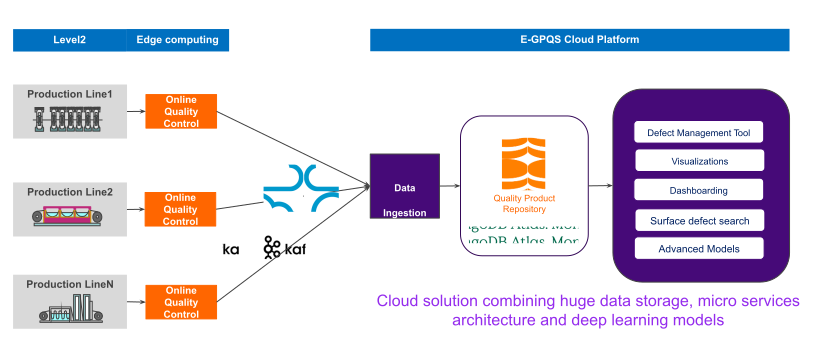
The company’s global R&D team developed a new component E-GPQS (Global Product Quality System), a quality control platform that stores data sourced from ArcelorMittal factories worldwide. Its primary aim was to deliver a centralized resource to aggregate and process data from multiple production lines in multiple factories across the globe.
A cloud-based solution clearly made sense for this application; however, ArcelorMittal also needed a database that would provide the capacity and scalability to enable E-GPQS to operate effectively.
.svg)
_1.svg)
_1.svg)

_1.svg)