


INTRODUCTION
Towards a Cloud Future
TIM is a global fixed, mobile, cloud and data center service provider. It holds leadership positions in Italy and Brazil. The group includes the Noovle, Sparkle, Olivetti and Telsy brands.
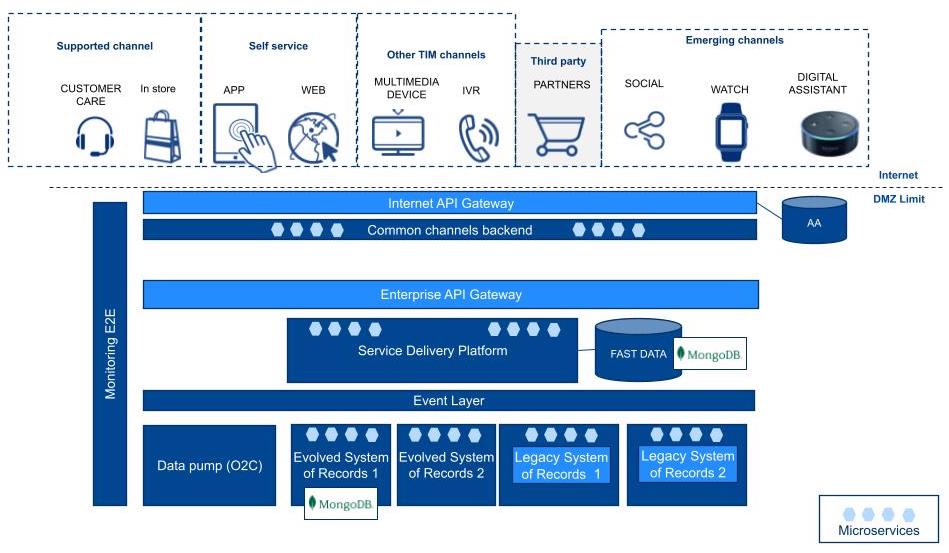
Like others in the space, TIM is moving to become a digital-first business. Its Fly Together project aims to create a software infrastructure based on microservices. The project will enable customers to access TIM services through digital channels such as online portals, apps and e-commerce. Digital, TIM believes, will drive a high quality, seamless customer experience.
“TIM is an organization with over 30 million users in Italy and the second largest mobile operator in Brazil,” explains Paolo Bazzica, Head of Digital Solutions at TIM. “Our vision for digital is to guarantee customers the best digital experience in the market, while providing a platform to expand the business into adjacent markets.
Fly Together kicked off in 2018 with a focus on TIM’s consumer segment; it was extended to include business customers in 2019. The project now manages the development of all new business applications, and the refactoring of legacy applications developed using traditional technologies.
“For a group that manages so many relationships and connections, performance and scalability are critical,” adds Bazzica.
THE CHALLENGE
Fast Data to Drive Innovation
“The challenge for companies that have IT applications created over the years,” continues Bazzica, “is sustaining the scalability and performance required by digital channels. Innovating while protecting back-end systems has been key to TIM’s digital acceleration.”
Digital moves at pace. TIM needs to develop new applications at speed, to make ongoing refinements, and to scale on demand. Changes caused by the COVID pandemic have seen a spike in digital channels.
For Fly Together to succeed, TIM needs ‘fast data’ - conceptually quite the opposite of big data – whereby the digital channels’ data models are decoupled from the data model partitions in the back-end systems. This would be impossible using traditional relational data structures, Bazzica says.
“We need a more modern and flexible model. For instance, when a customer uses the TIM app to find information about the different services available, the system must query up to 14 different databases, all created at different times and based on different technologies.
“‘Fast data’ means we need a flexible data model, based on a NoSQL database and exposed via API, that continuously updates the data. It must report any changes that take place in the back-end systems and make them available to users in an efficient manner.”
THE SOLUTION
Performance and Scale
TIM conducted a series of performance tests and an architecture analysis on several options, taking into consideration the anticipated volumes from the group's Brazilian subsidiary. Bazzica says MongoDB Enterprise Advanced was selected over the other alternatives because it met TIM’s performance and scalability requirements, as well as offering a platform for developing new functionalities.
“We were convinced by the flexibility and robustness of the MongoDB solution to support mission-critical applications,” he explains. “In a certain sense, we took a gamble on the solution, but basing it on a solid set of results and analyses, we then developed it with the support of our partners and MongoDB.

_1.svg)