As financial services enter an AI-first era, banks are rethinking how intelligence is embedded across every workflow—from onboarding and payments to trading, compliance, and portfolio management. Moving beyond isolated pilots to enterprise-scale AI production delivery requires a modern data platform that is secure, governed, and deeply integrated with the data layer.
In this blog post, we outline a reference architecture built on three core pillars: an AI Gateway layer for accessibility, control, and governance, an AI Agents layer for orchestration and decisioning, and MongoDB Atlas as the data layer for real-time data foundation. Together, these layers enable banks to operationalize AI with confidence, turning data into continuous, actionable insight.
Banking enterprise AI platform
Figure 1 shows the main components of a banking enterprise AI platform. It brings together data ingestion, real-time processing, model management, vector and embedding services, and agent orchestration within a governed architecture. Just as important, it highlights the foundational capabilities that regulated institutions need around security, compliance, observability, and resilience.
Figure 1. Key components of a banking enterprise AI platform.
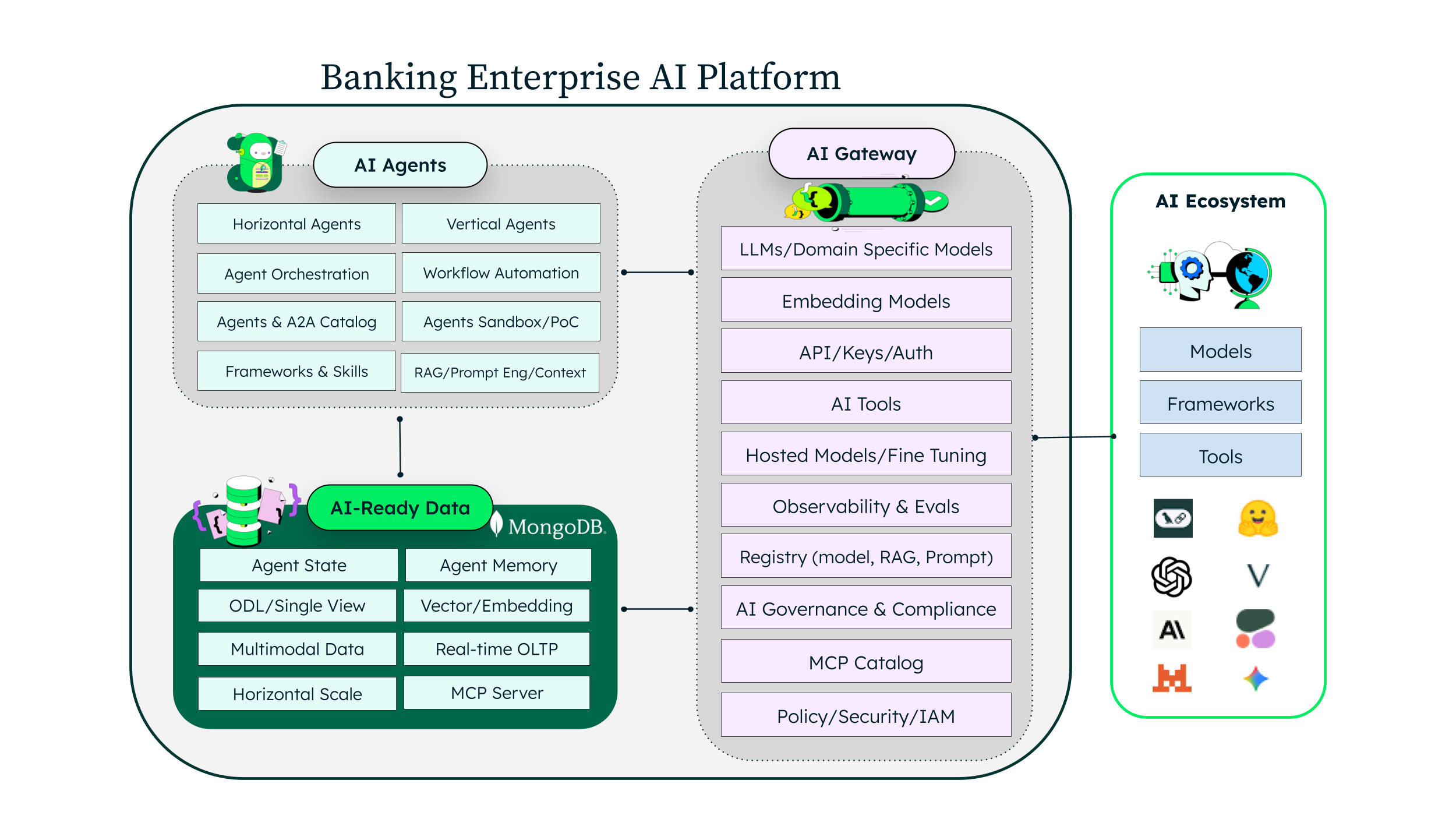
AI Gateway: The central hub for AI model management and access
The AI Gateway serves as the entry point and control center for all AI interactions within the platform. It acts as a unified interface that abstracts the complexities of various AI models, tools, and services, ensuring secure, governed, and efficient access. By centralizing these elements, the gateway minimizes redundancy, enhances performance, and enforces banking-specific compliance.
Key features of the AI Gateway:
AI Model Flexibility: Support for general-purpose large language models (LLMs) and banking-tuned models for use cases such as underwriting, credit risk assessment, and regulatory analysis. Support for embedding and reranking models—such as Voyage AI models— which enable semantic retrieval, recommendation, and similarity-based anomaly detection. Deployment options include API-hosted, private cloud, and on-premises models to meet latency, security, and data residency requirements.
Fine-tuning: Capabilities to customize bank-hosted models with proprietary banking data, improving accuracy for niche applications like anti-money laundering (AML) detection or intellectual property-related sensitive code generation.
Security, access, and policy enforcement: Secure access to AI services through API key management, authentication, and authorization mechanisms such as OAuth and JWT. Enforces security policies, including encryption, access controls, and monitoring to support compliance, auditability, and protection against unauthorized use.
AI asset registry and service catalog: A centralized registry for models, retrieval augmented generation (RAG) pipelines, and prompt templates, with versioning and reuse across teams. Can also include an MCP-based service catalog for discovering, sharing, and integrating vetted models, tools, agents, and external services.
Tools and integrations: A set of reusable tools and connectors for tasks such as data extraction, sentiment analysis, and integration with external systems like payment gateways, market data providers, and other enterprise APIs.
Governance, observability, and quality: Continuous monitoring and evaluation of AI systems in production, including model performance, data quality, runtime behavior, and decision traceability. Includes governance controls for explainability, bias detection, safety, and regulatory compliance, supported by logging, audits, and systematic evaluations across real and synthetic scenarios.
AI Agents: Intelligent automation for banking workflows
AI Agents represent the actionable intelligence layer of the platform, where autonomous or semi-autonomous entities perform tasks, make decisions, and orchestrate processes. In banking, agents can automate routine operations, enhance decision-making, and provide proactive insights, all while adapting to dynamic regulatory and market conditions. The agents are modular, allowing for customization to specific banking verticals or horizontal functions.
AI Agents key components:
Agent types: Support for both domain-specific (vertical) and cross-functional (horizontal) agents. Vertical agents handle specialized, higher-risk workflows such as onboarding, lending, or portfolio optimization, often with human-in-the-loop oversight. Horizontal agents provide enterprise-wide capabilities such as compliance, IT support, and operational automation.
Orchestration, frameworks, and workflow automation: Agent frameworks provide the reasoning, planning, and tool integration capabilities needed to build and operate AI agents. Orchestration coordinates agents across single-agent and multi-agent workflows, while workflow automation provides reusable building blocks for automating end-to-end business processes and enabling collaboration between specialized agents.
Knowledge and context management: RAG, prompt engineering, and context management capabilities that ground agents in enterprise data, optimize reasoning and response quality, and maintain task and conversational context across sessions. These capabilities also support interoperability and agent-to-agent (A2A) interactions.
Reusable agent components: An agent catalog of prebuilt agents, reusable skills, and workflow components that accelerate deployment, promote consistency, and enable reuse across business functions and use cases.
Sandbox and testing: Controlled environments for prototyping, experimentation, and validation before production deployment, reducing risk while enabling faster iteration and innovation.
MongoDB: The flexible data backbone for AI-driven banking
AI platforms are incomplete without a robust, AI-ready data foundation. Built on a flexible, document-oriented model, MongoDB is designed to handle the scale, variety, and velocity of data common in AI-driven banking use cases.
Unified data foundation: MongoDB natively supports structured, semi-structured, and unstructured banking real-time data through its flexible JSON-based document model. This unified data foundation also positions MongoDB as the AI context layer, providing agents and AI models with real-time, contextual access to operational, transactional, behavioral, and knowledge-based data across the enterprise.
Vector search and embeddings: MongoDB provides built-in, high-quality vector search capabilities for efficient retrieval of embeddings, enabling RAG and AI complex retrieval and queries at scale. It supports embeddings generated by leading models such as Voyage AI for embedding and reranking for higher accuracy, as well as ease of integration with other models accessed through the AI gateway.
Agent memory: MongoDB serves as a persistent layer as an effective AI agent’s short-term and long-term memory by storing conversation history, decisions, outputs, and user preferences across interactions, while supporting real-time queries.
Contextual memory: holds recent conversations, inputs, and the working context.
Procedural memory: stores rules, workflows, skills, and action patterns that guide how the agent behaves.
Episodic memory: persists past interactions, decisions, and outcomes so the agent can learn over time and personalize future responses.
Built for scale, security, and compliance: MongoDB enables banks to run AI and data workloads at production scale, combining horizontal scalability, high availability, and resilient performance. All while meeting strict security and compliance requirements. MongoDB delivers enterprise-grade security with capabilities such as encryption, Queryable Encryption, role-based access control, auditing, and support for data residency and sovereignty.
Seamless integration with AI ecosystems: MongoDB integrates seamlessly with modern AI frameworks, tools, and models such as LangGraph, LangChain, and other agent orchestration frameworks, serving as a unified data foundation across the AI stack. This tightly connects the AI Agent layers, supporting scalable, stateful, and auditable agentic AI workflows.
Three architectural patterns
As banks operationalize agentic AI, architecture becomes a strategic decision. The choice of pattern shapes everything from governance to speed of execution. The right architecture depends on how you balance control, autonomy, and scale. The following three architectural patterns represent the most common approaches banks are adopting to operationalize agentic AI across the enterprise:
Centralized architecture: brings orchestration, models, and decision-making into one shared platform. This makes governance, security, auditability, and regulatory alignment easier to manage, but it can also slow delivery and create bottlenecks when every new use case depends on a central team.
Decentralized architecture: gives each business domain control over its own agents, data pipelines, and models. That approach improves agility, speed, flexibility, and domain fit, but it can also create duplication, inconsistent controls, and challenges around enterprise-wide governance and compliance.
Hybrid architecture: aims to balance both by centralizing core services like governance and security while allowing domain teams to build for their own needs. For many large banks, this is the most practical path because it offers both consistency and flexibility, though it only works well with clear boundaries and strong coordination between teams.
Figure 2. The three enterprise AI architectural patterns: trade-offs and downsides.
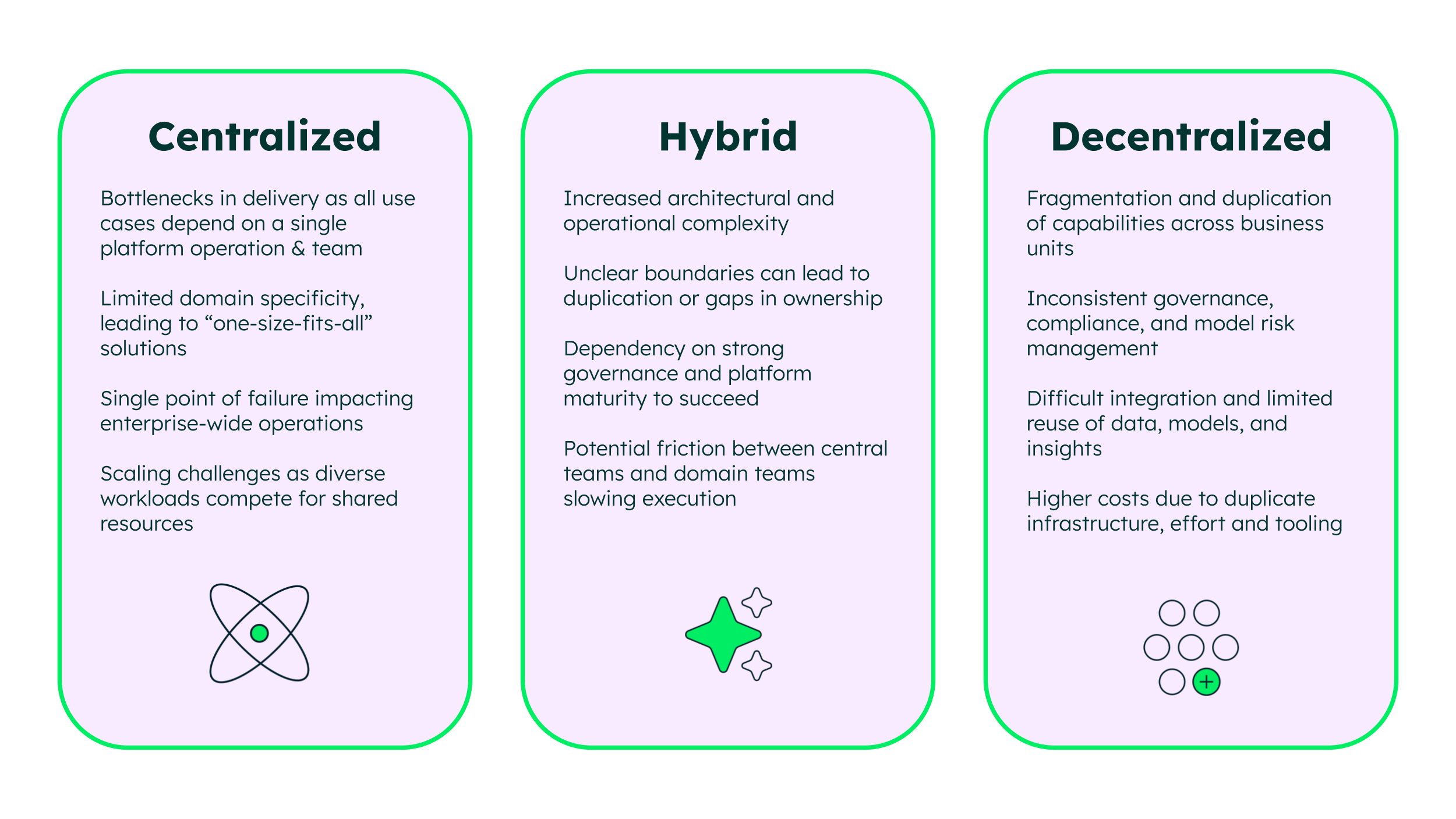
There is no universally “correct” pattern. The right choice depends on a bank’s risk appetite, regulatory environment, operating model, and innovation goals. In practice, many institutions begin with a more centralized approach to reduce early risk, then evolve toward a hybrid as capabilities mature and use cases scale.
Building a future-proof AI platform for banking
Banking AI platforms are no longer about individual models; they are about intelligent systems that learn, adapt, and orchestrate value across the enterprise, built on the right data foundation. The design for a Banking AI Enterprise Platform is centered around 3 major key capabilities: the AI Gateway, AI Agents, and AI Data Foundation. MongoDB provides a scalable, secure, and AI-ready data architecture that empowers this design. MongoDB addresses key challenges in delivering AI solutions by simplifying the data layer that allows banks to innovate faster. As AI continues to advance, this modular architecture can evolve, incorporating new models, frameworks, or agents while MongoDB acts as the critical data backbone of AI innovation.
Next Steps
Learn how to Unlock Financial Services Document Intelligence with Agentic AI and MongoDB
Discover more in our blog Reimagining Investment Portfolio Management With Agentic AI | MongoDB
Visit our main page to see how you can use MongoDB for Financial Services: modernize, secure, scale