Welcome back to our series on Building a Financial Crime Mitigation Platform, in which we demonstrate how MongoDB ideally supports the technical capabilities of modern digital financial operations as a unified data platform. In case you missed it, be sure to check out the series overview.
Modern financial institutions are increasingly constrained by architectural debt. Legacy systems, built on rigid schemas and batch-oriented processing, create significant data gravity that hinders real-time response. As an event-driven backbone, MongoDB allows architects to move beyond rule-based systems that lack the contextual richness required for comprehensive fraud analysis.
By combining a dynamic customer profile with continuously updated risk models, we can drastically improve fraud detection latency and lower the total cost of ownership (TCO) by reducing manual intervention. Let’s examine the implementation.
Behavioral risk modeling
Rule-based systems alone are no longer enough for today’s world. Modern financial services, like instant payments, real-time onboarding, and cross-border transfers, require a comprehensive analysis that combines rules and policies with transactional and customer context to answer more complex questions: Where is this transaction coming from? Is this the average/standard deviation amount from this customer’s profile? Is the biometric information in line with the customer's usual behavior? And more importantly: Is this a transaction that can be approved automatically, or does it need further investigation?
Successful modern solutions are the ones that combine the best of both worlds: maintaining rule-based applicable policies along with probabilistic reasoning, either with similarity search or by integrating with advanced machine learning solutions.
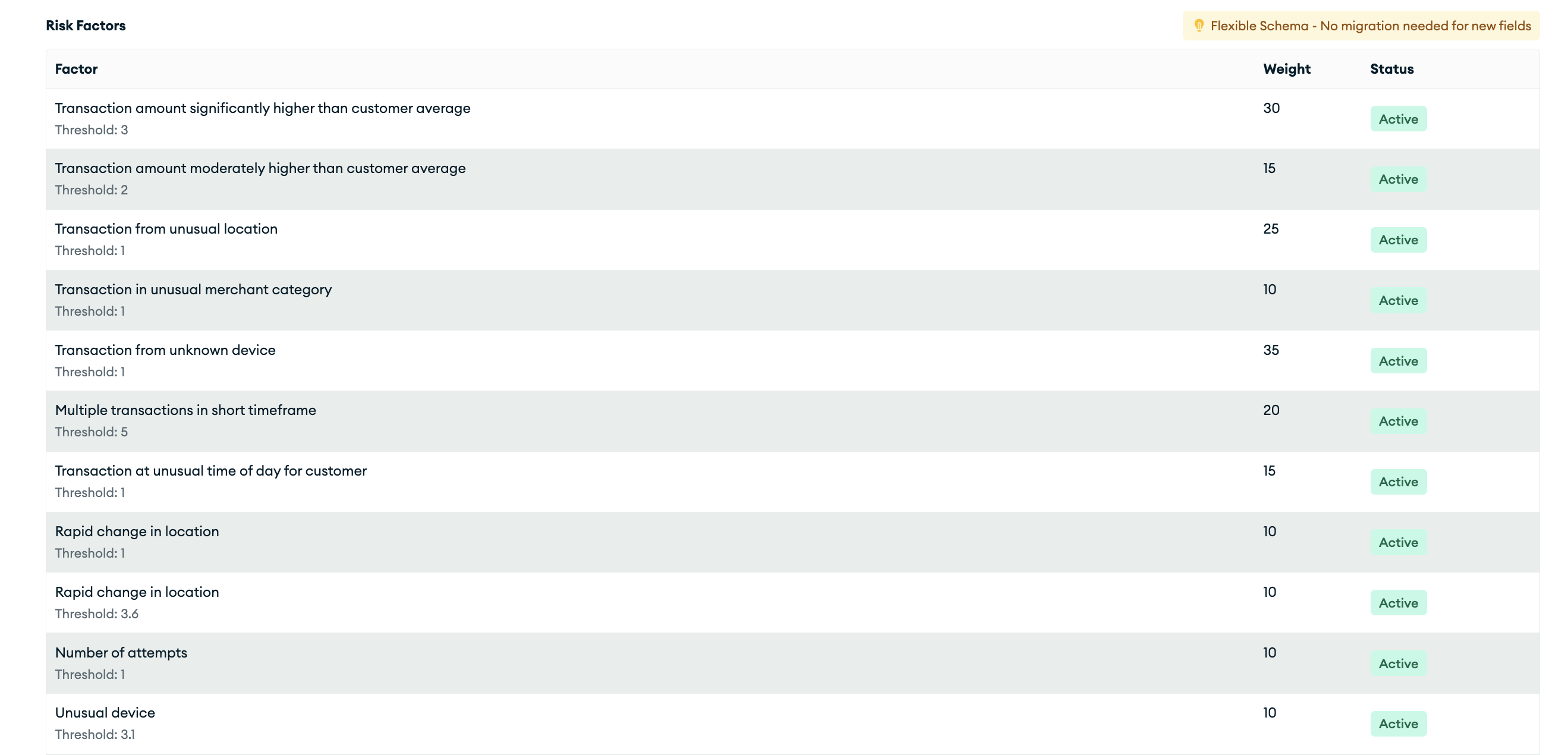
In practical terms, you can rely on MongoDB’s flexible data model to create a rule-based system, adding MongoDB’s change streams for asynchronous, decoupled processing of new events. This decoupled architecture enhances system resilience by isolating risk evaluation from the core transactional path. Let’s take the example of our demo prototype:
Figure 1. Behavioral risk model factors using MongoDB’s document data model.
(Image taken from our demo prototype. Disclosure: The look and feel is from a custom UI developed for demo purposes. It is not part of MongoDB’s offering.)
As shown in the figure, MongoDB captures behavioral events such as unusual typing or mouse patterns, as well as device IP addresses that match expected geographic locations already registered in the customer profile. MongoDB captures these real-time events through change streams. Change streams allow applications to access data changes as they occur and react immediately, without relying on legacy database updates, triggers, or brittle production scripts. This approach helps architects deploy new business rules quickly, enforce schema validation, and maintain a non-blocking, event-driven flow
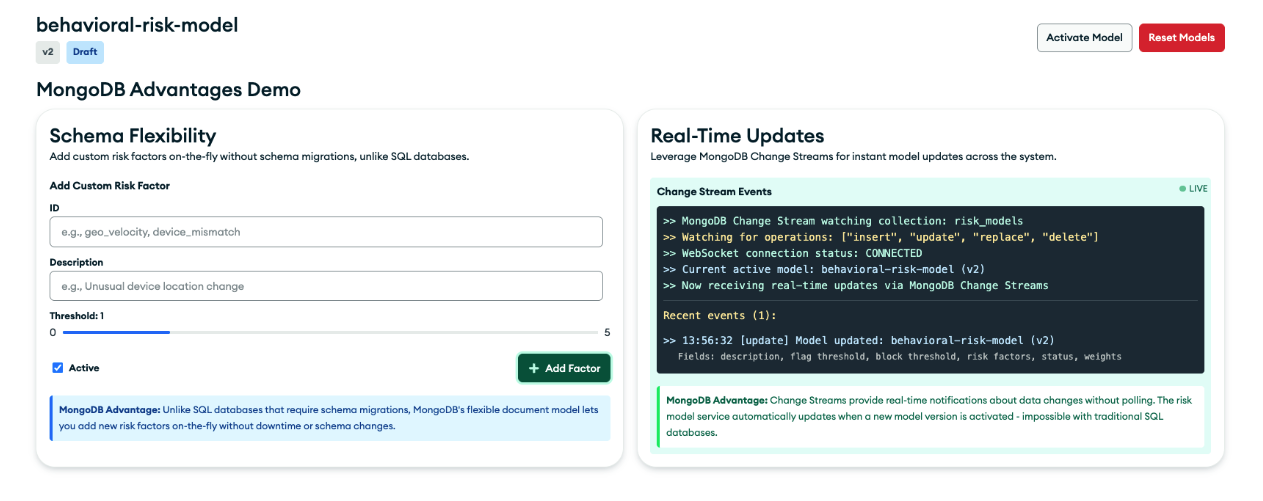
MongoDB’s multi-modal document model also aggregates transactional, operational, unstructured (vectorized), time series, and geospatial data into a single dataset. This allows financial institutions to build behavioral risk models on a broader and more contextual data foundation. Figure 2 shows a practical example of this approach by illustrating how new risk factors can be added on the fly.
Figure 2. Real-time updates for the behavioral risk model.
(Image taken from our demo prototype. Disclosure: The look and feel is from a custom UI developed for demo purposes. It is not part of MongoDB’s offering.)
Event-driven fraud detection
With a dynamic risk model that combines rule-based and behavioral assessment, financial institutions can analyze fraud in real time.
Customer behavioral analysis
As discussed in this series’ previous blog, building a customer dynamic profile, MongoDB’s document model makes this approach technically feasible. MongoDB can aggregate data from different sources and schemas into a dynamic profile that updates in an event-driven way.
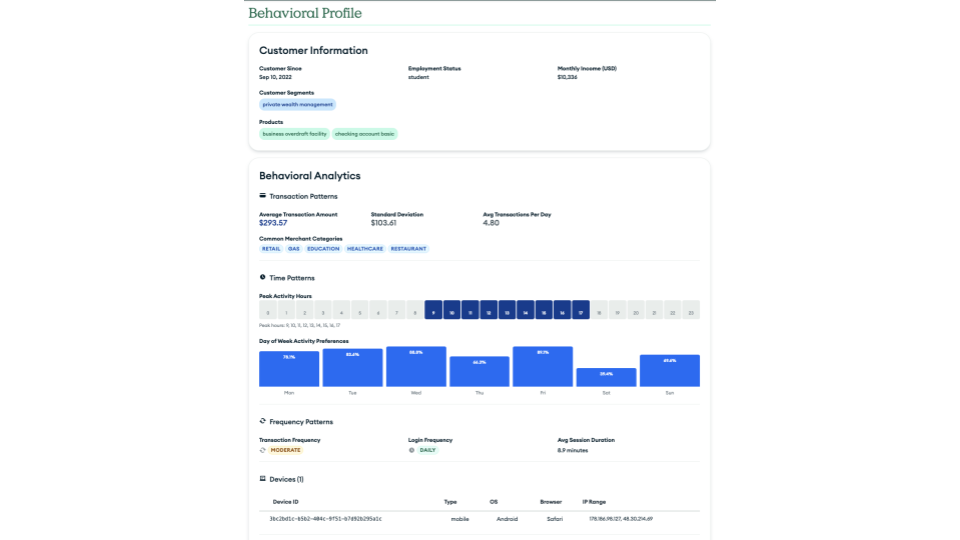
Based on the captured information, financial institutions can define a behavioral profile like this:
Figure 3. Dynamic behavioral profile.
(Image taken from our demo prototype. Disclosure: The look and feel is from a custom UI developed for demo purposes. It is not part of MongoDB’s offering.)
Beyond capturing event-driven signals, financial institutions can use MongoDB to incorporate derived features such as moving averages and standard deviations to build a truly multi-dimensional behavioral profile.
Transactional assessment
Using this profile, MongoDB can assess each incoming transaction through similarity search. MongoDB Vector Search compares the vectorized representation of an incoming transaction with prior transactions labeled as authorized or declined. This helps identify suspicious activity and route high-risk transactions to an advanced analytics solution for further investigation.
A vectorized representation of a transaction should include customer profile information, transaction information, applicable policies and regulatory rules, and the risk model described earlier. With this foundation, vector search can evaluate each transaction against relevant historical patterns.
Figure 4. Real-time transaction screening using Atlas Vector Search.
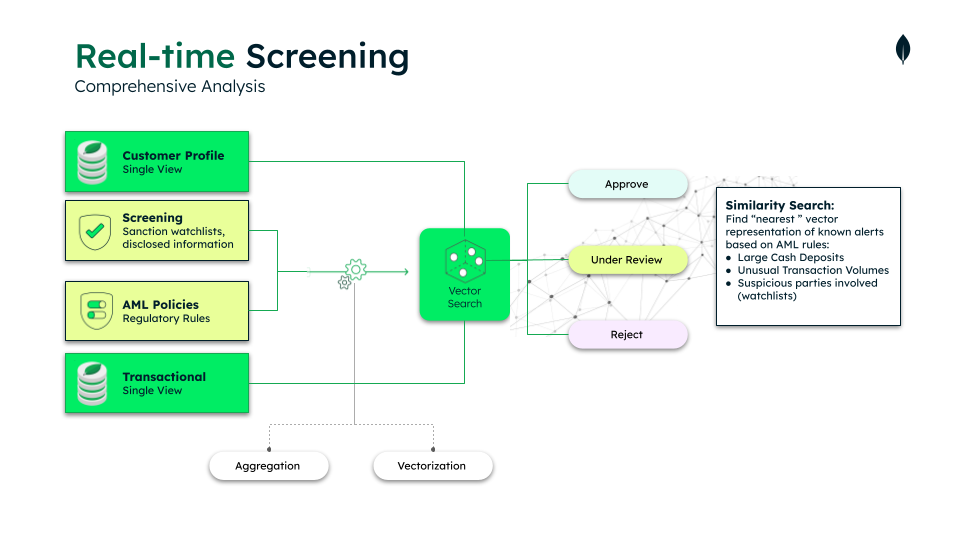
Architecturally, MongoDB Vector Search serves as an intelligent filter that separates low-risk, legitimate transactions from suspicious ones. This helps financial institutions reduce false positives and optimize the workload for downstream due diligence systems.
Reducing false positives
Let’s take a look at a practical example of using MongoDB’s vector to assess a fraudulent transaction.
If a customer has an average transaction amount of a few hundred dollars, usually transacts from a known location, and uses a registered device, the incoming transaction is likely to show high similarity to previous legitimate transactions. Conversely, a transaction that is far above the average amount, comes from an unknown location, and originates from an unregistered device is likely to show higher similarity to previous suspicious transactions.
Figure 5. Similarity detection results: valid vs. suspicious transaction assessment.
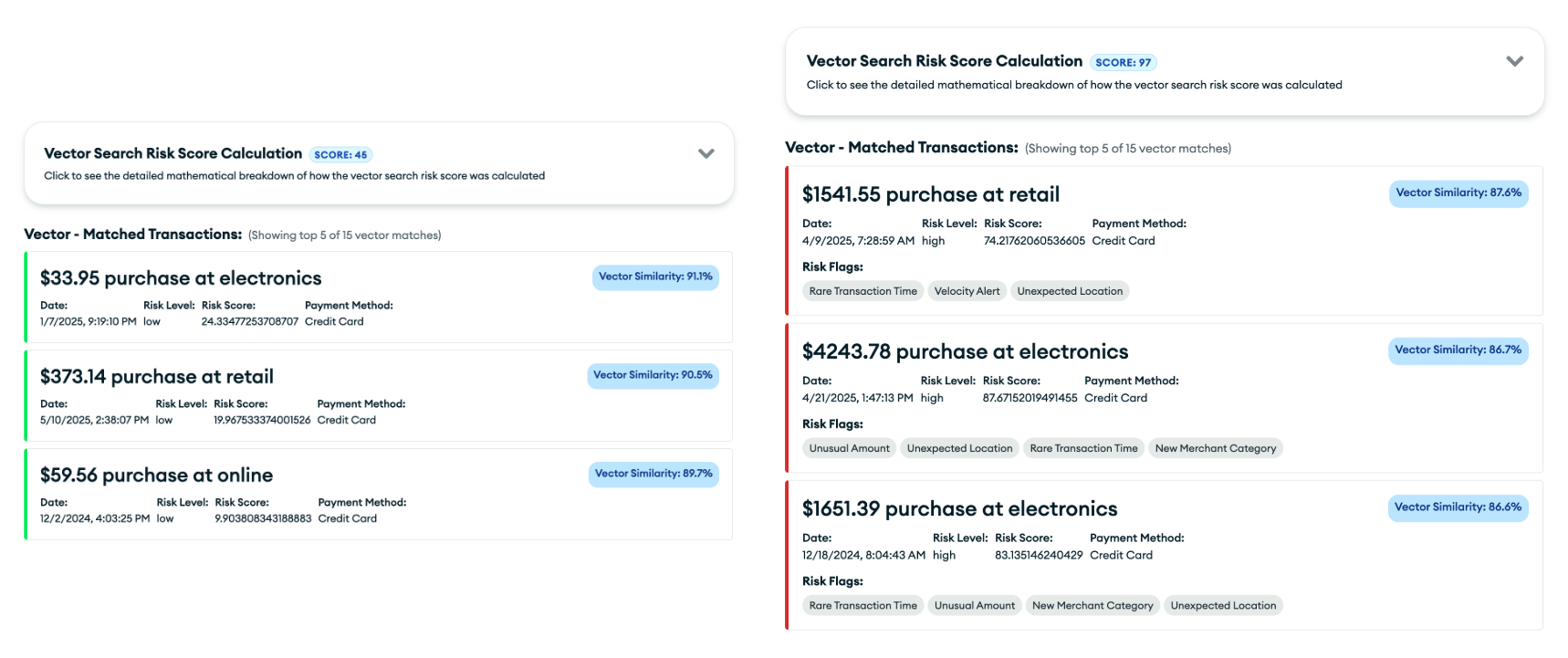
(Image taken from our demo prototype. Disclosure: The look and feel is from a custom UI developed for demo purposes. It is not part of MongoDB’s offering.)
One important consideration for similarity detection is that, while vector search captures behavioral features such as merchant category and location, it does not evaluate numerical data such as transaction amount. Financial institutions can assess those values through traditional risk scoring. This shows that a true comprehensive risk assessment is one that combines rule-based and contextual analysis.
Figure 6. The vector embedding process.
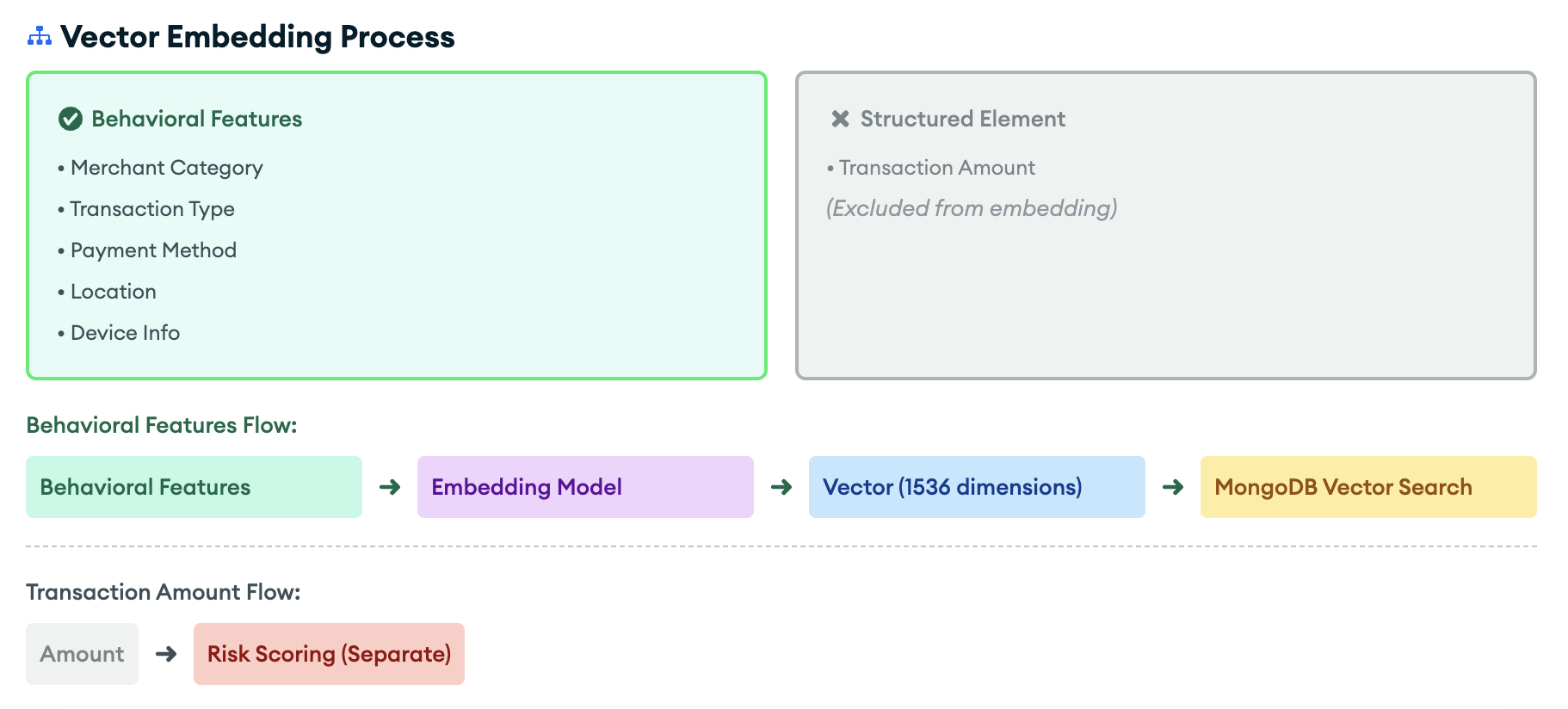
(Image taken from our demo prototype. Disclosure: The look and feel is from a custom UI developed for demo purposes. It is not part of MongoDB’s offering.)
Takeaways
MongoDB makes behavioral risk models and contextual fraud detection technically feasible through several core capabilities:
Its schema flexibility lets risk managers add heterogeneous risk factors on-the-fly without complex migrations or downtime.
Change streams update risk models in real time through an event-driven approach. This eliminates the need for periodic refreshes, API polling, or traditional scripts.
Version control, schema enforcement, auditing, and rollback capabilities make risk model management more efficient without downtime.
MongoDB Vector Search assesses incoming transactions in near real time through similarity search. It compares transactions against common patterns to help isolate suspicious activity.
In the next article in this series, we will dive deeper into how MongoDB’s platform capabilities can enable Agentic AI systems for streamlining case management processes. Stay tuned!
Next Steps
Read our series overview on "Building a Financial Crime Mitigation Platform with MongoDB"
Check out these guided step-by-step tutorials on building a Financial Crime Mitigation Platform with MongoDB Atlas and AML Network Analysis with $graphLookup.