In today’s always-connected world, every digital interaction—from browsing a shopping site to streaming a show or sharing feedback—adds to a growing stream of data. This data reflects our demographics, preferences, behaviors, and sentiments. Platforms use it to personalize experiences, recommend content, and continuously improve their services.
But this data isn’t always uniform or organized—it’s diverse, messy, and constantly evolving. Organizations face the challenge of storing and analyzing data coming in many formats and from countless sources. They need a powerful, scalable solution designed to store vast volumes of structured, semi-structured, and unstructured data assets in native form—a platform that can be easily queried to retrieve the data for insights, innovation, and intelligent decision-making, i.e., the data lake platform.
The ability of data lakes to ingest huge amounts of big data, as well as their growing role in fueling machine learning and advanced data science, are just some of the reasons that the data lake market is anticipated to grow at a compound annual growth rate (CAGR) of 23.8% from 2024 to 2030.
Through this article, we will learn about data lakes, why they matter, and how MongoDB Data Federation can help organizations view and analyze data across various sources in one place without actually moving it, and use in-house tools to get rich, actionable insights.
Table of contents
- What is a data lake?
- Why data lakes?
- Data lake architecture
- Data lakes vs data warehouses
- Challenges of data lakes
- Selecting the right data lake tools
- MongoDB Atlas Data Federation
- Data lake best practices
What is a data lake?
A data lake is a centralized repository to store vast amounts of big data in its original format. This means that data ingestion of different types of data—i.e., batch data and streaming data into a data lake—is possible without any type of preformatting. It also means that a variety of structured data (like customer details, health records, financial statements), semi-structured data (like JSON documents, emails, XML, sensor data), and unstructured data types (e.g., text files, PDFs, audio, video, images) can be stored in the same place providing a single unified view of all the data.
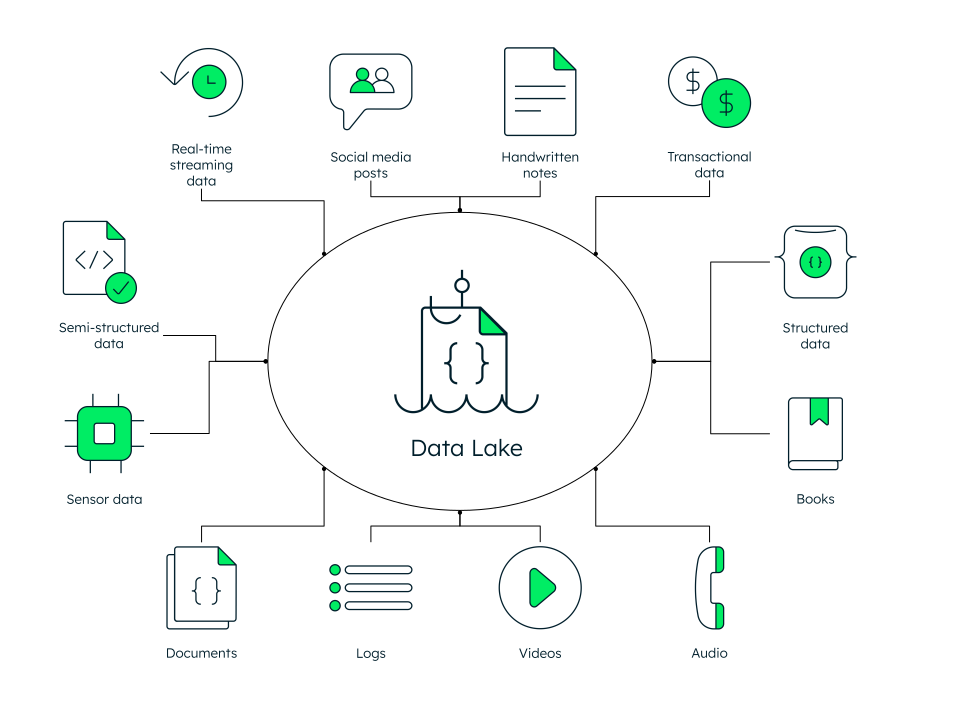
Let us take a simple example where a hospital wants early diagnosis of chronic illnesses (heart disease, diabetes) using patient data stored in the data lake, collected over time from multiple sources.
The patient demographics like height, weight, and age, along with their lab test results like cholesterol, blood sugar, and their visit history—for example, dates on which tests were done, diagnoses, and departments visited—will constitute the structured data.
Their diet intake in calories, heart rate, sleep patterns, and activity levels obtained from a wearable device, and electronic health records, are the semi-structured data.
Further, handwritten doctor prescriptions; clinical observations; images of X-ray, MRI, and CT scans; voice recordings of consultations; email feedback; social media feeds for lifestyle choices; and web searches for particular health topics or experiences constitute unstructured raw data.
Combining all the above data will give a holistic view of the patient’s clinical, behavioral, and lifestyle patterns. The data from the data lake can be given to machine learning (ML) models to detect these patterns to find any potential diseases and suggest preventive plans in lifestyle, diet, and exercise, along with medicines, if required.
Data lakehouses take the concept of the data lake to the next level. Data lakehouses provide a unified data management solution, offering the reliability of data warehouses (DWHs) as well as the cost efficiency of data lakes in one place.They support business intelligence and machine learning and eliminate data swamps and data corruption.
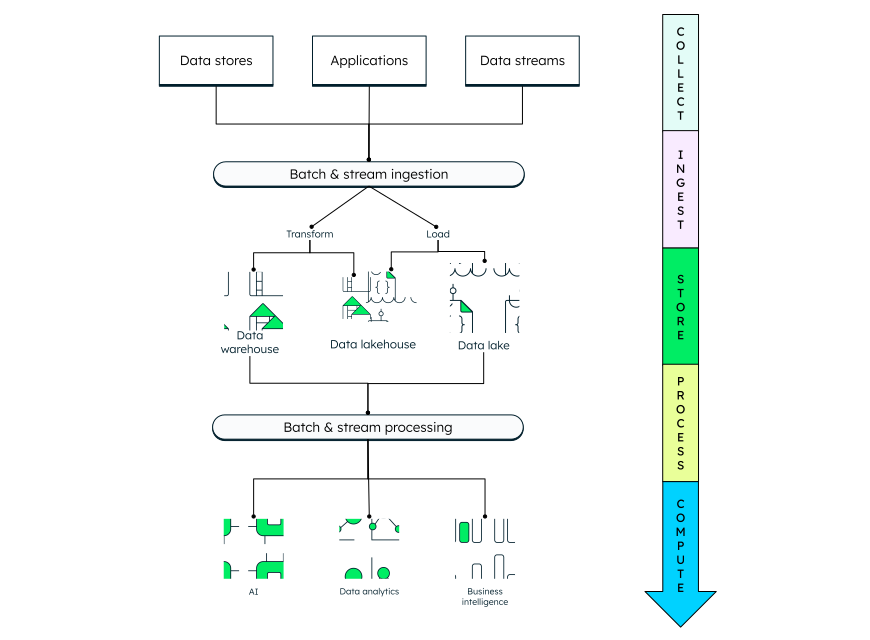
Organizations leverage data from data lakes, data warehouses, and data lakehouses for both batch and stream processing. The processed data is then made available for business intelligence, reporting, interactive dashboards, alerts, and real-time analytics applications.
Data from various sources is collected and ingested in batches (periodic uploads) or in real time (data streams through Kafka). Data can land in a data lake or go to the next stage for data profiling—i.e., validation (identify missing values, duplicates, anomalies) and transformation—to be sent to a data warehouse (ready for analysis).
Data lake characteristics
Some prominent characteristics of data lakes include:
- Multiple data sources: Data lakes can easily inges different types of data from diverse data sources.
- Batch and stream ingestion: Data lakes are able to load large volumes of data in batch, which speeds up the ingestion process and improves performance. Further, real-time, raw data can be ingested directly into a data lake without any exploratory analysis.
- Store now, analyze later: A data lake is a central repository to store data in its native format (raw format) for future analysis and business intelligence purposes.
- Schema flexibility: Data lake storage systems are able to infer the schemas from previously ingested data stored within the data lake. This is sometimes referred to as schema-on-read.
- Metadata management: To bring data governance, data integrity, and discoverability, data lake solutions have metadata management. The metadata is a data catalog that manages information about the data, like the data size, type, creation date, storage location, purpose, owner, ingestion data, and transformation date. Metadata management helps in avoiding data swamps.
Why data lakes?
Before data lakes, organizations struggled with scattered data, poor integration, and high costs of scaling and analyzing large volumes of diverse and fast-moving data. Modern data architectures, like data lakes, addressed these issues by providing a centralized, scalable, and flexible platform that could store and analyze all types of data efficiently.
A data lake:
- Provides a central repository to collect data for better data accessibility.
- Resolves the challenge of storing fragmented data across multiple systems (data silos), and inconsistent data formats and data quality issues.
- Delivers a scalable and unified platform for flexible data storage and on-demand analytics.
- Enables quick and easy access to relevant information, supporting timely business decisions.
Data lake architecture
Contrary to the predefined nature of data warehouse architecture and associated platforms, data lake architecture can be described as an architecture pattern, or set of tools (supporting the schema-on-read approach), surrounding a vast repository of native-format data. As such, data lake architecture often varies from organization to organization depending on their specific data usage and analytics needs. Read our detailed article on data lake architecture.
Data lakes vs data warehouses
While both a data warehouse and a data lake can support the data storage needs of big data in terms of capacity, DWH solutions are not effective in processing, storing, and analyzing unstructured data. This is due to the fact that DWHs follow the rules of relational databases which require strict adherence to predefined data formats and guiding hierarchies.
The differences between a data lake vs data warehouse are highlighted in terms of how data integration, data structure, and data storage are approached, as well as how a data lake versus a data warehouse will access data, query data, and process data.
The table below summarizes some of the key differences between data lakes and data warehouses.
Data lakes follow the Extract-Load-Transform mechanism, where data is first loaded and then transformed later when the need (a use case) is identified, while data warehouses follow Extract-Transform-Load, where data is transformed and then loaded since the purpose of the data is already known.
Challenges of data lakes
The biggest challenges of early data lakes were data governance, data lake security, and data quality. Modern data lakes handle these challenges to a great extent:
- Governance: By using metadata and data catalogs, data classification, and tagging, data can be labeled based on its sensitivity and domain. Further, governance tools enforce access control and regulatory compliance.
- Quality: The quality of unprocessed data goes through validation, cleansing, transformation, and versioning to ensure consistency and integrity.
- Security: Security can be handled through access control, encryption techniques, masking of sensitive fields, auditing, and network isolation.
Selecting the right data lake tools
Choosing the right data lake platform starts with understanding your organization’s use cases and goals. Is your data lake meant to serve as a scalable, cost-effective storage layer? Will it complement your existing data warehouse? Do you want it as a foundation for advanced analytics, AI, and machine learning?
Most organizations today use data lakes alongside their data warehouses. Having a clear strategy for how the two systems coexist can save enormous time and complexity later.
Scalability and flexibility are equally important. Your data requirements will evolve—what you store today may look very different from what you’ll store two years from now. A good data lake solution should make it easy to ingest, process, and analyze growing volumes and new types of data without a major overhaul.
It’s also worth considering who will use the data. Data scientists and engineers may need direct access to raw files for experimentation, while business users depend on big data processing for dashboards and BI tools for data analytics. Choosing a platform that supports both types of users—through integrations, query capabilities, and APIs—ensures everyone can access data in a way that fits their work.
Another critical aspect is data governance and quality. Unlike warehouses, data lakes don’t enforce strict schema rules at the time of ingestion. This flexibility is powerful, but without strong metadata management, access controls, and quality checks, a data lake can quickly turn into a “data swamp.” A well-designed governance framework helps maintain trust in the data and ensures compliance with security and privacy standards.
Finally, evaluate your internal skills and vendor reliability. Managing a large-scale data lake requires specialized expertise in big data engineering and cloud infrastructure. If these skills are still developing in-house, a managed or cloud-native solution can significantly reduce operational overhead. Look for vendors with strong integration capabilities, robust security, and a proven track record.
Platforms like MongoDB Atlas Data Federation simplify much of this journey by providing a fully managed, scalable, and secure environment that can handle diverse data types, integrate seamlessly with your analytics stack, and allow teams to run queries directly on data stored in the cloud—without complex setup or movement.
MongoDB Atlas Data Federation
Modern data lakes are often built on cloud platforms such as AWS S3, Azure Storage Gen2, or Google Cloud Storage, which provide scalable and cost-efficient foundations for storing massive datasets (object storage). Organizations and data scientists rely on big data analytics tools and a query engine to organize, process, and analyze data efficiently.
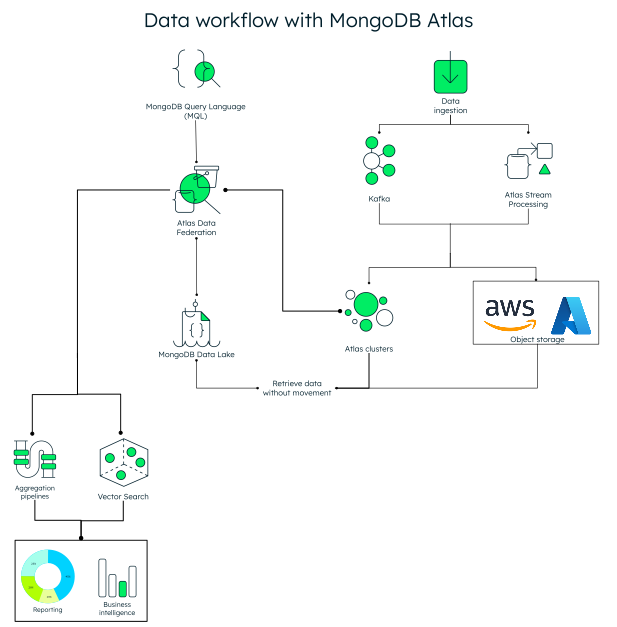
Within this ecosystem, MongoDB Atlas extends its role beyond operational storage. MongoDB Atlas Data Federation enables users to query data in-place across MongoDB Atlas clusters and cloud storage containers like S3 buckets and Azure blobs, using the familiar MongoDB Query Language (MQL), minimizing the need for complex ETL pipelines or data duplication. Atlas Federation (Data Lake) acts as a query engine and a managed interface to get a unified view of data.
Further, tools like MongoDB Atlas Vector Search can be useful to enhance semantic search capabilities within Atlas, supporting AI/ML workloads and real-time analytics. Together, these services unify access to all your data (operational and analytical), simplify governance, and accelerate insights across diverse data sources.
Data lake best practices
Data lakes are useful when maintained judiciously. Here are important points to keep in mind to keep your data lake in its best of health:
- Store historical data, but not for too long, as stale data will lead to data swamps when the data lake grows.
- Maintain business context, schema, metadata, and catalogs for easy data discoverability and governance.
- Keep raw data separated from transformed data to ensure quality.
- Secure the data lake through encryption and access control.
- Maintain a minimal structure for easier data management and consistency.