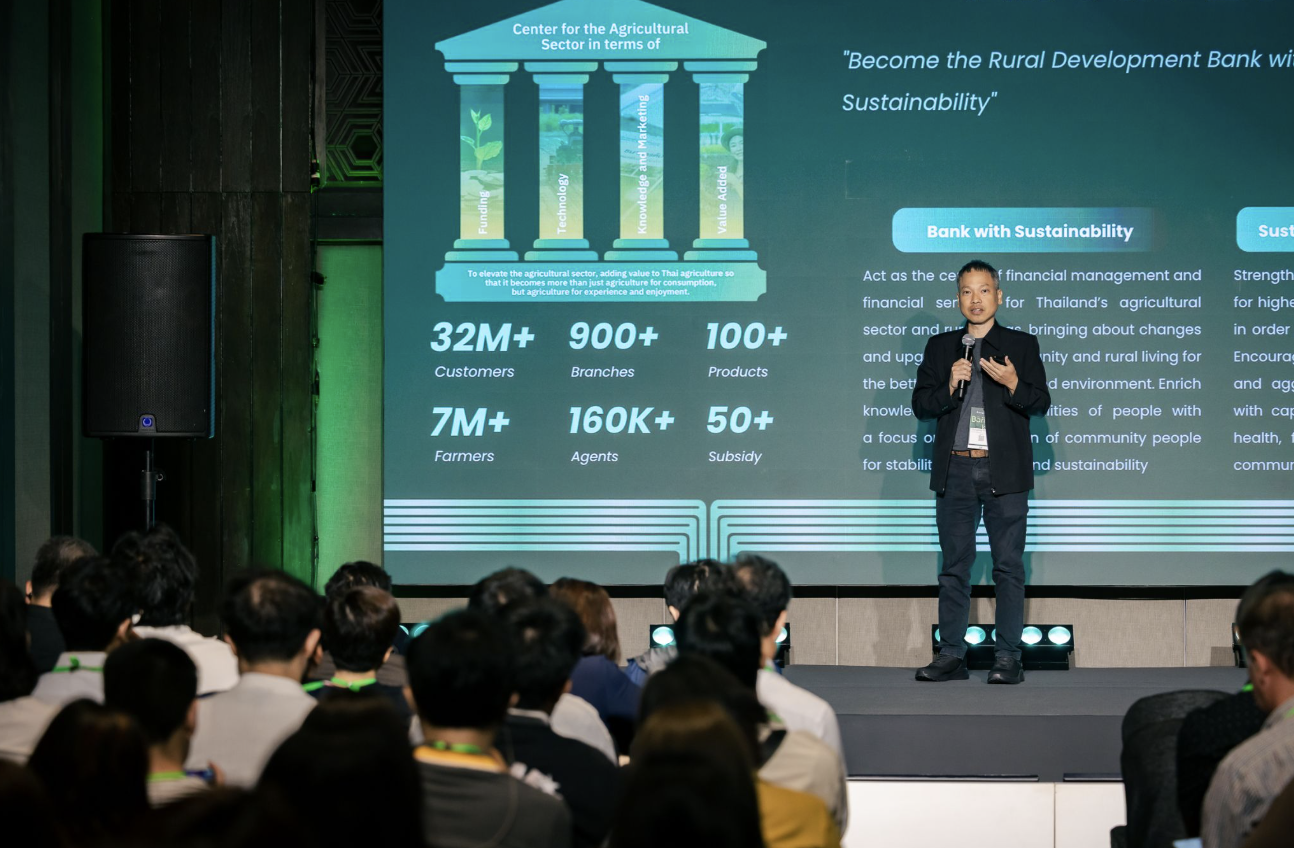
One of Thailand’s largest state-owned banks, the Bank for Agriculture and Agricultural Co-operatives (BAAC), serves over 32 million customers and 7 million farmer households across Thailand. BAAC is focused on rural development, and the bank provides essential funding, knowledge, technology, and value-added services to Thai farmers.
Delivering reliable, always-on mobile banking is no longer optional, even in rural areas. To meet the growing expectations of its customer base, in 2023, BAAC embarked on a journey to modernize its digital architecture.
At MongoDB.local Bangkok in 2025, Pongthep Promsiri, Senior Vice President of Data Management at BAAC, shared how BAAC powered the modernization of its legacy mobile application with MongoDB.
Legacy pain points: a monolithic RDBMS and expensive downtime
BAAC’s first mobile app—‘A-Mobile BAAC’—launched in 2017. The app included features like transfers, balance inquiries, deposits, and payments.
While the app initially worked fine, it relied on a monolithic architecture built on a relational database management system (RDBMS). This legacy database meant that BAAC quickly ran into challenges as the application scaled.
“Everything was bundled together: business logic, mechanisms, and the access layer”, said Promsiri. “If even one service failed, the entire system would go down, affecting all our customers using the mobile application.”
This was a major concern given the Bank of Thailand’s strict regulations, which impose hefty fines for each minute of service downtime.
The relational database model also posed additional challenges and limitations that prevented BAAC from modernizing and innovating. Issues with the RDBMS included:
- Inflexible scaling: Scaling the RDBMS required adding resources like CPU and memory. This inevitably necessitated scheduled downtime. As customers shifted towards 24/7 access, these maintenance windows became increasingly unacceptable, resulting in lost transaction opportunities.
- Schema rigidity: Traditional relational database solutions rely on a rigid schema. This hindered BAAC’s ability to collect the diverse range of customer data needed to build new features. Additionally, schema changes often resulted in service interruption and downtime.
“We needed a foundation that could deliver the scale, agility, and resilience expected of a major financial institution,” said Promsiri. That’s why BAAC turned to MongoDB.
Embracing schema flexibility and microservices with MongoDB
Recognizing that the core solution to its problems lay in schema flexibility, BAAC began experimenting with MongoDB Community Edition in 2018.
“We first started using MongoDB for our web applications, such as registration applications for farmers, and some of our internal systems,” said Promsiri. “What this taught us was the benefits of schema flexibility.”
After five years of gradually migrating its web applications and internal systems onto MongoDB Community Edition, BAAC gained the confidence to modernize its critical mobile banking services.
“In 2023, BAAC successfully re-architected its mobile banking application with MongoDB, transitioning from a monolithic RDBMS architecture to a microservices-driven approach,” said Promsiri. “And we rebranded as ‘BAAC Mobile’.”
MongoDB's document database model enabled BAAC to make schema changes at any time. These updates were possible without mandating application downtime, as previously associated with RDBMS table alterations.
Thanks to MongoDB’s sharding capabilities, BAAC was able to isolate each of its services. This ensured that even in the event of a single service failing, the failure would be contained. All other services would continue to run seamlessly.
“We created services based on the ‘Single Source of Truth’ principle, with each microservice having its own data,” explained Promsiri.
Since adopting MongoDB, it has been easier for BAAC to comply with the Bank of Thailand’s requirements surrounding Disaster Recovery Plans (DRP)—all commercial and state banks must test their DRP at least once a year.
“Previously, testing our disaster recovery site meant shutting down the service twice. Once to move workloads from our main site to the backup site, and again to move them back when the test was completed,” said Promsiri. “But now, with MongoDB’s replica sets capabilities, we have completely transformed this process. Both sites now operate actively, so one site can handle operations seamlessly if the other goes down. We’re able to perform annual disaster recovery testing without any service interruption, which ensures reliability while reducing resource waste and costs.”
More recently, BAAC moved to MongoDB Enterprise Advanced, the version of MongoDB built for self-managed deployments, with tools to enable automation, operations, and security. Being able to access features like MongoDB Ops Manager proved crucial to help manage BAAC’s complex and mission-critical clusters.
“With Ops Manager, there are four major features that our database team especially enjoys,” said Promsiri. They include:
- Backup and recovery: BAAC can now perform backup and recovery operations on the fly. All without impacting the production database.
- Advanced monitoring: BAAC is able to monitor and analyze query performance. This instantly identifies slow operations like collection scans and recommends optimal indexes to improve efficiency. These capabilities are vital to meet sub-100 ms latency demands of front-end teams.
- Cluster management and deployment: BAAC can deploy nodes, create indexes, and manage the entire cluster across both DC sites from a single interface.
- Security and encryption: MongoDB Enterprise Advance’s built-in security and encryption capabilities ensure that such requirements are handled at the database layer natively. This relieved the development teams of the considerable burden of writing custom encryption functions and managing key rotation to satisfy auditors and regulators.
By leveraging the flexibility of MongoDB's document model and the enterprise-grade capabilities of MongoDB Ops Manager, BAAC successfully modernized its mobile banking application. As of 2025, BAAC delivers resilient, scalable, and secure digital services that exceed customer expectations. Concurrently, compliance with the strict regulations of the Bank of Thailand has been ensured.
Next Steps
Visit our product pages to learn more about MongoDB Enterprise Advanced and MongoDB Community Edition.