Financial institutions face a critical challenge: legacy payment architectures are fragmented, rigid, and deeply siloed, making it difficult to adapt to new payment rails or build trustworthy systems for AI operations. To overcome these limitations, banks need an operational data foundation that decouples payment logic from tightly coupled legacy systems. MongoDB provides the unified document data layer required to implement composable capabilities and canonical payment models, enabling financial institutions to seamlessly evolve their payment operations while giving AI agents the trusted, real-time context necessary for reliable decision-making.
Why these changes matter now
Every new payment rail, standard, regulatory requirement, or customer expectation can introduce another data model, integration, and processing path. Agentic AI adds another dimension. Banks are exploring systems that reason over payment information, investigate exceptions, and assist operations teams. But adding AI to a fragmented payment environment does not make the architecture less fragmented — it just gives the fragmentation a faster, more confident way to fail.
We've written before about the canonical payment model as a way to preserve context across ISO 20022, legacy formats, cross-border rails, and about the agentic patterns — resolution agents, human-in-the-loop repair — that can act on that context once it exists. This blog is about the layer underneath both of those: the business-capability architecture that determines whether a canonical model and its agents stay coherent as the bank keeps changing, or risk becoming one more thing to untangle in five years.
That's where composability, and specifically the Banking Industry Architecture Network (BIAN) standard, comes in. And it’s not just a concept for future use. It's being built out now directly in our current reference implementation.
The challenge: Fragmentation across the payment lifecycle
A payment may look like a simple journey to the customer, who may not even think about what goes through once they hit send. But behind the scenes, that payment can span many systems. After a customer initiates a payment, the bank puts it through a series of steps in which it:
Authenticates the request and checks entitlements and limits
Validates and enriches the instruction
Determines how it should be executed
Sends it to the appropriate payment rail
Records the financial impact
Reconciles the transaction against clearing and settlement information
Conceptually, it appears as one lifecycle. Technically, each stage may involve different systems, data structures, and processing models.
Wires, internal transfers, ACH, and cards can each introduce different schemas and integrations. When rich payment information is forced through rigid schemas or repeated transformations, context gets lost. If the information an agent needs is scattered across applications, assembling trusted context becomes another integration problem before it's ever an AI problem.
The challenge then isn't just connecting more systems. It's building an architecture where payment capabilities can evolve without continually increasing complexity.
The architectural response: composable capabilities, a canonical model
Composable architecture organizes around reusable business capabilities rather than individual payment products or applications. BIAN provides a framework for defining those capabilities independently from the systems that implement them, such as initiation, orchestration, execution, and reconciliation.
Each capability has a defined responsibility while participating in the same payment journey, moving across capabilities without becoming one tightly coupled application.
BIAN defines the business architecture rather than prescribing a physical database schema. This is a common vocabulary and set of capability boundaries that leaves institutions free to determine how those capabilities are implemented and evolved.
These capabilities become more powerful when they share a consistent representation of the payment moving between them. That's the canonical model's job. It gives every payment a common business vocabulary and identity throughout the lifecycle, covering the debtor, creditor, amount, currency, account information, status, and processing metadata. Each rail then extends that core with its own attributes, since a wire needs information an internal transfer doesn't, and ACH and cards add more. The canonical model isn't just a translation mechanism. It's the operational representation of the payment as it progresses through the lifecycle, changes state, and accumulates context. It shows which validations ran, what was enriched, which execution path was chosen, what came back from the rail, and how any exception was resolved.
BIAN alignment in practice: One payment and one capability
It's easier to see how this holds together with an actual payment moving through a single capability boundary than to describe it in the abstract.
Let's consider orchestration. The term is used to describe the BIAN Payments Hub stage responsible for submitting a validated, approved payment to the appropriate payment rail within its applicable timing constraints. This capability reads the canonical payment document, tracks elapsed time against the internal cutoff for that rail and value date, and either submits the payment or raises an exception. It doesn't own how the payment was validated upstream or how it's later reconciled. That separation is what lets the bank change cutoff policy for one payment type without touching anything else.
Here's what that looks like for one payment: A USD international wire completes authentication, validation, screening, and approval at 6:22 p.m. ET—seven minutes past Leafy Bank's 6:15 p.m. ET internal cutoff. Under a traditional setup, it would simply roll to next-business-day processing. Instead, the capability writes a cutoff-exception event into the payment's accumulating context: which stage it was in, how long it had been there, and that the external Fedwire pacs.008 cutoff of 6:45 p.m. ET remains open even though the internal cutoff was missed. The payment's canonical status moves to an exception state, without another capability needing the timing details.
That accumulated context gives the agent a specific basis for action, not a generic exception signal. A cutoff risk and exception management agent can read the canonical document and its history, confirm that approvals and screening are complete, weigh the remaining external window against what submission still requires, and recommend expedited same-day processing rather than an automatic deferral—with human review (HITL) mandatory where policy requires it. The agent never has to reconstruct what happened by querying five different systems; the capability boundary already made that context legible.
Another benefit can show up later, when the bank adds a new rail. ACH or cards can be introduced by extending the canonical representation, and composing all the capabilities (including execution) into the new lifecycle, rather than standing up a parallel validation stack. The capability’s responsibility has not changed, only its rule set has. This is composability doing its actual job... Change becomes localized to the capability and the schema extension, not systemic.
MongoDB: The data foundation underneath both
This is where MongoDB goes beyond an operational data layer. The document model can concurrently hold a lot, from canonical fields to processing metadata, without forcing every payment into a rigid structure, and the model can evolve as standards and payment types do.
A few platform capabilities are particularly relevant here:
Flexible data model: Structured, semi-structured, and contextual information coexist in a document model that evolves with new payment types and new capabilities, without migrations forcing a redesign.
Search and semantic retrieval: MongoDB Search supports lexical and fuzzy retrieval; MongoDB Vector Search enables semantic matching. With this, an agent can find similar historical exceptions, not just exact ones.
Real-time, event-driven processing: Change streams allow workflows and agents to react to a payment's state change—like the validation-failure event above—the moment it happens, rather than on a batch cycle.
Consistency and auditability: Multi-document transactional support keeps operational and audit updates atomic, so an agent's proposed and approved changes are as reliable as any other posting.
Figure 1. Canonical payments model with MongoDB.
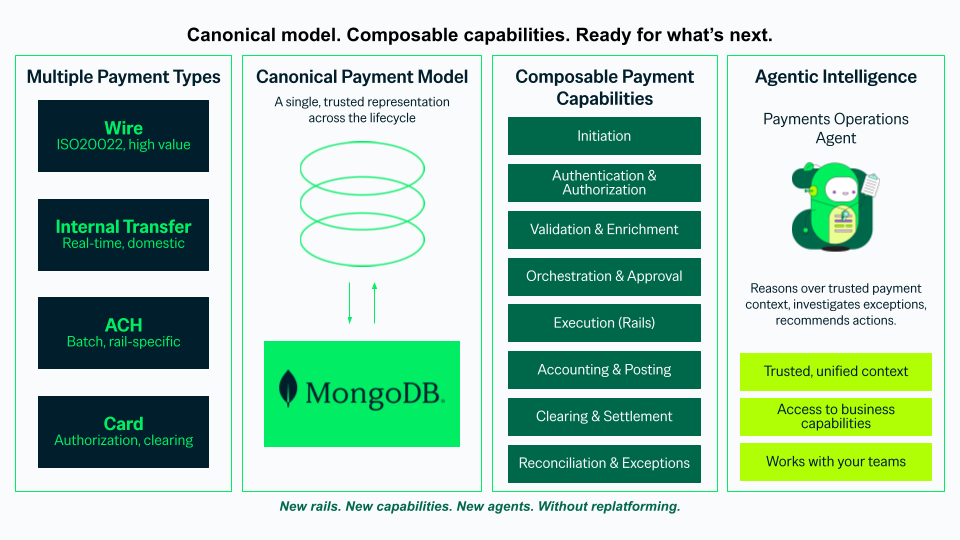
MongoDB isn't just where the payment sits. It's also the layer where the capability boundaries, the canonical representation, and the agent's context all meet—governed by the same access controls, encryption, and audit trail throughout.
How canonical payment context supports agentic operations
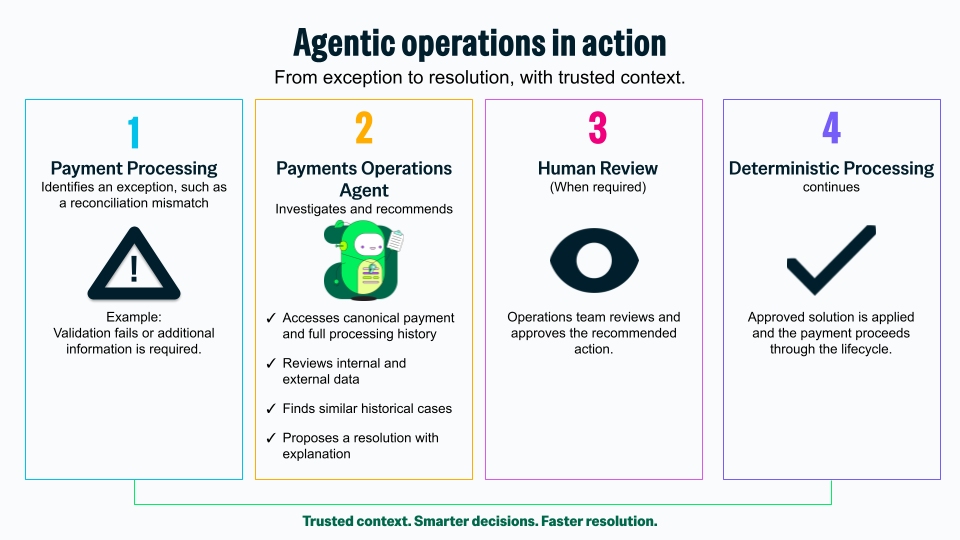
Banks have started exploring agentic AI for reasoning over payment information, investigating exceptions, and assisting operations teams, as noted above. Recall the cutoff exception from "orchestration." Once that event lands in the payment's context, a cutoff risk and exception management agent can read the canonical document and its history. At this stage, it can identify whether the delay reflects normal variance or a specific blocker such as a pending approval. It will then propose an action grounded in what actually happened and how much time remains—without creating a generic exception ticket. Human review stays in the loop where policy requires it, and once approved, the payment resumes through the lifecycle deterministically.
None of that works if the agent is reasoning over data it isn't authorized to see, or that isn't verifiably up to date; that’s a governance question we're treating in depth elsewhere. At the data layer, MongoDB Atlas encrypts and access-controls the underlying data. Every agent action is logged alongside the payment's own audit trail, allowing agent-assisted steps to be traceable the same way any other posting is.
Figure 2. Agentic payment operations.
How composable capabilities isolate future payment changes
The practical value of this approach is that change stays local. A wire and an internal transfer can share initiation, validation, and a canonical identity from day one, diverging only where the rail requires it. ACH and cards extend the model later without creating another silo. A cutoff risk and exception management agent scoped to wires today can be handed approved tools for reconciliation or broader exception analysis tomorrow, capability by capability, rather than through a platform rewrite.
The future of payments won't be defined by one rail, standard, or AI model. BIAN separates banking responsibilities into composable capabilities. The canonical model gives those capabilities a shared representation of payment intent and lifecycle. MongoDB provides the flexible, secure operational and agentic data foundation underneath both.
A modern payments architecture shouldn't only be designed to process today's payments. It should be designed for the future that is right around the corner.
Next Steps
Discover how financial institutions are modernizing payments with MongoDB.