For IT leaders evaluating sensitive or regulated workloads, data sovereignty can be explored through architecture and governance questions rather than treated as a single legal status. From a legal and policy perspective, the term should be treated as a market expression, not as a universally defined legal standard, certification, or conclusion about compliance. Data sovereignty refers to questions organizations may have about where data resides, who can access it, how it moves, and whether an organization retains meaningful control over it, especially across jurisdictions.
Depending on the organization’s circumstances, the assessment may include deployment location, access paths, encryption design, key custody, portability, operational resilience, support processes, and the treatment of associated metadata. These considerations and their relative importance can differ by country, industry, workload, contractual commitments, and risk posture. One practical question is therefore not whether a platform carries a universal “sovereignty” label, but which controls and operating boundaries an organization may want to evaluate for its own environment.
Europe illustrates why data sovereignty discussions cannot be reduced to storage location. GDPR (General Data Protection Regulation) is a data protection framework that can affect how organizations collect, use, protect, and transfer personal data. DORA (Digital Operational Resilience Act) addresses digital operational resilience and ICT (Information and Communications Technology) third-party risk for in-scope financial entities, while NIS2 (Network and Information Systems Directive 2) addresses cybersecurity risk and incident-related obligations for in-scope entities. These frameworks are different in purpose, scope, and application. They may influence how an organization evaluates deployment, access, encryption, operational resilience, portability, and evidence, but no conclusion is drawn here about their requirements or whether a particular architecture satisfies them. Organizations should assess the relevant legal and regulatory context with qualified counsel and their internal compliance teams.
Similar questions arise in other markets, although the relevant frameworks are not interchangeable. Examples include India’s DPDP (Digital Personal Data Protection) Act, China’s PIPL (Personal Information Protection Law), Brazil’s LGPD (Lei Geral de Proteção de Dados), and the UAE’s Federal Data Protection Law. These examples illustrate that organizations operating across APAC, LATAM, the Middle East, and other regions may need to consider different combinations of data protection, localization, transfer, cybersecurity, sector, and operational requirements. The existence or scope of a framework does not by itself establish a common global definition of data sovereignty, and no legal obligations are characterized here as applicable to any particular organization.
That context can become more complex when provider jurisdiction and potential extraterritorial access are part of the risk analysis. Laws such as the US CLOUD Act (Clarifying Lawful Overseas Use of Data Act), alongside data protection, cybersecurity, and operational resilience frameworks, illustrate why organizations may choose to design solutions that are secure, flexible, and measurable against their own data sovereignty objectives. The challenge is translating those objectives into an architecture whose controls and dependencies can be examined in practice. The next section explores that challenge, followed by five illustrative areas intended as a practical reference for evaluating architectures, not as a legal test, certification checklist, or guarantee of sovereignty.
The challenge: Translating sovereignty objectives into technical questions
Physical location remains an important consideration, but it is only one part of a broader control boundary. Who operates the service, who can access plaintext, where key custody sits, and whether management or support functions extend beyond the deployment region can all influence an organization’s assessment. An architecture addressing these questions may consider the full operating model, not just storage geography.
A jurisdiction-by-jurisdiction response can create parallel platforms, fragmented operations, and duplicated control processes. The architectural challenge is to support different levels of control without multiplying unnecessary complexity. A flexible platform model can give organizations options for evaluating placement, encryption, access governance, portability, and operational resilience according to each workload and risk profile.
Regulatory and geopolitical conditions can change over time, making it important to consider whether an architecture can adapt as an organization’s risk posture, provider relationships, or jurisdictional needs change. These pressures make the underlying architecture the next question: which capabilities can organizations evaluate to design a secure, flexible, and measurable approach to data sovereignty?
Key capabilities for sovereignty by design
To turn these ideas into practical design questions, the following sections explore five illustrative technical areas that organizations may evaluate when considering data sovereignty objectives. They offer one way to compare deployment options, understand trade-offs, and identify where technical, contractual, security, compliance, or legal review may be needed. This is a practical guide for architecture decisions, not a legal test, certification checklist, or guarantee of data sovereignty.
Figure 1. Core technical pillars of data sovereignty.
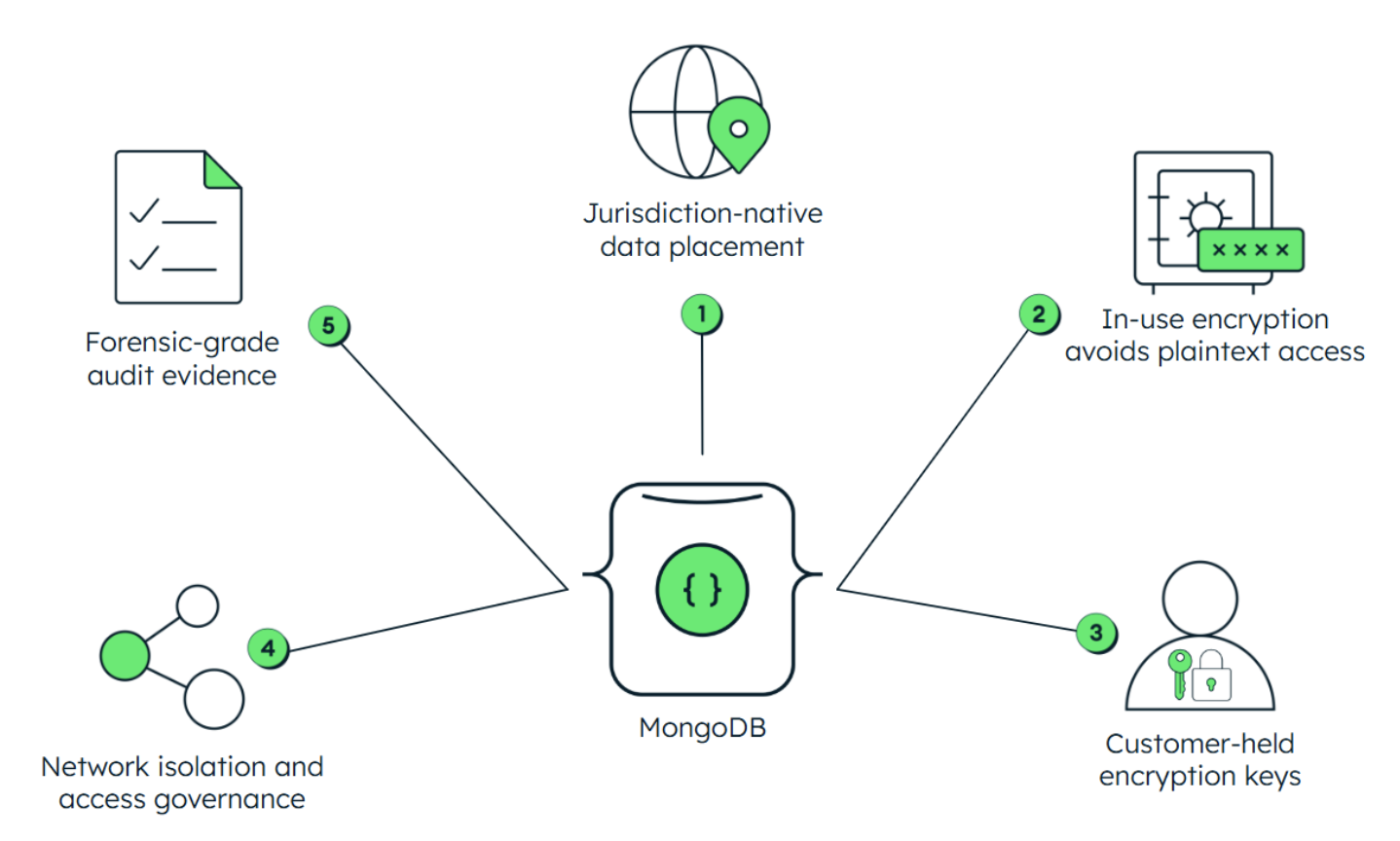
Jurisdiction-native data placement: Organizations may evaluate whether data-placement controls operate at the infrastructure layer, rather than only at the application layer. Relying on application code for regulatory requirements can lead to risks like misconfigurations, data being stored or processed outside the permitted jurisdiction, or unauthorized access to sensitive data. These issues can result in regulatory violations, reputational damage, and loss of customer trust.
In-use encryption that can reduce plaintext exposure: Encryption at rest and in transit is table-stakes. In-use encryption can protect configured PII (Personally Identifiable Information) and sensitive fields from plaintext access by the database server during supported query processing. This may reduce provider-level plaintext exposure for protected fields, depending on the encryption configuration, key-management model, and organization’s threat model.
Customer-held encryption keys outside the provider's reach: Keys accessible by the platform provider extend the provider's access to the customer's data. Key-management requirements and provider access controls depend on the organization’s deployment model, threat model, and stated requirements.
Network isolation and identity-based access governance: Private connectivity options, multi-factor authentication, federated identity, and least-privilege controls can be evaluated according to the deployment model and the organization’s access requirements.
Forensic-grade audit evidence: Organizations may evaluate whether authentication, access, configuration, schema, and key-management events can be captured and integrated with centralized security monitoring, subject to product configuration and scope.
How MongoDB capabilities can support the evaluation
MongoDB offers deployment options for different operational contexts. This article does not simply focus on workload portability. It outlines five sovereignty capabilities that enterprises can consider to evaluate platforms, while enabling teams to select the appropriate operating model for each jurisdictional risk profile:
MongoDB Atlas: Fully managed cloud database service, available in AWS, Azure, and GCP; MongoDB manages infrastructure, patching, and high availability.
MongoDB Enterprise Advanced (EA): Self-managed deployment for organizations seeking direct infrastructure control, including on-premises, private-cloud, and air-gapped environments.
MongoDB Community Edition: Open-source edition for development and evaluation workloads.
Atlas holds third-party certifications, including SOC 2 (System and Organization Controls 2), ISO 27001, PCI DSS (Payment Card Industry Data Security Standard), and a HIPAA (Health Insurance Portability and Accountability Act) Business Associate Agreement. It also provides public documentation and guidance on product capabilities, deployment considerations, and security controls to help organizations assess alignment with regulatory obligations such as GDPR, DORA, and NIS2.
Enterprise Advanced supports many of the same security and deployment control patterns, but the relevant certifications, attestations, and audit outcomes depend on the customer’s own infrastructure, operations, and assessment scope.
Jurisdiction-native data placement: Atlas enables strict technical boundaries for data placement by enforcing Resource Policies that block cluster creation outside approved regions at the platform level, regardless of who initiates the operation, while zone-based sharding automatically routes specific customer populations to designated geographic regions without requiring application changes. These platform constraints form a robust baseline for data residency, but achieving data sovereignty requires evaluating broader legal and operational dimensions, as it ultimately depends on how an organization defines sovereignty and the specific regulations to which it is exposed. Variables such as control plane dependencies, cross-region support access, cloud provider jurisdiction, and applicable frameworks like the US CLOUD Act must be individually assessed based on the organization's unique requirements.
In-use encryption: Atlas supports Queryable Encryption (QE) and Client-Side Field Level Encryption (CSFLE) as two in-use encryption approaches. Both can encrypt selected sensitive fields in the client before data reaches the database server. They can be used in the same application or deployment, but not together in the same collection. For configured encrypted fields, the database server receives encrypted values and cannot decrypt them without access to the relevant keys. While this technical control does not entirely resolve jurisdictional challenges like the US CLOUD Act on its own, as compliance depends on a broader set of governance factors, including key custody, metadata handling, control plane access, and organizational risk management, it serves as an effective mechanism to mitigate plaintext data exposure under strict extraterritorial disclosure requests.
Customer-held encryption keys: Atlas integrates BYOK (Bring Your Own Key) with AWS (Amazon Web Services) KMS (Key Management Service), Azure Key Vault, GCP KMS (Google Cloud Platform Key Management Service), and any KMIP (Key Management Interoperability Protocol)-compliant key management infrastructure. Key custody through the customer’s KMS ensures that encryption keys remain under the customer's control, providing audit evidence that bridges the gap between contractual commitments and technical enforceability.
Network isolation and access governance: Atlas provides private connectivity options, including Private Endpoints and VPC (Virtual Private Cloud) peering, that can reduce or avoid public exposure for database connections, subject to the deployment and supporting services. Role-based access control (RBAC), multi-factor authentication (MFA), and identity federation via LDAP (Lightweight Directory Access Protocol) and OIDC (OpenID Connect) govern all access at the platform layer.
Forensic-grade audit evidence: Atlas provides audit and activity evidence for relevant authentication, access, configuration, and security events, with integration into SIEM (Security Information and Event Management) platforms, subject to configuration and scope.
MongoDB Enterprise Advanced for customer-controlled and air-gapped deployment models: EA serves as an architectural option for organizations requiring direct control over their deployment environment, particularly when regulatory-defined infrastructure perimeters, complete network isolation, or self-managed control planes are preferred. While cloud-managed services satisfy many compliance standards, self-hosted deployments like EA provide the flexibility to operate within fully isolated networks or custom sovereign boundaries. This approach highlights the practical value of geopatriation, allowing organizations to maintain application continuity while shifting to a fully customer-governed operational boundary when specific legal or risk requirements demand it.
One critical caveat applies to all Atlas deployments: the Atlas control plane and the MongoDB support team, responsible for cluster provisioning, monitoring, and operational management, operate across a broader infrastructure footprint than the data plane. Organizations with requirements that restrict data or metadata movement may evaluate Enterprise Advanced and Atlas-specific configuration controls separately, together with technical and legal review of the relevant limitations. This illustrates the distinction between controls that support selected residency objectives and broader organizational objectives covering data, access, operations, and evidence.
Potential business considerations
When organizations address these considerations early in platform architecture, they may identify several potential operational and business benefits.
Faster market entry and reduced cost: Addressing placement, access, encryption, and evidence requirements early may simplify some procurement and architecture-review activities, depending on the organization’s requirements and implementation. A common platform with centralized monitoring, consistent encryption policies, and consolidated audit logging may reduce some operational duplication, although regional requirements may still require separate deployments or processes. A flexible architecture may make it easier to adapt as country-specific requirements, regulations, or provider relationships change.
Reduced operational overhead: A common operating model may reduce the need to maintain separate monitoring and incident-response processes, subject to workload and jurisdictional needs. The engineering capacity previously consumed by maintaining parallel regional clusters returns to product and AI feature development.
Accelerated AI delivery and defensible procurement posture: A consistent governance model may support data and AI initiatives across markets, subject to each workload’s access, transfer, and data-use requirements. An architecture that limits plaintext access for configured protected fields, applies an appropriate key-management model, and considers portability can provide a stronger basis for evaluating provider and jurisdictional risk. Application impact during a provider or deployment change depends on the architecture.
Final thoughts
Sovereignty objectives can be translated into observable technical and operational controls. If an architecture cannot demonstrate its placement, plaintext-exposure, key-management, access, and evidence controls, organizations may find it more difficult to assess the architecture against their stated objectives. MongoDB provides a practical path across managed and self-managed deployment models, but the differentiator is disciplined implementation: explicit control boundaries, control-plane-aware design, and evidence-backed operations from day one.
Disclaimer
This content is for informational purposes only and does not constitute legal advice. Regulatory requirements vary by jurisdiction and industry. Organizations should consult qualified legal counsel and their internal compliance teams to understand their specific obligations.
Next Steps
Schedule a strategy session with the MongoDB Industry Solutions team to discuss architecture considerations, evaluate your current environment against the five proposed technical lenses, and identify next steps with your technical, legal, and compliance teams.