Fraud has always been a behavioral problem. The signals that distinguish a genuine payment from a fraudulent one are rarely visible in a single field. Instead, they live in the pattern of how an account holder behaves over time: the merchants they frequent, the rhythm of their spending, and the sequence of events before and after each payment. Banks have known this for decades. The question has always been how to put it into practice.
Rules and hand-crafted machine learning (ML) features have been the industry’s answer, and they work—up to a point. They can only detect patterns that their designers thought to measure. As fraud evolves, those features go stale, requiring a new hypothesis, a new feature, and a retraining cycle before the model responds. And they are increasingly gamed by fraud rings who map the feature space and structure payments to stay just outside every threshold, indefinitely.
Behavioral vector embeddings address both problems directly. Rather than encoding a fixed set of hypotheses, an embedding model learns a representation of payment behavior straight from transaction sequences—surfacing patterns no analyst would have thought to engineer, adapting as fraud evolves, and forcing a fraudster to reproduce an entire behavioral history rather than simply dodge known thresholds. But a well-trained embedding model is only half the answer: those embeddings must be current, searchable, and highly available at the exact moment a payment decision is made. That is a data platform problem. In this post, we'll look at how behavioral embeddings are transforming fraud detection—drawing on production results from Stripe and Featurespace—and how MongoDB's unified operational and vector data platform lets institutions put them to work in real time, layered on top of the fraud models they already trust.
Payment transactions are not just rows
The value of behavioral embeddings for payment fraud is now well-evidenced. Yet a common objection persists: embedding models suit unstructured text, but payment transactions are just structured rows. In fraud, the signal is not in any single field. Instead, it lives in the behavioral pattern formed across fields and over time: amount, merchant, channel, device, counterparty, timing, and sequence. That cross-field, sequential structure is precisely what embedding models learn.
The industry has validated this directly. Stripe’s Payments Foundation Model is itself an embedding model. This self-supervised transformer is trained on tens of billions of transactions. It distills each payment into a dense vector representation, capturing behavioral context across sequences. When applied to card-testing fraud detection, it raised production detection rates from 59% to 97%[1]. Featurespace’s TallierLTM™ is likewise an embedding model. Its core product is an embedding API that converts a consumer’s full transaction history into a behavioral feature vector—a behavioral barcode in Featurespace’s own terms. Institutions then feed this vector into their existing fraud models, delivering up to a 71% improvement in fraud value detection.[2] Both examples prove that embedding structured payment transaction behavior is moving from isolated innovation toward broader industry practice.
2 ways behavioral vectorization reaches production
Behavioral vector embeddings reach production through two complementary approaches, each with distinct architecture implications.
Approach 1: Vector similarity search for risk decision
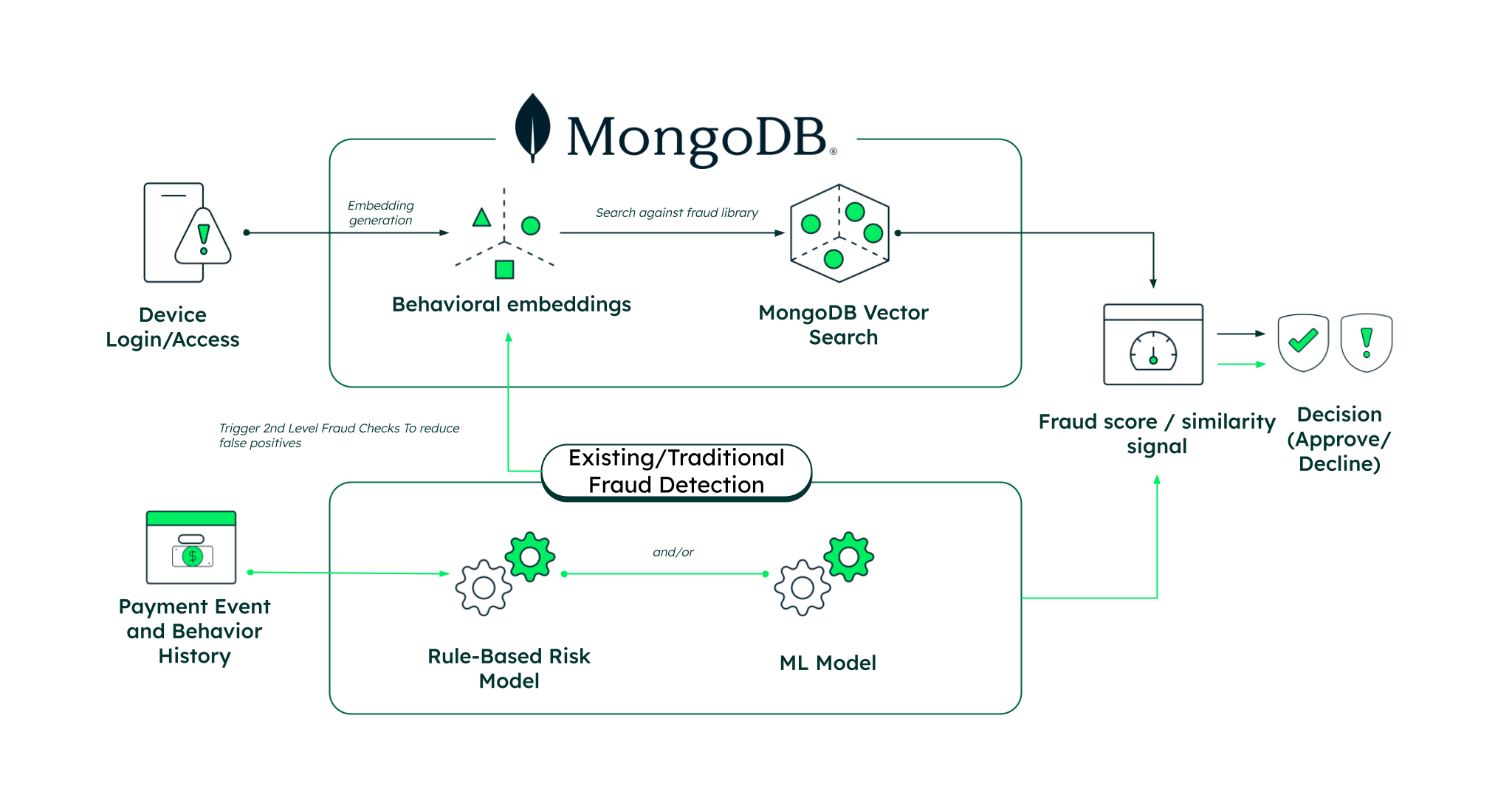
A direct approach is to encode each payment sequence as a vector embedding and run a vector search against historical fraud patterns. A variation is to apply vector search selectively, only after an upstream model raises an initial alert. In this step-up architecture, vector similarity acts as a secondary defense layer that helps reduce false positives without replacing the primary fraud decisioning path. This allows institutions to continue using existing trusted rules and models while avoiding the performance overhead of generating embeddings for 100% of transaction volume. Because MongoDB supports operational and vector data in one platform, institutions can store payment events alongside their embeddings, index them, and return similarity scores with low enough latency to inform the fraud risk decision.
Approach 2: Enriching existing fraud models with behavioral embeddings
A foundation model pre-trained on payment transactions generates behavioral embeddings. These embeddings are added as enriched input features to an institution’s existing fraud model without replacing it. This is the pattern at work in Featurespace’s ARIC™ Risk Hub, the fraud risk engine that powers TallierLTM™ in production and uses MongoDB as a core data store component for real-time feature serving. The embedding API converts a consumer’s payment history into a behavioral feature vector that plugs into whatever fraud model the institution already runs. Stripe’s Payments Foundation Model[1] uses both approaches. Its embeddings feed a model for direct attack detection and are also exposed as enriched features for existing task-specific models across its risk stack.
Both approaches require the same thing: behavioral embeddings that are current at the moment the payment decision is made. That is the data platform constraint—and it is arguably more consequential than the model itself. A well-trained model running on stale data produces decisions that reflect how a customer behaved days ago, not now. The model cannot compensate for what the data platform fails to serve.
Why the data platform is the critical fraud architecture decision
Most fraud stacks fragment the payment record, behavioral features, and vector embeddings across separate systems synchronized on pipeline schedules. Each boundary is a freshness gap: a fraud decision based on a behavioral baseline updated hours ago is not a behavioral decision. The synchronization lag is not a configuration detail—it is a detection gap.
A unified operational and vector data layer
MongoDB [3] addresses this by keeping payment data, behavioral embeddings, and customer payment history in the same operational data foundation—without a separate ETL-synchronized vector store. Because MongoDB Vector Search runs natively against live data, new transactions and embedding updates are indexed automatically in near real time rather than on batch pipeline schedules. Existing rule engines and ML models remain the first-pass filter; MongoDB Vector Search activates on escalated payments, contextualizing the upstream alert rather than overriding it. MongoDB’s aggregation pipeline combines similarity scores with structured payment signals in one query before the decision is returned.
Availability and resilience for payment-grade workloads
A fraud system that goes offline or becomes impaired when a payment is in flight forces an impossible choice: block everything or pass everything unchecked. MongoDB is designed for this constraint. Multi-region global clusters and automatic failover keep fraud detection online across zone and regional failures, backed by a 99.995% uptime SLA. Dedicated search nodes isolate vector search from the operational payment write path, so a spike in fraud query volume cannot compete for resources with payment processing. Zero-downtime rolling upgrades mean index updates require no maintenance window—an increasingly untenable concept for payment platforms operating across time zones.
The compounding feedback loop
Every confirmed fraud case improves the embedding index; every cleared payment updates the behavioral baseline. In a fragmented architecture, this loop runs on pipeline schedules—days of lag between a confirmed pattern and its propagation to the detection layer. In a unified data model, it is continuous. At scale, the difference is a sustained exposure window versus a system that gets sharper with every decision it makes.
In production: two fraud architecture decisions
The architectural patterns above are not theoretical. A leading digital bank in Southeast Asia—serving millions of consumers and businesses through an all-in-one payments and banking app—deployed them across two distinct fraud challenges, both built on MongoDB Vector Search.[3]
Device fraud: From blacklists to behavioral fingerprints
Rule-based device blacklists are defeated by design: block a device ID, and the fraudster rotates. The institution needed to recognize the behavioral signature of a fraud tool—hardware attributes, OS signals, sensor patterns, and interaction timing—rather than maintain a list of known identification tags. Device metadata is encoded into vector embeddings and indexed in MongoDB Vector Search. At each login or payment registration event, incoming embeddings are compared against the library of known fraudulent fingerprints; near-variant matches are surfaced automatically. The system’s response to a new evasion technique is a new data point in the index, not a rule update.
Payment fraud: reducing false positives with behavioral context
With device fingerprinting in production, the institution turned the same architectural approach to one of the most persistent challenges in payment fraud detection: false positives. Their existing ML model caught genuine attacks but flagged enough legitimate payments to create customer friction and analyst overhead—it lacked the behavioral context to distinguish an unusual payment by a genuine account holder from a fraudster on a stolen account.
MongoDB was layered on top of the existing ML model rather than replacing it. When the model raises an alert, the system retrieves the customer’s recent payment history. Because this data is stored as a time-ordered sequence in the same operational data foundation as the current payment, it requires no cross-system retrieval. The system then passes that window to an embedding service. MongoDB Vector Search compares the resulting vector against an indexed library of known fraudulent payment sequences within the sub-second SLA. A payment that matches the account holder’s own behavioral baseline is treated differently from one that matches a known fraud sequence—reducing false positives without softening the detection threshold on genuine attacks.
Figure 1. Real-time fraud-detection architecture with MongoDB.
The pattern is already there. Now it is visible.
The payment data every institution needs is already in its systems. The question is whether the data platform can serve that information at the exact moment a decision is required. It must deliver current embeddings, live operational payment states, and behavioral context with the high availability that payment infrastructure demands. MongoDB provides that foundation: a unified, always-on layer where the vector index, the payment record, and the decision logic share the same live data. Fraud teams seeing the largest gains have stopped treating the database as a passive store. Instead, they treat it as an active layer in the payment decisioning pipeline.
References
[1] Using AI to optimize payments performance with the Payments Intelligence Suite
[2] TallierLTM: The World's First Large Transaction Model—Featurespace
[3] Fraud Prevention and AML using MongoDB Atlas Vector Search—MongoDB Docs