Smart grids are getting smarter. Millions of connected meters, batteries, and electric vehicle chargers now talk back to the systems that run the global grid, and that two-way flow is exactly what makes demand response, distributed energy resources (DER), and real-time balancing possible. It's also what makes this interconnected grid a bigger target than ever before.
Most smart grid security conversations stop at the wire. Standards like IEC 62351 do brilliant work locking down the communication protocols behind substation automation, authenticating every device, and encrypting every message between a meter and a control center. It’s a necessary, genuinely global standard, but it's not enough. Every reading, every dispatch signal, and every charging session that those protocols protect in transit still need to live within a database. These platforms get queried every day by billing systems, DER management platforms, and increasingly, AI copilots built to help operators make sense of it all.
That's where MongoDB Queryable Encryption comes in. It closes the gap between "secure in transit" and "secure while it's actually being used," and it does it without asking your teams to give up the queries they depend on.
Encryption stops at the wire, but your data doesn't
IEC 62351 secures the protocols behind IEC 61850, the standard your substations and control centers use to talk to each other. It handles authentication, authorization, and message integrity, and it does that job well wherever your grid operates. But once telemetry lands in your data platform, IEC 62351 relinquishes any security. From that point, it is your responsibility—not the protocol’s—to protect any querying.
That's a real gap, and it's exactly what attackers look for. A compromised admin account, a misconfigured service, or a subpoenaed cloud provider doesn't need to break a communication protocol. It just needs to read your database.
Regulators around the world already see this gap, too
No single region owns this problem, and no single rulebook solves it. In North America, the North American Electric Reliability Corporation's Critical Infrastructure Protection standards (NERC CIP) mandate cybersecurity controls for the bulk electric system. Further, California's Public Utilities Commission has its own privacy rules specifically for smart meter data, since a household's usage pattern can reveal far more than kilowatt hours. In the European Union, the Network and Information Security Directive 2 (NIS2) puts energy among its most critical sectors and calls out metering infrastructure by name, while the General Data Protection Regulation treats granular meter reads as personal data outright.
Beyond these regional mandates, several specialized frameworks can help utilities translate high-level obligations into practical security controls. For industrial control systems and operational technology (OT), the IEC 62443 series provides a relevant foundation for securing industrial systems, components, and their lifecycle. For smart grid-specific cybersecurity and privacy guidance, the NIST Interagency/Internal Report (NISTIR) 7628 Revision 1, Guidelines for Smart Grid Cybersecurity, offers a dedicated, non-mandatory framework for assessing risks and identifying appropriate security requirements. ISO/IEC 27019 complements broader ISO/IEC 27001-based programs with information security controls tailored to energy utility environments.
Different regions, same conclusion: Your platform to multiple regulators at once, all converging on the same requirement to protect this data where it's actually used, not just where it travels. These frameworks strengthen the case for minimizing plaintext exposure, enforcing least privilege, and demonstrating resilience—all of which queryable encryption can support.
What queryable encryption actually gives you
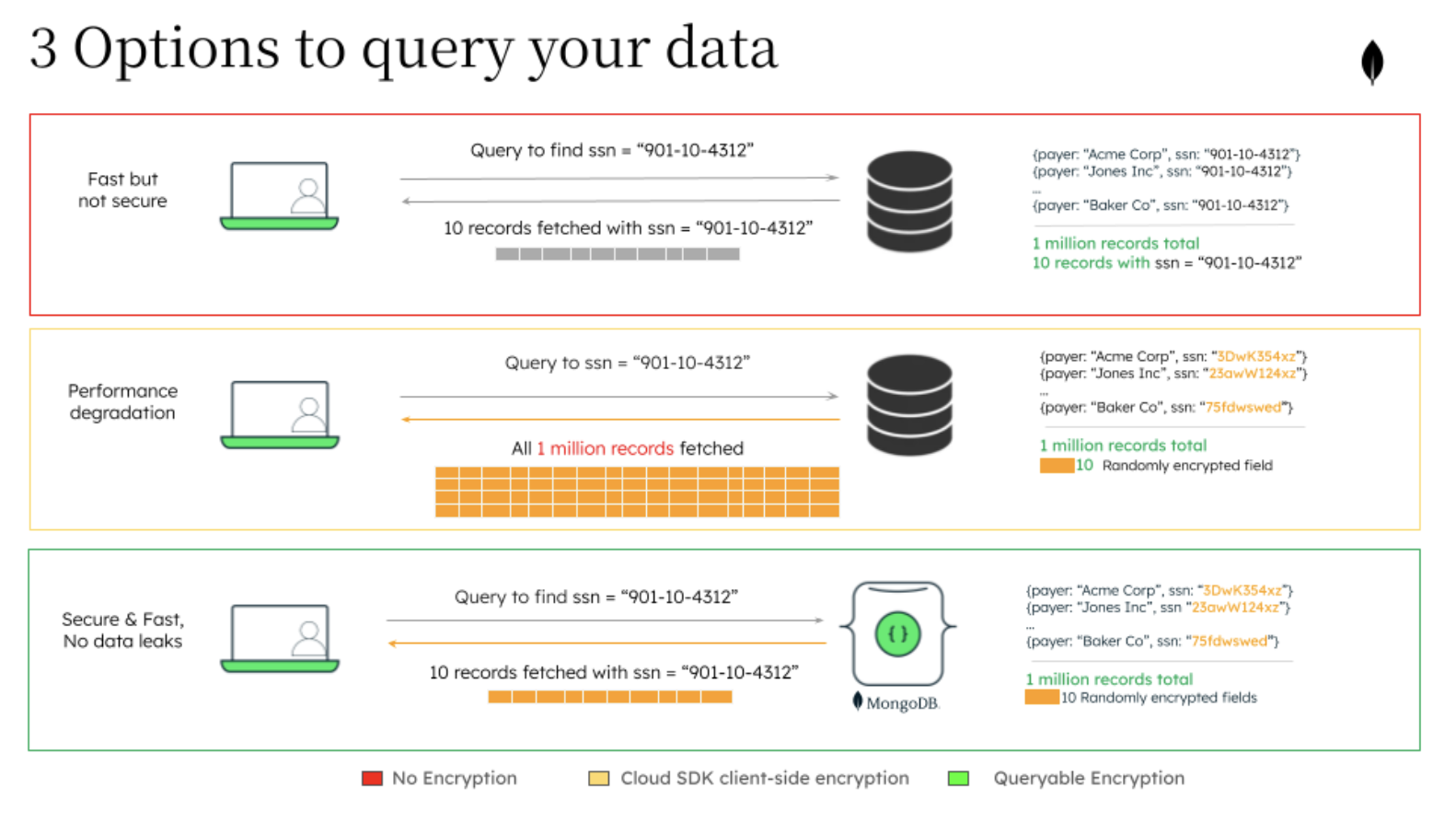
Encrypt sensitive fields on the client side, store them as fully randomized ciphertext on the server, and run equality and range queries directly against that ciphertext. MongoDB never sees the plaintext values it's operating on. Only your client, holding the keys, ever decrypts anything.
That's a genuinely different guarantee than encryption at rest. A breach of your database doesn't hand over readable data, because there's nothing readable to hand over. Your DBAs, your cloud provider, and MongoDB can all keep the database running without ever needing plaintext access to what sits inside.
Two setup paths get you there. Automatic encryption lets your driver handle encryption and decryption behind the scenes, supporting selected query patterns. That includes equality and range queries on specifically configured encrypted fields. Explicit encryption puts your application in direct control, which is the right call for the small number of fields where you need to prove separation of duties, rather than just assume it’s true.
MongoDB Queryable Encryption is even stronger when encryption keys are governed by customer-controlled key management, such as a cloud key management service (KMS) or hardware security module (HSM), so that database operations and key custody remain separate.
Figure 1. How Queryable Encryption makes querying your data both fast and secure.
Where queryable encryption earns its place on your grid
Smart meter data. The mapping between a meter ID and a household is the clearest case for encryption. Query consumption ranges for billing or tariff segmentation without that mapping ever existing as plaintext on your server.
DER and battery telemetry. Dispatch instructions and state-of-charge data can expose a fleet's operating strategy to anyone who can read them. Range queries on encrypted telemetry keep your dashboards and anomaly detection running without exposing that strategy to every service touching the stream.
EV charging sessions. A charge point, a timestamp, and a payment identity quickly add up to personal data, and that surface only grows as charging networks scale worldwide. Encrypted range and equality queries keep billing and roaming settlement working exactly as they should.
Cross-border and cross-utility data sharing. Data moving between distribution operators, transmission operators, and regional coordination bodies—whether that's Europe's CACM framework, a North American reliability coordinator, or an equivalent body elsewhere—constantly crosses organizational boundaries. Encryption that travels with the data holds up far better than perimeter security that stops at your firewall.
This transcends compliance
Grid security has become a national security question around the world. In the United States, CISA, the NSA, and the FBI have warned that state-sponsored actors known as Volt Typhoon have pre-positioned themselves inside U.S. critical infrastructure, including at least one confirmed electric utility, with the stated goal of disruptive access during a future crisis. In Europe, the European Initiative for Energy Security's ESLC-Europe advisory council (former defense chiefs, energy ministers, and sitting executives from companies like Equinor and Fortum) has framed energy strategy as a pillar of rebuilding European deterrence. No matter the location, the same underlying pattern exists: grid data and grid access are now treated as strategic assets, not just operational ones.
Guaranteeing that no single compromised account, vendor, or legal order can expose plaintext operational data—while the systems that need it can still freely query—isn't just good practice. It's a resilience property that deserves a place on the same list as redundancy and physical hardening when you're designing for the long term, regardless of the grid you aim to secure.
The bottom line
IEC 62351 secures the wire. NERC CIP, NIS2, and their regional equivalents set the bar for how you govern your organization. None of them, however, protects your data in the event of a breach. Queryable encryption can make stolen database contents unreadable when protected fields remain encrypted, and keys are kept outside the attacker’s reach. Build QE into your smart grid architecture now, wherever your grid operates, and you close a gap that most platforms still leave wide open long after the network and governance layers are already locked down.
Next Steps
Grid security doesn't stop at the wire. Build a more resilient smart grid today by ensuring your sensitive telemetry and consumer data remain protected—even while in use. Explore MongoDB's Queryable Encryption documentation to learn how to integrate these protections into your architecture. Or, check out our quick start guide to start testing with your own data.