LAUNCHMongoDB 8.3 is built for the sub-100ms retrieval & zero downtime AI demands. Read blog >
AI DATAStop fighting your data layer. Get the memory & retrieval agents need to scale. Read blog >

What is Embedded Analytics?

Try Atlas Free

Businesses need analytics that can give more actionable insights in real-time—for example, an instant alert message when the number of users accessing your website reaches one million.

Traditional BI was great for static dashboards and reporting. However, satisfying modern business requirements required a more interactive approach, which led to the popularity of self-service BI. Over time, analytics matured drastically from being just a basic reporting component, a standalone reporting and dashboard component, to an infused (embedded) component into the application workflow itself.

An image of an Embedded Analytics Maturity Model

From separate workflows to analytics integrated in the application itself, embedded analytics has come a long way.
Embedded analytics lets you view data analytics inside of an enterprise business application through interactive dashboards and reports, removing the need to switch to a separate application.

How?

Embedded analytics integrates intelligence and visualization inside your applications and workflows for a more proactive analytical and visual experience through:

  • Interactive reporting in the form of tables with filters and scheduling options.
  • Charts and dashboards for displaying performance metrics.
  • Mobile reporting for better functionality on mobile devices.
  • Comparing current performance metrics and best practices for benchmarking.
  • Ad-hoc querying and self-service to explore datasets and create custom reports and dashboards.
  • Creating visual workflows using a drag-and-drop interface.

There are many ways in which reports and dashboards can be integrated into an application—for example, via an iframe, API, or a plugin. Modern data platforms like MongoDB support highly valuable embedded analytics.

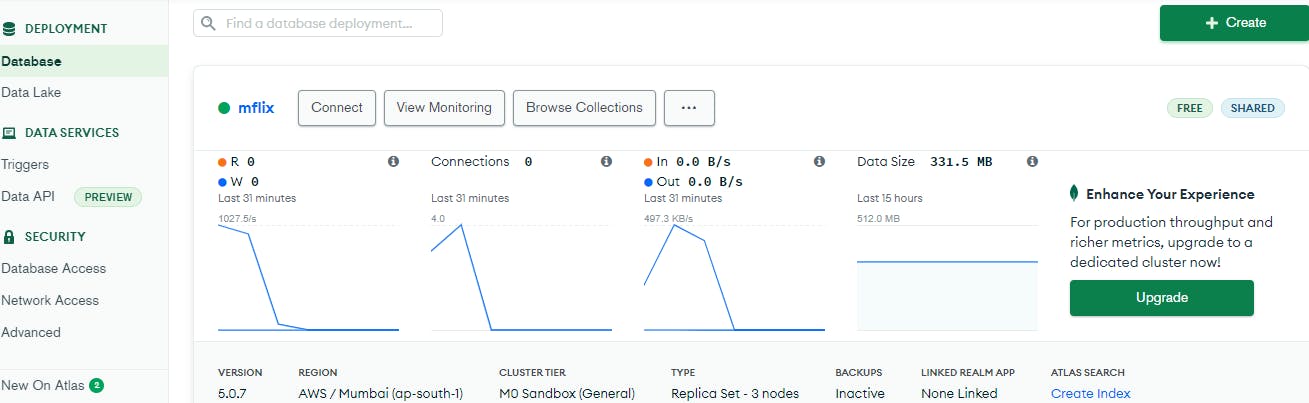
An example of embedded metrics is the Atlas UI. In the following image, you can see how users can get real-time information about their cluster status metrics—like reads, writes, connections, and data size—inside the Atlas interface itself.

An example of an embedded analytics dashboard


With this kind of real-time monitoring, you have more chances to quickly rectify any glitches and also offer a better user experience based on their behavior.

You can create a free Atlas cluster today to see it live.

Why is embedded analytics important for business?

With standalone or traditional analytics, application and analytics are in a different environment, and there need to be dedicated people with data-handling expertise. Embedded analytics gives users relevant and timely insights within their application workflow. Businesses are able to use the data more effectively for improving sales and service. Embedded analytics is important because of its capability to:

  • Discover and prepare data, and build interactive reports, dashboards, and visualizations.
  • Provide a better user experience by showing customized content.
  • Make strategic business decisions based on the analysis.

Embedded analytics provides self-service capabilities, customized UX elements, click events, and predictive analysis capabilities to business users.

With embedded analytics, data access can be restricted via custom applications, thus ensuring security.

Various industries—including financial services, technology, retail, manufacturing, healthcare, business services, and education—use embedded analytics for internal as well as commercial purposes. For example, a company’s IT department may use embedded analytics to improve operations, while a customer may use it to drive more website traffic and offer product discounts.

Benefits of embedded analytics

Embedded analytics has something to offer everyone—developers, business analysts, stakeholders, and even end-users. From an enhanced user experience to increased profits, you get a lot from embedded analytics.

  • Competitive advantage: Embedded analytics has expanded its wings to many domains today. For example, adding tools and plugins to websites helps businesses understand the usage patterns of their customers and suggest similar content. This means increased personalization and more potential customers.
  • Data-driven strategic decisions: As the number of people who use digital media for educational and transaction purposes is increasing, it makes sense to make use of all of that data in the best way possible. With embedded analytics, you don't have to go outside the application. All the insights you need are in one view for you to make quick strategic decisions.
  • Increased sales and profits: The most common example of this is product recommendations and customized offers and discounts. Embedded analytics also enables real-time monitoring, allowing, for example, support teams to better understand the difficulties faced by customers in placing their order, or if they have items left in their cart, and so on.
  • Get more value from data: Having analytics embedded into existing applications gives users in-context data insights within the existing platforms, rather than learning a new analytics platform. Also, most embedded analytics tools provide self-service intelligence capabilities, thus making life easier for developers and analysts.

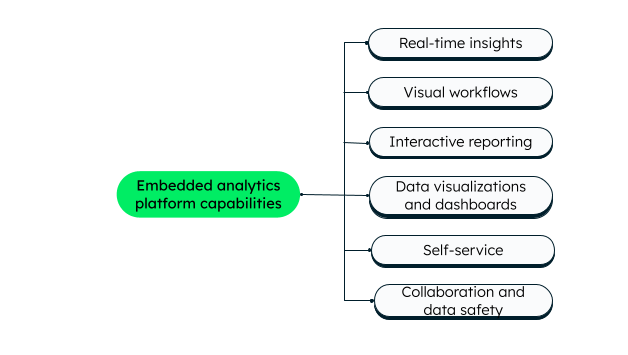
Embedded analytics platform capabilities

Embedded analytics platforms have many capabilities. Advanced tools even support augmented analytics that mostly rely on artificial intelligence and automated analytics. Some common capabilities of embedded analytics platform are:

An image depicting the capabilities of an Embedded Analytics Platform


Core capabilities of embedded analytics platforms

Use cases for embedded analytics

Some of the effective embedded analytics use cases are:

  • Consolidating data from multiple sources, and integrating and filtering data to get the desired reports and insights—for example, event management systems and patient health records.
  • Better visualizations and immediate access to fresh (real-time) data, enabling quick and informed decision making. Examples are accounting services, failed transactions, and fraud detection.
  • Intuitive dashboards with desktop and mobile access allowing users to drill down data from anywhere, at any point, visualize and create reports on the go, and collaborate easily. Examples are financial services and team collaboration.
  • Increased efficiency, reduced time to market for products, increased user adoption for analytics, fewer errors, and intuitive UI, allowing for faster release of products and services—for example, new features on a website and developing a new product using agile methodologies.

Embedded analytics is finding applications in many domains like supply chain management, logistics and shipping, banking and finance, software and technology, and event management. Modern data platforms like MongoDB have a flexible schema and offer a powerful aggregation framework. This means you can:

With MongoDB Atlas, you can access updated data anywhere across the world over the cloud and get real-time insights to make strategic business decisions.

FAQs

Get started with Atlas today

Get started in seconds. Our free clusters come with 512 MB of storage so you can play around with sample data and get oriented with our platform.
Try FreeContact sales
GET STARTED WITH:
  • 125+ regions worldwide
  • Sample data sets
  • Always-on authentication
  • End-to-end encryption
  • Command line tools