LAUNCHMongoDB 8.3 is built for the sub-100ms retrieval & zero downtime AI demands. Read blog >
AI DATAStop fighting your data layer. Get the memory & retrieval agents need to scale. Read blog >

What is Agile Development? A Beginner's Guide

Get Started Free

Agile methodology is a widely used set of practices and principles for software development and project management that focuses on accelerating the delivery of value to customers through an iterative approach to development.

Agile is designed to allow teams to respond to unpredictability through incremental, iterative work processes known as sprints. Usually, agile software development includes small, self-organizing teams of software developers and business stakeholders who meet regularly during the software development lifecycle to deliver small pieces of working software in short bursts called "sprints."

Table of contents

Agile: A methodology and a mindset

While Agile is often described in terms of methodologies like Scrum or Kanban, at its core, Agile is about adapting to change and continuously improving. It encourages teams to learn through the process of work, to self-organize while collaborating on problems, and to reflect on successes and failures to improve continuously. In this sense, Agile is also considered a mindset and an ability of individuals and teams to respond to changes and uncertainties.

An Agile methodology optimizes for a software development lifecycle that recognizes changes are a normal part of a fluid environment, adapts to them, and provides sustainable solutions.

For development teams, one of the primary benefits of agile is it promotes business agility and delivers faster time-to-value, better software quality, and, as the name implies, greater flexibility and adaptability to change. Agile practices cut down on extensive planning stages and fixed development cycles, enabling businesses to respond quickly to new requirements.

Overview: The Agile software development process

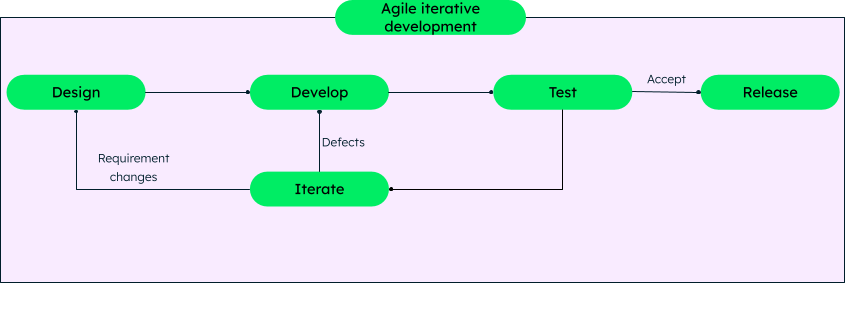
Agile software development ensures an iterative, outcome-focused approach to building software. Agile methods revolve around iterative and incremental processes where design, development, and testing happen in cycles. Each cycle, or "sprint," delivers a piece of the software, allowing for regular feedback and adjustments based on user experience and stakeholder input.

The three stages of the Agile software development process

The agile development typically includes three stages:

  1. Iterative design and development
  2. Continuous integration and testing
  3. Regular adaptation to feedback

Iterative design and development

Each sprint starts with a planning phase where goals are set based on priorities that align with business objectives and user experience goals. The short cycles facilitate frequent reassessment of project direction, a critical feature for adapting to change rapidly. (Agile is like imagining you’re trying to hit a moving target: You check where it is, close your eyes, and run toward it. When you open your eyes, you often find the target has shifted. However, the more frequently you open your eyes to reassess, the better you can adjust your direction and ultimately reach the target efficiently.)

Teams release software features at continuous intervals in an iterative manner, and requirements evolve as the software is delivered and tested. This approach is more efficient when compared to the traditional approach of rigorous planning and fixed linear stages.


Agile development
Agile development process where design, development, and testing happen iteratively

Continuous integration and testing

Agile promotes the development and testing of software in smaller pieces, allowing teams to identify and address issues promptly, thus maintaining a high quality of software throughout the development process.

Regular adaptation to feedback

Continuous collaboration with customers throughout the development cycle is pivotal. It ensures that the development process is aligned with customer needs and expectations, making it possible to adjust quickly to feedback and changes.

The Agile Manifesto, Agile core values, and Agile core principles

The Agile Manifesto, created in 2001 by 17 software developers, emerged from a desire to find a better way to develop software. The developers sought a better approach to lightweight development methods, driven by their shared dissatisfaction with the traditional, heavily regulated, and plan-driven methodologies like Waterfall.

The result was the Agile Manifesto, which outlined four core values and 12 guiding principles that emphasize flexibility, collaboration, and the delivery of high-quality software.

Note: Prior to the Agile Manifesto, methodologies like Kent Beck’s Extreme Programming (XP) had already pushed the boundaries of software development practices in the late 1990s, advocating for principles that would later be embraced by the Agile community. XP even went beyond what was accepted later in the Agile Manifesto, highlighting the evolving attempts to refine and improve software development methodologies.

3 core values of Agile

Outlined in the Agile Manifesto, the core values of Agile development emphasize include:

  1. Individuals and interactions over processes and tools.
  2. Customer collaboration over contract negotiation.
  3. Responding quickly to change rather than following a rigid plan.

Individuals and interactions over processes and tools

Although tools and techniques might be effective in speeding up the development cycle, they are of no use if placed in the wrong hands. More team collaboration and regular meetings ensure everyone is on the same page. Agile prioritizes personal interaction and collaborative teamwork over strict adherence to tools and processes. This focus enhances transparency and aligns team efforts toward common objectives.

Customer collaboration over contract negotiation

Businesses and their markets are ever-evolving and so, a fixed plan may not always work. As business grows, demands and goals will continually change for good. Businesses should be flexible to quickly adapt to new changes and respond positively. Involving stakeholders throughout the project lifecycle, Agile values customer collaboration above strict adherence to contract terms. This flexibility facilitates beneficial adjustments and enhancements during the project.

Responding quickly to a change rather than following a rigid plan Businesses are ever-evolving and so, a fixed plan may not always work. As business grows, demands and goals will continually change for good. Businesses should be flexible to quickly adapt to new changes and respond positively. Agile teams are highly adaptive, recognizing that responsiveness to change can lead to significant product improvements and higher customer satisfaction.

The 12 principles of Agile software development

The 12 principles behind the Agile Manifesto offer more detailed guidance on implementing Agile in day-to-day operations. They include:

1. Our highest priority is to satisfy the customer through early and continuous delivery of valuable software.

The first principle of Agile makes clear that the primary focus is customer satisfaction.

Software development takes time, costs money, and exists to meet customer needs. Sooner equals better: The goal of Agile is to generate high-value applications early and often.

2. Welcome changing requirements, even late in development. Agile processes harness change for the customer's competitive advantage.

The second principle of the Agile process recognizes that the only thing permanent in business is change, so adjustments and modifications to application requirements should be expected and welcomed, even in the late stages of development. The last thing users and customers need is software that's outdated or irrelevant upon arrival.

3. Deliver working software frequently, from a couple of weeks to a couple of months, with a preference for the shorter timescale.

This principle underscores the importance of iteration and accelerated time-to-value. It's never too early to generate value, which is why Agile focuses on a time frame of a couple of weeks to a couple of months. Think smaller releases, more often.

4. Business people and developers must work together daily throughout the project.

Agile emphasizes overcoming traditional silos and barriers to smooth collaboration between the development and business sides of the house. The fourth principle recognizes that misunderstandings are resolved before they can find their way into code, and feedback comes quickly enough to avert problems before users ever see them.

5. Build projects around motivated individuals. Give them the environment and support they need, and trust them to get the job done.

Projects are only as good as the people who work on them — and software development is a case in point. Developers whose skills are empowered by the right training, environment, tools, and management support will naturally create successful projects.

6. The most efficient and effective method of conveying information to and within a development team is face-to-face conversation.

The sixth Agile principle acknowledges the importance of clear, direct communication.

In other words, the best and most productive interactions are one on one. With modern tools like Zoom, Skype, and Teams, distributed teams can and should collaborate face-to-face over distances and time zones.

7. Working software is the primary measure of progress.

If there's one Agile rule that stands above all the rest, it's the seventh principle: That progress is measured not by models, analysis, or flowcharts — but by a real, live, functioning product. When following an Agile development process, the mantra is always: Working software is the primary measure of progress. Note: It’s understood that software that passes tests is considered working software.

8. Agile processes promote sustainable development. The sponsors, developers, and users should be able to maintain a constant pace indefinitely.

The essence of the eighth Agile principle is continuity. Agile is about ongoing exertion, not one-time spurts. When successfully employed, its processes facilitate workflows that are consistent and sustainable over the long term.

9. Continuous attention to technical excellence and good design enhances agility.

Undeniably, Agile puts a premium on rapid development, but not at the expense of good design and technical quality. A mediocre product won't fully meet user needs no matter how fast it gets delivered. That's why the ninth principle acknowledges the critical cross-functional collaboration that Agile promotes: Agility must be counterbalanced with a focus on quality and user experience.

10. Simplicity — the art of maximizing the amount of work not done — is essential.

The tenth Agile principle defines simplicity as “the art of maximizing the amount of work not done.” This means, among other things, eliminating outmoded procedures, favoring automation over manual processes, using macro libraries where available, and in general, taking the most direct route to each given objective. Simplicity is essential.

11. The best architectures, requirements, and designs emerge from self-organizing teams.

The eleventh Agile principle understands that good developers work best when they feel ownership in the work product. According to Conway’s Law, the design of a system will mirror the communication structures of the organization that built it. Therefore, a key enabler for effective development rests with management. Higher-ups must trust the team to organize its efforts, consult with business stakeholders, and dive into coding — free from over-control or micro-management.

12. At regular intervals, the team reflects on how to become more effective, then tunes and adjusts its behavior accordingly.

The twelfth agile principle acknowledges the fact that no individual or group makes perfect decisions all the time. There's always room for improvement. This makes it imperative for Agile teams to periodically assess, optimize, and fine-tune their efforts. Often this is called a “retrospective” or, in the case of a failed project, a “post-mortem.”
Key concepts in Agile software development

Agile methodologies include a range of concepts foundational to Agile frameworks, including:

  • Scrum: Scrum is the most popular Agile framework where a project is divided into smaller iterations called sprints. Each sprint is a short, time-boxed period typically lasting from two to four weeks, during which specific project tasks designated as user stories are completed. The framework emphasizes role definitions (Scrum Master, Product Owner, and Team Members), ceremonies (such as sprint planning, daily scrum, sprint review, and sprint retrospective), and artifacts (like product backlog, sprint backlog, and increments), fostering an organized and predictable project environment.

  • Sprint: Central to the Scrum framework, sprints are the fundamental units of development. They are designed to provide a clear timeline for when work must be completed and reviewed. Sprints facilitate a consistent development pace and allow teams to incorporate feedback quickly, making adjustments to the product in a controlled manner.

  • User stories: A user story is a concise, simple description of a software feature from the perspective of the end-user. (Note: The same application may have more than one end-user — e.g., YouTubers who create videos and people who watch them.) It helps to focus development on user needs and is often written in the format: “As a user, I want to see the total time spent on the website before I click the logout button.”

  • Daily stand-up: This is a quick, daily meeting, often limited to just 15 minutes, where each team member summarizes what they did the previous day, what they plan to do today, and any impediments they're facing. The daily stand-up enhances team communication and quickly identifies blockers that could impede the project's progress.

  • Incremental development: In incremental development, small portions of software are delivered in phases. This method helps to detect issues early on and integrate feedback more effectively, ensuring a more tailored and user-approved final product.

  • Iterative development: In an iterative development approach, software is built and released in successive refinements. Unlike incremental development, where each delivery is a part of the whole, iterative development might rework previously delivered software based on feedback. This approach is highly responsive to change and can evolve to meet changing business and user requirements.

  • Milestone: Milestones are specific, planned events along a project timeline that signify the completion of a key phase of work. They are checkpoints that help track progress, evaluate the project's health, and align team expectations. Milestones are often used in project planning to signal important achievements and are critical for phased assessments and reviews.

  • Retrospective: A retrospective is a meeting that takes place at the end of every sprint to reflect on what happened in the sprint and identify actions for improvement going forward. It's a chance for the team to discuss what worked, what didn't, and how processes could be improved to make future sprints more effective.

  • Business agility: Business agility refers to the ability of an organization to adapt quickly to market changes, integrate feedback from stakeholders, and manage evolving priorities with ease. Agile methodologies contribute to business agility by shortening the feedback loop between product releases and customer responses, allowing companies to more rapidly respond to opportunities and threats.

The Agile methodology

The set of principles and practices that a team decides to follow form the Agile methodology for the team. The methodology is always based on the core values and principles but can be tailored to specific project requirements.

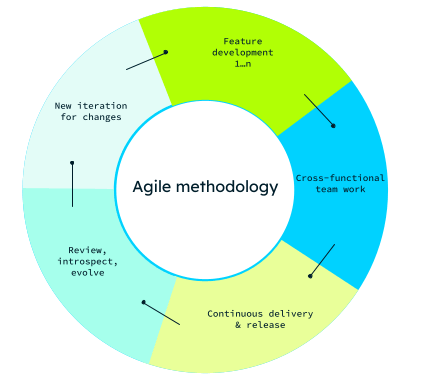
Agile processes and methods emphasize:

  • Feature development: Split the project into small tasks (or features) and start development with the available information.

  • Cross-functional teamwork: There is more face-to-face interaction between team members and business personnel. Teams are self-organized, accountable, and take complete ownership of their piece of work.

  • Rapid delivery of high-quality software: Continuous builds and testing ensure the software becomes better with every release.

  • Thorough alignment with customer needs and company goals: Because of continuous feedback and quick response to changes, the product is always aligned with the company's vision and goals.

  • Frequent inspection and adaptation: Teams and business owners discuss the progress regularly, provide feedback, and quickly work on the changes requested in new iterations.


Agile methodology
Agile methodology consists of iterations of design, development, testing, and review of a project


Agile and MongoDB

MongoDB — the most popular non-relational (or NoSQL) database — is designed to support modern Agile development.

MongoDB offers a dynamic schema that easily adapts and evolves along with your application. Its JSON-like documents work especially well with modern object-oriented programming. You can store data in the database immediately, alter it whenever necessary, and create schema validation rules at any point without database downtime — giving you the flexibility to define additional use cases as you go. And there are schema design patterns that can help you achieve this, like the document versioning pattern.

MongoDB is optimized for cloud and distributed computing using affordable commodity servers. So, you can develop robust big data applications at a lower cost than with a relational database.

To an even greater extent than other non-relational databases, MongoDB lets you query your data in any way you'd like, with little or no remodeling. Flexible indexing, a rich query language, and an aggregation pipeline give you uncommon data querying flexibility. One especially beneficial MongoDB feature? An object in your code typically maps to a single document in the database without having to be broken down.

Scaling is easier too. MongoDB readily scales horizontally so you can add more servers — and align with business needs — whenever needed. A background process automatically balances the load among them. And as mentioned earlier, you can use money-saving commodity hardware.

FAQs

Get started with Atlas today

Get started in seconds. Our free clusters come with 512 MB of storage so you can play around with sample data and get oriented with our platform.
Try FreeContact sales
GET STARTED WITH:
  • 125+ regions worldwide
  • Sample data sets
  • Always-on authentication
  • End-to-end encryption
  • Command line tools