


INTRODUCTION
Turning customer interactions into actionable insights
Since 2015, Gong has been on a mission to transform revenue organizations by harnessing customer interactions to increase business efficiency, improve decision-making, and accelerate revenue growth. How? By leveraging artificial intelligence to analyze the interactions (phone, email, web conference, text, etc) and surface actionable insights.
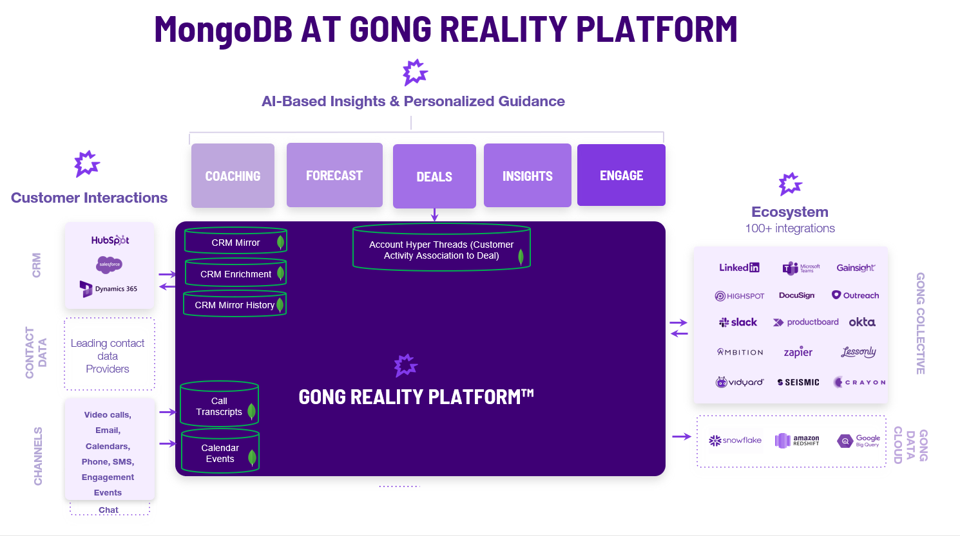
Gong’s Revenue Intelligence Platform enables companies to capture, understand, and act on all customer interactions in a single, integrated platform. The platform provides revenue teams with advanced visibility to see a unified view into customer and market dynamics, and smart guidance to improve productivity, prospecting, pipeline management, forecasting, and coaching.
The company has more than 1,200 employees across the world serving more than 3,500 customers. “We’re focused on turning customers into raving fans by enabling them to improve operating efficiency, make smarter business decisions, and achieve their full revenue potential,” said Nadav Hoze, Software Architect at Gong. “Conventional approaches yield conventional results. We’re aiming for extraordinary.”
THE CHALLENGE
Managing growing volumes of disparate data
To stay extraordinary, Gong needs to be at the forefront of modern development and trends. Its ‘Deal Association’ algorithm processes tens of millions of daily interactions and engagements (calls, emails, web conferences, etc) its customers have with their customers and prospects, and identifies the attributes that link each activity to the correct sales opportunity.
Opportunities can then be analyzed to identify the most successful tactics, trends, and areas for improvement. Customers can run searches and filter data by their choice of criteria to find the most meaningful insights for their needs. To continue providing this level of real-time visibility at scale, Gong needed a high-performing transactional database.
“Customer dashboards display their pipeline and activities. If our algorithm is slow, it leaves them blind. They won’t be able to track keywords, monitor deal sentiment, or find insights quickly enough to act on them,” said Hoze.
Initially, Gong encountered a challenge with a previous database provider as it failed to meet the operational requirements of their algorithm. "We needed transactions while maintaining low latency and high throughput. The previous provider was based on Lucene, and lacked transactional capabilities, so we had to store oversized documents containing thousands of interactions, which led to significant slowdowns in both read and write operations." says Nadav.
“We needed a database with Atomicity, Consistency, Isolation and Durability (ACID) properties and high throughput to support our algorithm and ensure we can analyze customer data coming from calls, meetings, emails and other engagements as quickly as possible,” added Hoze.
THE SOLUTION
A transactional database with ACID properties
Gong went to market to find an adaptable database capable of supporting its complex data structure and handling future optimization with no downtime.
“MongoDB Atlas is a great fit for us. It can perform processes in milliseconds that other technologies fail to deliver, it has ACID properties, and it supports sharding,” explained Hoze. “We were already using it to store transcripts, so we decided to roll it out as our single source of truth for all customer data.”
The team ran an initial proof of concept with one customer and saw amazing results. As it scaled the solution to more customers, it continued to see impressive results — processes that were taking tens of seconds now took 20-30 milliseconds.
“It was super easy to switch to MongoDB, both as a developer and for my team. MongoDB Flex Consulting helped with the design and schema and provided training on how to use the platform,” recalled Hoze. “MongoDB has a simple interface, rich capabilities and great documentation, so we got up to speed quickly.”
Gong decided to shard its data across five clusters to future proof the environment. Sharding helps to allocate resources more evenly and meet SLAs with each customer by eliminating cross-shard queries, which are slower and less efficient.
“MongoDB Atlas automatically tries to balance data, which is something we couldn’t do with our previous solution. Now we can easily keep customer data together on one shard and have greater control over the environment,” added Nadav Hoze.
Empowering developers to focus on their own projects
MongoDB Atlas addresses concerns that the previous solution was causing heavy reads and writes and enables developers to work directly in Java without needing a third-party solution, speeding up velocity and productivity. Teams can develop independently at speed and focus on their own projects, where previously they needed a broader knowledge of other development work in the pipeline.
Moving to a solution with ACID properties also ensures the database is always in a consistent state and protects data integrity. As Hoze explains, “MongoDB Atlas knows if something happens between transactions and can roll back if necessary. If, for example, it was running a query to determine whether to associate CRM data with a specific deal when a second transaction relating to the same deal starts up, it can remove the first association if the second is more relevant without creating inconsistencies.”

_1.svg)