As we race toward 2050, the U.S. electric grid faces a massive capacity surge, with transformer needs projected to increase by 160%–260%, according to the U.S. Department of Energy. For utility operators, grid modernization is no longer a long-term goal; it’s an urgent operational necessity.
Many utilities face a core challenge: grid data is spread across disconnected control systems, outage platforms, and maintenance records, each with its own format and latency. This fragmentation prevents teams from connecting signals fast enough to support critical operational decisions. Without a unified view, operators struggle to detect emerging risks early or investigate issues across systems, making it difficult to turn growing volumes of information into timely action.
The success of this transition won’t be defined solely by adding more sensors, but by how effectively massive, fragmented data sources can be unified into a single, actionable picture that supports rising demand and extreme weather resilience.
In this blog, you’ll learn how MongoDB helps energy providers build a smart grid management platform on a unified data layer for operational analytics, application development, and agentic AI. Enabling operators:
Detect and localize outages faster with real-time telemetry and time series analytics.
Understand customer behavior and demand trends with integrated meter and customer data.
Forecast demand and support tariff optimization from the same operational platform.
Investigate grid issues faster with a Grid Support Agent powered by agentic AI.
How smart meters improve grid visibility and why coordination matters more
Built decades ago, traditional grid infrastructure was never designed to handle the complexity and variability of today’s energy landscape. Smart meters are helping change that by acting as the eyes and ears of the modern grid, continuously capturing how and when energy is used so utilities can improve visibility into system performance.
Adoption is already gaining traction. As noted by Envelio, in nearly half of EU countries, more than 80% of households already have smart meters in place. But visibility at the edge is only the first step. To deliver real operational value, that data must feed into a broader energy management framework that can coordinate activity across the full network.
Figure 1. Smart grid energy management across distributed infrastructure.
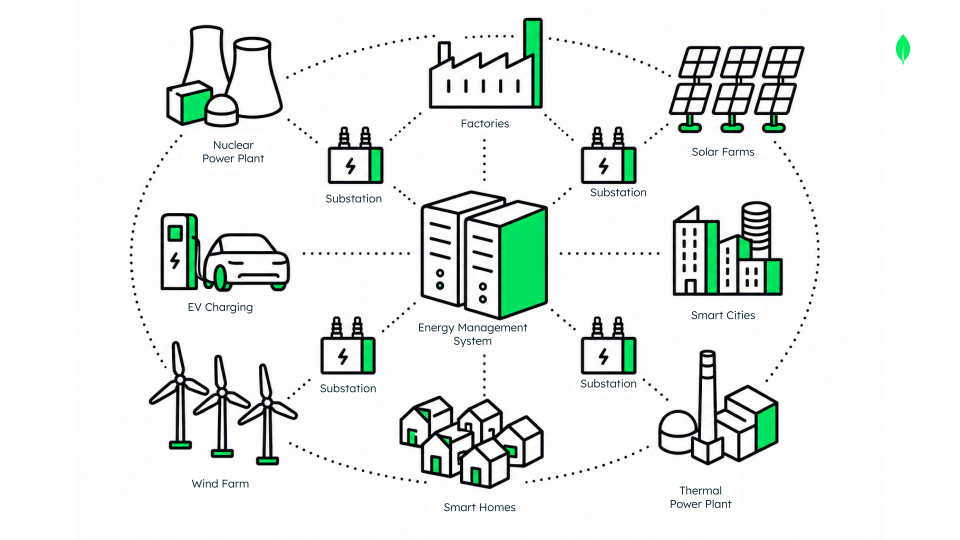
A central energy management system coordinates distributed assets such as power plants, factories, solar and wind generation, substations, EV charging, smart homes, and smart cities.
For an energy utility operator, this complexity shows up in everyday decisions. They need to understand demand trends, investigate outages, access customer and billing context, and maintain a clear view of network conditions. In most environments, those needs are spread across separate systems.
Figure 2. Core functions of an energy utility operator.
.png)
Operator’s core responsibilities include monitoring the network, detecting outages, accessing customer and billing records, and forecasting demand trends.
How a smart grid platform connects telemetry, customer context, forecasting, and agentic AI
A smart grid management platform, built on MongoDB Atlas, brings those capabilities together in one place. Built on a unified data foundation, a modern smart grid platform should serve the decisions that matter most to utility operators: faster outage detection through real-time analytics, customer consumption analysis and segmentation, demand forecasting, personalized tariff recommendations, and an AI agent that supports natural-language investigation.
MongoDB Atlas powers each of these services as the core data foundation of the platform.
Figure 3. Smart grid management platform high-level architecture.
.png)
To deliver these capabilities, a modern smart grid platform has to bring together the data operators already depend on, from smart meter telemetry and network data to customer records, tariff catalogs, weather feeds, and utility documents. Regardless of where that data lives, it can be ingested into MongoDB Atlas through flexible integration patterns such as messaging services, cloud-native connectors, and sync pipelines.
Once unified on MongoDB Atlas, that data becomes a common foundation for analytics, search, and application development. Instead of stitching together fragmented systems, utilities can use a unified operational layer to power outage detection, customer intelligence, demand forecasting, network monitoring, and tariff recommendations. While also creating the context needed to support AI-driven experiences.
Figure 4. Agentic AI orchestration architecture.
.png)
A Grid Support Agent gives operators a faster way to investigate issues and understand what is happening across the grid in real time. Instead of clicking through separate systems, they can pose a natural-language question: “Which feeders are under the most stress right now?” — and rely on an orchestration layer that combines enterprise knowledge retrieval and live operational data from MongoDB Atlas. The model can then reason over both enterprise knowledge and application data, while using persistent memory to maintain continuity across interactions.
The result is a grounded, contextual response that helps operators move from fragmented systems and manual investigation to faster and more informed decisions.
MongoDB Atlas gives utilities one platform for operational, analytical, and AI workloads
Taken together, the patterns in this blog point to the same conclusion: effective energy management depends on three things: integration across fragmented systems, real-time access to operational data, and the ability to work across multiple data types without adding unnecessary complexity. MongoDB provides a single operational foundation for analytics, applications, and AI that aligns with those requirements.
MongoDB delivers that value in four ways:
Unified data platform: Consolidating disparate data types, including relational, document, and time-series data, into a single, accessible foundation.
High-performance time series ingestion: Architected to handle high-velocity and large data streams, ensuring efficient storage and processing at scale.
Advanced data transformation: Leveraging powerful aggregation pipelines to process, reshape, and turn raw data into actionable insights in real-time.
Native AI & intelligent search: Built-in full-text search, vector search, and AI integrations allowing developers to ground LLM-powered applications in live, operational data without complex infrastructure.
Better data foundations lead to faster decisions and stronger utility operations
At its core, the business value presented in this blog is not just architectural simplification. It is the ability to help utilities move faster and act with better context. By bringing together the data behind operations, planning, and customer engagement, MongoDB Atlas helps teams reduce friction, improve responsiveness, and scale new use cases from the same platform.
Figure 5. Transforming operator queries into actionable insights.
.png)
Next Steps
Ready to modernize your energy management operations? MongoDB can help utilities unlock real-time insights, optimize systems, and support smarter decision-making across the grid. To explore the demo in more detail, check out the Smart Grid Platform GitHub repository.
Ultimately, the objective centers on transforming a single operator inquiry into a definitive, actionable response by leveraging the complete breadth of available operational, consumer, and corporate knowledge. That matters because faster, better-informed decisions can improve resilience, strengthen customer experience, and prepare utilities for the next generation of grid use cases.