


INTRODUCTION
A leading energy company transitioning to Net Zero
Based in Italy, Eni is a leading integrated energy company with more than 30,000 employees across 69 countries. Its operations vary from exploring and drilling for natural gas and oil to cogenerating electricity, renewables, biorefining, and chemical production.
In 2020, Eni launched a strategy to reach Net Zero emissions by 2050 and develop more environmentally and financially sustainable products. Eni’s decades of research and innovation around technology will be vital in achieving this.
“I work on the technical computing for geosciences and subsurface operations team alongside the geology, geoscience, and geophysics departments,” explains Sabato Severino, Senior AI Solution Architect for Geoscience at Eni. “We’re responsible for finding the best solutions on the market for our cloud infrastructure and adapting them to meet specific business needs.”
Projects include using AI for drilling and exploration, leveraging cloud APIs to accelerate innovation, and building a smart platform to promote knowledge sharing across the company’s biggest business division —natural resources.
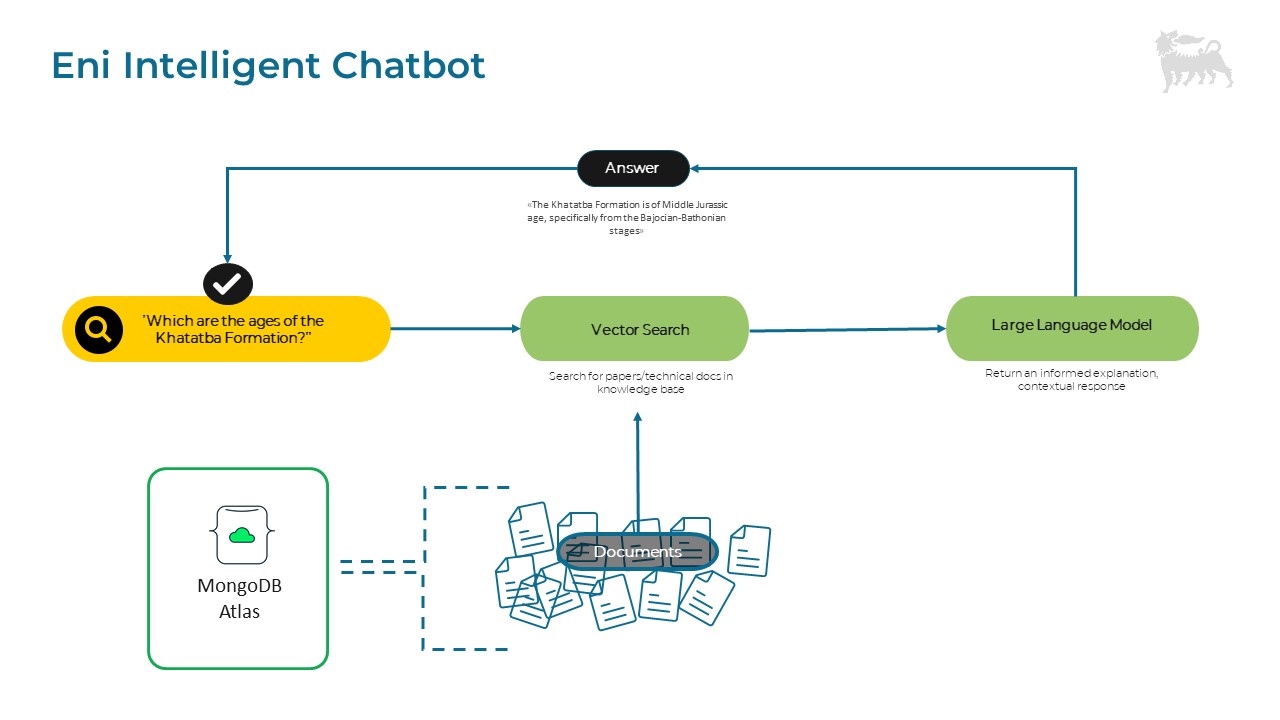
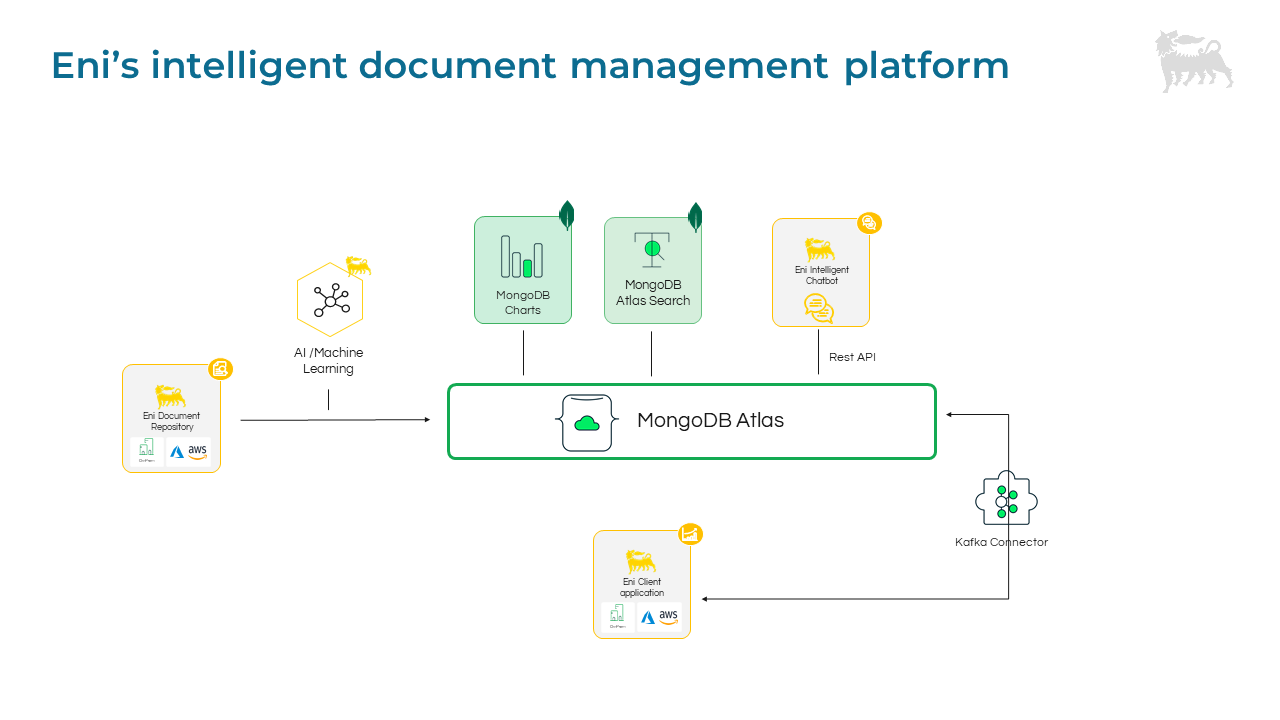
Eni’s document management platform for geosciences offers an ecosystem of services and applications for creating and sharing content. It leverages embedded AI models to extract information from documents and stores unstructured data in a NoSQL database. This data is closely connected to structured data managed by a proprietary data platform. This data is visualized in custom apps for content managers, data analysts, and specialists such as geologists, engineers, and drilling teams to obtain further insights.
“Our platform needs to be secure, accurate, and efficient. Precision is vital for scientists working in this industry,” explains Severino. “Used correctly, this data helps us work faster and smarter, reduces costs through optimization, and supports our business decisions.”
THE CHALLENGE
Making comprehensive data available for scientific research
Eni’s document platform ingests and homogenizes vast quantities of unstructured data. Documents generated by different countries span Italian, English, and French, and each region uses different units of measurement. Users pull data into dashboards for querying based on specific criteria, but a lack of standardization was making it too complex to create comprehensive data sets and run queries with the original relational database.
The challenges for Severino’s team were to maintain the platform as it ingested a growing volume of data — hundreds of thousands of documents and terabytes of data — and to enable different user groups to extract relevant insights from comprehensive records quickly and easily.
“As we developed our platform, we realized we were spending too much time managing multiple systems. We needed to speed up time to market while ensuring the platform could support a global, multi-cloud environment in the future — something our incumbent database couldn’t do,” says Severino.
From a technical standpoint, the company needed to create a scalable and managed document data platform that allows the organization, retrieval, and utilization of data extracted and enriched from processed documents. This system needed to be capable of performing complex searches through a Google-like interface, and enable the development of a set of Natural Language Processing (NLP) and generative AI microservices to support the ecosystem. The document data platform would act as a support infrastructure for storing and manipulating text, tables, images, and metadata obtained from the content extraction and enrichment processes.
THE SOLUTION
Migrating to a cloud-agnostic managed document data platform
Eni partnered with MongoDB Consulting for training and to support the migration of workloads into MongoDB Atlas. “MongoDB is much more cost-effective than our previous solution, which had a complex pricing model that made it difficult to optimize costs for unpredictable workloads,” says Severino.
The company wanted to move to a managed service with a seamless user experience and easy-to-use interface for developers. Many staff were already familiar with MongoDB, which streamlined the transition and ensured ongoing efficiency. Additionally, the cloud-agnostic nature of Atlas offers the flexibility that Eni needed to avoid vendor lock-in and maintain multi-cloud capabilities. This aligns with its long-term strategy and ensures it can adapt to changing business requirements.
“MongoDB Atlas isn’t just a database, it’s a complete set of products and services. It’s cloud agnostic and combines rich functionality with the flexibility we needed to make it our own,” explains Severino. “The support we got from MongoDB Consulting was great, it was tailored to our unique challenges and we’re looking forward to that relationship growing in the future.”
Eni initiated a test environment on MongoDB Atlas and with support for multiple programming languages, JSON data, and REST APIs – which enable data to be accessed through HTTPs requests – Eni is able to meet the industry’s strict data security and compliance requirements.
_1.svg)