A warning light appears on the dashboard while a driver is navigating a tunnel, a remote area, or an underground garage. The driver asks the vehicle what is wrong and what to do next. In that critical moment, getting a helpful answer shouldn't depend on whether the car has cell service.
As vehicles become increasingly software-defined, drivers are beginning to expect the same digital assistance in their cars that they use everywhere else. But connected experiences are only valuable when they remain available at the moment they are needed most. More than 400 million connected vehicles are expected to be on the road worldwide[1], making the resilience of these experiences an increasingly important consideration for automakers.
This leads to a strategic question: should in-vehicle AI be designed around permanent connectivity, or should it be designed to remain useful when connectivity disappears?
The answer is increasingly clear. For software-defined vehicles, offline capability is not a fallback feature. It is a requirement for trustworthy in-vehicle AI.
This blog explores how automakers can meet that requirement through an offline-first approach. Intelligence and relevant vehicle knowledge remain available at the edge, while MongoDB Atlas provides the cloud foundation for shared knowledge, synchronization, and continuity when connectivity returns. Together, these capabilities balance local resilience with cloud scale, helping critical assistance remain available when drivers need it most.
The connected-vehicle assumption is breaking down
Cloud services are essential to the modern vehicle experience. They provide centralized knowledge, scalable processing, software updates, analytics, and a shared history across vehicles and users.
But a vehicle is not a smartphone in motion. It operates across tunnels, rural roads, underground parking facilities, border crossings, and areas with inconsistent network coverage. Connectivity can also be interrupted by temporary outages or changing network conditions.
Those interruptions are not merely technical inconveniences. They can occur precisely when a driver needs assistance: when a diagnostic code appears, a warning light turns on, a repair procedure is unclear, or a driver needs to understand what the vehicle is communicating.
A resilient vehicle experience, therefore, needs a different design principle: critical assistance should remain available locally, while the cloud provides continuity when connectivity returns.
This is not an argument for moving every cloud capability into the vehicle. Instead, it defines which interactions are too important to risk on a network round-trip.
Three principles for resilient in-vehicle AI
1 - Design for the moment of need
Drivers do not think in terms of edge computing, synchronization, or service availability. They think in terms of a simple question: “Can my vehicle help me right now?”
A resilient assistant should be able to respond to common, high-value requests even when the vehicle is offline. That might include explaining a diagnostic code, answering a question from the digital manual, checking relevant vehicle information, or guiding a driver through a basic procedure.
The product implication is significant. Offline functionality should not be treated as a degraded mode that is added after the connected experience is complete. It should be considered when defining the experience itself.
This changes what teams optimize for. Instead of asking only how quickly a cloud service can answer, they must also ask which answers need to be available immediately, which knowledge should be stored locally, and how the experience should behave when the network is unavailable.
2 - Turn vehicle knowledge into an evolving product asset
A vehicle assistant is only as useful as the knowledge behind it. Digital manuals, diagnostic information, vehicle signals, and service procedures should not remain isolated sources that drivers must search manually.
They can become contextual knowledge that the assistant retrieves and explains in the language of the driver’s situation.
This knowledge also needs to evolve. New vehicle generations introduce new signals, features, and system relationships. Manufacturers may extend common vehicle models with their own requirements. Documentation changes as procedures and software change.
COVESA’s Vehicle Signal Specification (VSS) provides a shared way to describe vehicle signals and their relationships, while still allowing automakers to extend the model for their own platforms. That combination of common language and product-specific flexibility is important as vehicle software evolves.
Figure 1. COVESA data model.
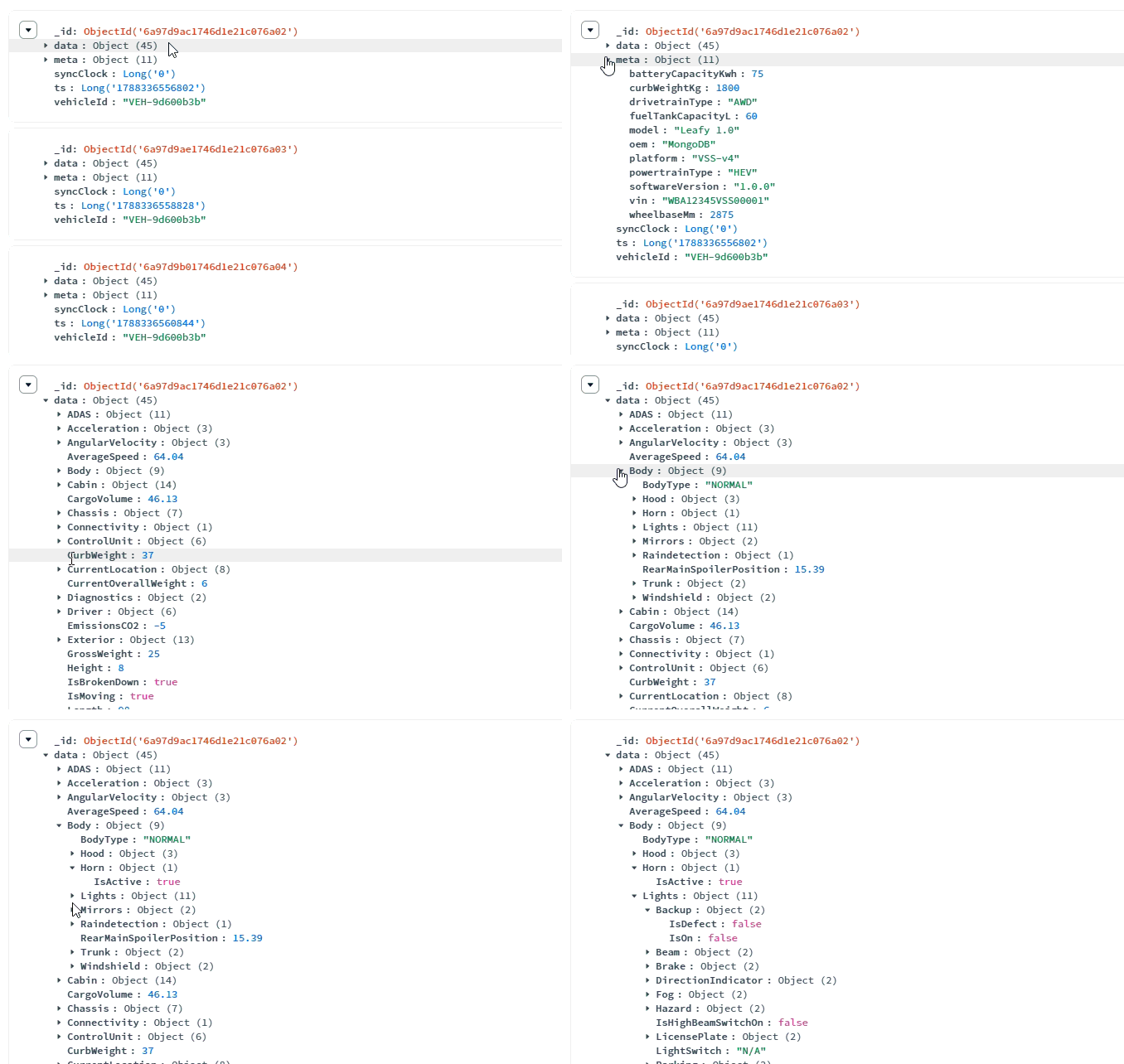
The broader lesson is that automakers should treat vehicle data and documentation as living product assets. Their value multiplies the moment they are connected, updated, searched, and delivered directly to the driver's context.
3 - Separate availability from connectivity
The most resilient architecture separates two responsibilities.
The vehicle edge is responsible for keeping critical interactions available. It can store the local knowledge and recent data needed to answer important questions, interpret requests, and support the driver without waiting for a round trip to the cloud.
The cloud is responsible for scale and continuity. It can provide centralized updates, shared knowledge, durable history, broader analytics, and synchronization across vehicles and services.
When connectivity returns, the local and cloud environments can reconcile changes and continue working as one system. This allows the vehicle to remain responsive without giving up the benefits of centralized platforms.
The important architectural insight is not that every capability belongs at the edge or in the cloud. It is that the boundary between them should be intentional.
What this means for automakers
An offline-first approach has implications beyond system architecture.
It can build customer trust. A vehicle that remains helpful during a stressful moment feels more dependable than one that simply displays an error when connectivity is interrupted.
It can create product differentiation. As software-defined vehicles become more common, the quality of assistance may become as important as the number of digital features. Reliability can become part of the experience that distinguishes one vehicle platform from another.
It can improve the value of existing content. Manuals and diagnostic documentation become more useful when drivers can access the right information without navigating hundreds of pages or relying on a QR code and a network connection.
It can support long-term software evolution. Vehicle signals, knowledge, and user interactions will change across model years. A data foundation that can evolve with those changes helps teams build new capabilities without losing historical context.
It can support more deliberate data governance. Not every interaction needs to leave the vehicle immediately. Keeping selected data and capabilities local can improve resilience while allowing manufacturers to define what should be synchronized, when it should be synchronized, and where it should be stored.
These considerations require collaboration across vehicle software, cloud engineering, data teams, product management, and customer support. Offline-first AI is therefore not only a technical pattern. It is a product and operating model decision.
A practical implementation pattern
A reference implementation can combine a local application and model with a cloud data platform. On the edge, ObjectBox can provide local persistence for vehicle data, searchable knowledge, and recent interactions, allowing the assistant to continue operating when the vehicle is offline. When connectivity is available, ObjectBox Sync can synchronize local changes with MongoDB Atlas, where centralized knowledge, updates, scalable storage, and durable history can be managed.
MongoDB Atlas provides the cloud data foundation for vehicle information, assistant knowledge, and synchronized interactions. MongoDB Atlas Vector Search helps retrieve relevant content, while the flexible document model can represent both structured vehicle signals and knowledge enriched with metadata. Together, ObjectBox at the edge and MongoDB Atlas in the cloud support a division of responsibility: keep critical interactions close to the driver while preserving continuity with cloud services.
Figure 2. Reference architecture.
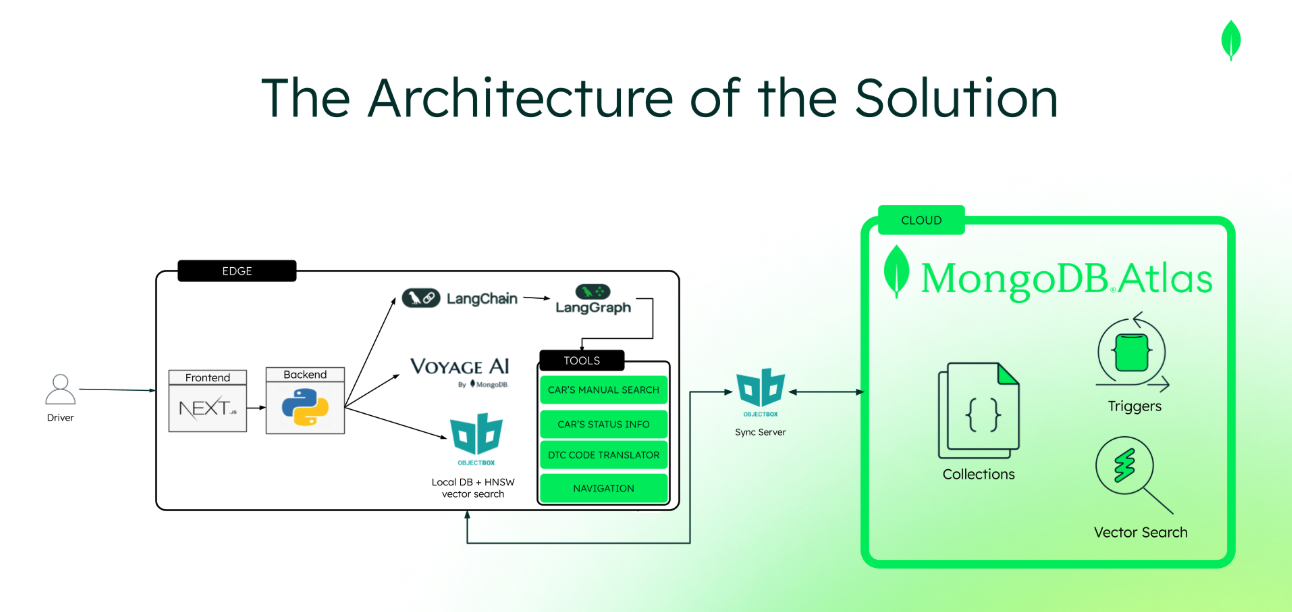
The specific technologies will vary by vehicle platform and use case. The enduring pattern is more important: keep the experience available at the edge, use the cloud for scale and coordination, adopt shared data-modeling approaches where they add value, and design the data model to evolve as vehicles evolve.
The next competitive advantage is resilience
The next generation of connected-vehicle experiences will be defined not by constant connectivity, but by how intelligently they operate when it disappears.
For automakers, this creates an opportunity to rethink in-vehicle AI around the moments that matter most. An assistant that can answer a question in a tunnel, explain a diagnostic code on a rural road, or surface the right manual content in an underground garage is doing more than demonstrating technology. It is building a vehicle that drivers can actually rely on when it matters most.
Offline-first design is not about recreating every cloud service inside the vehicle. It is about ensuring that critical assistance is available when drivers need it, while cloud connectivity continues to provide scale, updates, and continuity in the background.
That is the foundation for in-vehicle AI that drivers can trust.
Next Steps
Explore the voice-car assistant-v2-reference-implementation to see how offline-first AI can be applied to vehicle data, digital manuals, and a resilient in-vehicle assistant.
[1] Axis Intelligence, “Connected Car Market.”