For decades, global financial institutions relied on messaging standards defined by SWIFT to exchange information about cross-border payments. These legacy standards—aka MT messages designed in the 1970s—carried payment instructions in largely unstructured formats that required downstream systems to interpret free-text fields.
To modernize this infrastructure, the industry migrated to ISO 20022, a new messaging standard built around structured, machine-readable data capable of carrying far richer payment information. The reality, however, was that the November 2025 deadline for SWIFT ISO 20022 coexistence was not just a formatting update—it sparked a data handling challenge. Financial institutions attempting to force rich, hierarchical ISO 20022 data into rigid, legacy relational databases face spiraling ETL costs, performance bottlenecks during reconciliation, and heightened compliance burden.
While SWIFT MX became mandatory in 2025, MongoDB has been a foundational data platform for payments modernization since the early adoption phase of ISO 20022 and related payment transformations. Major global banks have leveraged MongoDB to process high-volume payment workloads, including SEPA transactions and credit card data, benefiting from its ability to handle evolving financial data models. The recent SWIFT mandate reemphasizes MongoDB’s proven role as a key data platform underpinning modern payment architectures aligned with ISO 20022 principles and messaging since its inception.
This post explains how MongoDB Atlas provides a native operational data layer for ISO 20022 messages (e.g., pacs.008, the message format for customer credit transfers between financial institutions), enabling banks to ingest, validate, and query complex payment messages without the “schema rigidity” that plagues traditional SQL approaches.
The real business problem
Most banks are treating ISO 20022 as a “translation” exercise at the edge, converting rich XML into flat CSVs or SQL rows for internal processing. This results in data truncation risk, which can contribute to:
Operational impact: Truncating unstructured remittance info to fit a 140-character SQL field removes key reconciliation context.
Fraud control erosion: Truncating UltimateDebtor data due to outdated schema breaks 4-layer party identification and weakens anti-money laundering (AML) screening.
Cost of “shredding”: Splitting a 5KB ISO message across 15 SQL tables and reassembling it later drives major latency and CPU overhead.
Why ISO 20022 matters
ISO 20022 introduces a common business model across the globe for financial messaging. Unlike the MT standard, which was essentially a “digital telegram” (relying on short, semi-structured fields), ISO 20022 is a rich, standardized data dictionary designed to support far more detailed and structured financial information. Here is more background on why ISO 20022 matters:
Background: ISO 20022 was developed by the International Organization for Standardization in 2004 to modernize financial messaging. It replaced fragmented and rigid legacy standards with a unified standard, enabling richer, structured data exchange across payments ecosystems.
Role of MongoDB: Over the past decade of ISO 20022 adoption across modern payment systems, MongoDB, with its document model, has enabled financial institutions to process and manage complex, hierarchical message structures with high fidelity, supporting scalable, real-time payment processing and continuous schema evolution.
Recent updates: Since November 2025, SWIFT has required cross-border payments and reporting (CBPR+) messages on its network to use ISO 20022 (MX format). During the transition, SWIFT provides translation services to support interoperability with legacy MT messages.
Scope: ISO 20022 affects high-value payment systems (HVPS), real-time gross settlement (RTGS), and instant payment rails. Sample JSON: pacs.008 (customer credit transfer)
Sample JSON: pacs.008 (customer credit transfer)
Below is what an enriched but complex ISO 20022 format looks like for customer credit transfers between financial institutions.
In the sample message below, Tesla Motors Inc instructs its bank (BIC CHASUS33) to transfer USD 15,000 to German Auto Parts Ltd through Deutsche Bank (DEUTDEFF).
Functionally, it serves a role similar to the legacy MT message (more specifically, message type - MT103), but within the ISO 20022 framework, it carries significantly richer and more structured data.
Instead of relying on loosely formatted text fields, a pacs.008 message explicitly defines elements such as the debtor, creditor, their respective banks, settlement details, remittance information, and regulatory metadata, enabling better automation, compliance screening, and transparency in cross-border payments.
Why “legacy” and “hybrid” SQL approaches fail
Legacy RDBMS are fundamentally mismatched for ISO 20022 in a number of ways:
Impedance mismatch: ISO 20022 is hierarchical (trees of data). RDBMS is tabular (rows and columns). Mapping one to the other requires complex object-relational mapping (ORM) that is brittle and slow.
Schema rigidity: If the ISO standards body updates the pacs.008 definition (e.g., adding a new RegulatoryReporting code), an RDBMS requires ALTER TABLE commands that can lock the database.
“BLOB” Trap: Store the XML as a BLOB (binary large object) in a SQL column. This makes the data opaque; you cannot query, index, or analyze specific fields inside the message without extracting it first.
PostgreSQL is fundamentally a relational engine. JSONB was added later.
Syntax penalty: Querying nested fields in pacs.008 (e.g., CdtTrfTxInf[0].RmtInf.Strd[0].AddtlRmtInf) requires verbose SQL (->>, #>>, lateral joins), whereas MongoDB uses simple dot notation: CdtTrfTxInf.RmtInf.Strd.AddtlRmtInf
Array agony: ISO 20022 contains many arrays. Updating a nested array element (e.g., adding a status flag to one transaction) is efficient in MongoDB, whereas Postgres JSONB often rewrites the entire JSON object, causing write amplification.
Indexing dilemma: You often have to choose between a heavy GIN index (indexes everything, slow writes) or expression indexes (fast writes, but inflexible query patterns).
What “good” looks like (target state)
The ideal payment architecture should treat the ISO 20022 message as a first-class citizen:
Native storage: Store messages in their natural hierarchical structure (JSON/BSON).
Semantic precision: Apply ISO 20022 XSD-style validation to JSON representations of messages using MongoDB’s native JSON schema validation rules (for example, IBAN patterns, required elements, and value ranges)
Agility: Support new SR (standard release) fields immediately without downtime or schema migrations.
How MongoDB Atlas solves the problem
MongoDB Atlas stores data in BSON (Binary JSON), which maps 1:1 to the hierarchical structure of ISO 20022 messages.
While MongoDB’s core document model handles the structure of ISO 20022, MongoDB Atlas provides the essential services to handle the security, search, and scale required by Tier-1 financial institutions through:
Ingestion and normalization: Instead of splitting a pacs.008 message across multiple tables, MongoDB can store the entire payment as a single document, eliminating expensive joins.
Semantic validation (schema validation): MongoDB can enforce JSON Schema validation to reject invalid values before they reach downstream systems for ISO 20022 compliance.
Enrichment and compliance: Since MongoDB is schema flexible, you can enrich ISO documents with internal metadata (e.g., SanctionsScore, InternalRoutingCode)
Transformation and routing: MongoDB’s aggregation framework enables powerful transformation pipelines, allowing you to reshape a pacs.008 (customer credit transfer) into a pacs.002 (status report)
Intelligent search on remittance information (Atlas Search): In ISO 20022 messages, fields like RmtInf.Ustrd often contain unstructured text. Atlas search enables fast fuzzy search on this data, helping handle typos and improving payment reconciliation.
Data sovereignty in cross-border payments (MongoDB Atlas global clusters): Cross-border payments like pacs.008 span multiple jurisdictions, creating data residency challenges for single-location databases. MongoDB Atlas global clusters solve this by pinning data to regions (e.g., using Dbtr.PstlAdr.Ctry as a shard key).
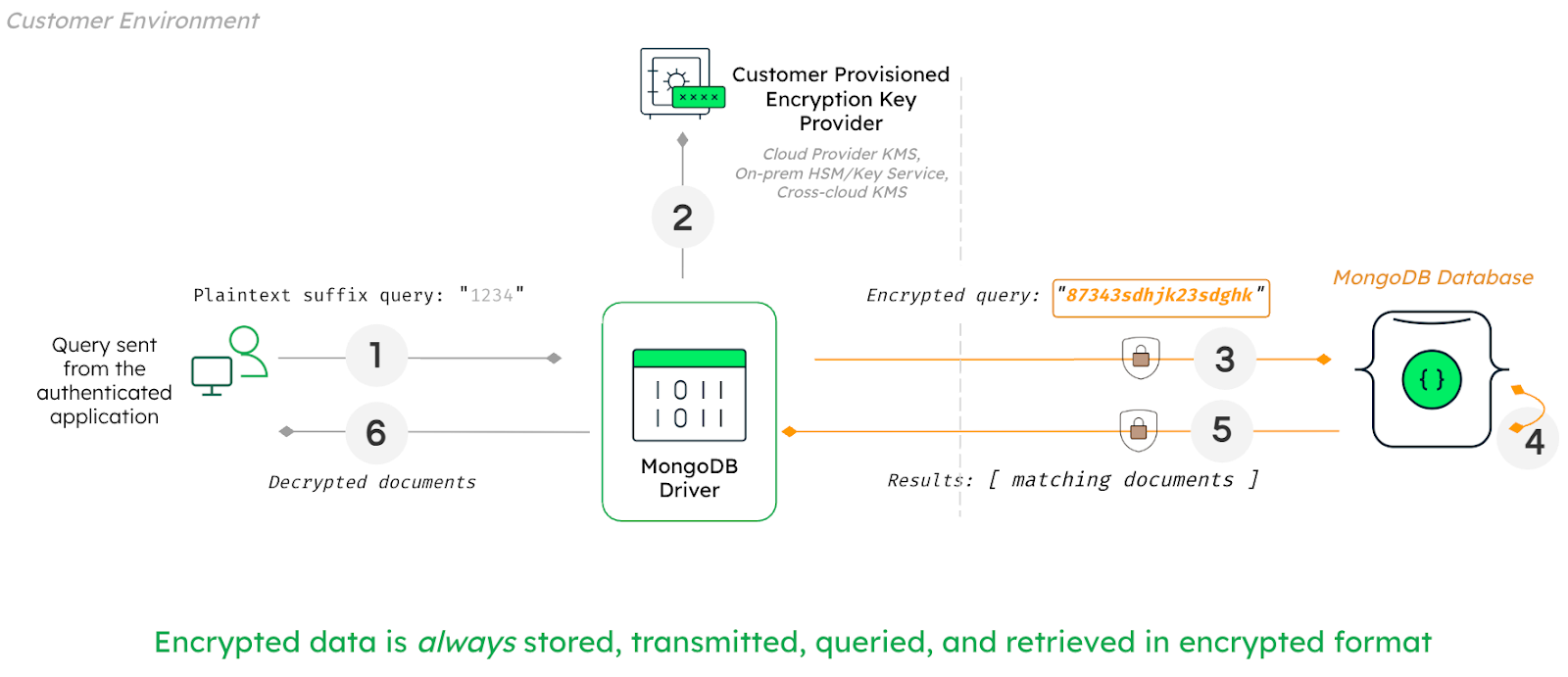
Protecting PII in transit, at rest, and in use: ISO 20022 exposes sensitive personally identifiable data (PII)—which includes names, addresses, IBANs—in plain text. MongoDB keeps this data encrypted in transit, at rest, and notably in use, thanks to Queryable Encryption. This industry-first technology enables expressive queries to be performed directly on non-deterministically encrypted data such as PII.
- Real-time validation pipeline (MongoDB Atlas stream processing): Atlas Stream Processing can ingest the raw ISO 20022 Kafka stream, validate the schema, and filter out malformed messages in flight before they ever hit the database storage, ensuring your payment hub remains pristine.
Concrete example: the “fuzzy” remittance search
The scenario: A cross-border payment is sent from Mumbai (debtor) to Berlin (creditor). The pacs.008 message contains critical business context in the RemittanceInformation field. However, humans are messy. The sender manually typed “Py” instead of the standard format.
The problem: A compliance officer in Germany needs to find this transaction later. They search for “Battery Packs.”
In SQL: A LIKE ‘%Battery%’ query misses it because of the typo (“Bttery”).
In legacy systems: The search times out because scanning millions of text rows is an O(N) operation.
The solution: MongoDB Atlas Search. By creating a search index on the RmtInf field, we can use Lucene-powered fuzzy matching to find the payment instantly, even with typos.
The ingested document (pacs.008)
Note the typo in the Ustrd (Unstructured) field.
Atlas search index definition
Below is the search index definition for instantly locating payment references even when invoice numbers or company names are misspelled or formatted incorrectly.
Atlas search query
Instead of a slow regular expression, we run an aggregation pipeline using the $search stage. We enable fuzzy matching to allow for character swaps or missing letters.
Result
The system successfully finds the document despite the data quality issue.
Business impact
By adopting this architecture, financial institutions can unlock several operational and compliance advantages, such as:
Faster query performance: By eliminating joins on the critical path, payment status lookups (using the UETR) become sub-millisecond operations.
Zero-downtime compliance updates: When SWIFT releases “SR 2026,” you simply start ingesting the new fields. No ALTER TABLE maintenance windows required.
Reduced false positives: By storing the full, un-truncated UltimateDebtor and UltimateCreditor data, your sanctions screening engine has the complete picture, reducing manual repair queues.
Reduce TCO (eliminate search sprawl): By using Atlas search, you retire the separate licensing, hardware, and sync pipelines required for standalone search engines (like Solr/Elastic) typically used to search payment descriptions.
Audit-ready compliance: With Atlas auditing and queryable encryption, you can prove to regulators that sensitive PII was never exposed to DBAs or cloud providers, even while being actively queried for sanctions screening.
Next Steps
Financial institutions modernizing their payment platforms need infrastructure that can evolve with ISO 20022, scale globally, and remain compliant.
MongoDB Atlas provides a unified platform for operational data, search, encryption, and analytics, eliminating the complexity of managing multiple systems.
Start exploring how MongoDB Atlas can power modern payment architectures by creating a free Atlas cluster or reviewing the financial services reference architectures.