LAUNCHMongoDB 8.3 is built for the sub-100ms retrieval & zero downtime AI demands. Read blog >
AI DATAStop fighting your data layer. Get the memory & retrieval agents need to scale. Read blog >

What is a Search API?

Get Started Free

The development and implementation of an internal search engine is a complex and difficult undertaking. It requires a vast amount of dataset and/or website search engine indexing, the development of advanced algorithms and multiple types of query processing, as well as monitoring and analytics to determine the degree of match to the initial user query. Required internal skills sets include backend development, database management, search technologies, API design, deployment, testing, and security.

This complexity is why more and more companies are looking to implement search APIs rather than an in-house search capabilities solution. Read on to discover what a search API is, the benefits of using one, and the considerations to keep in mind when choosing a search API.

Table of contents

What is a search API?

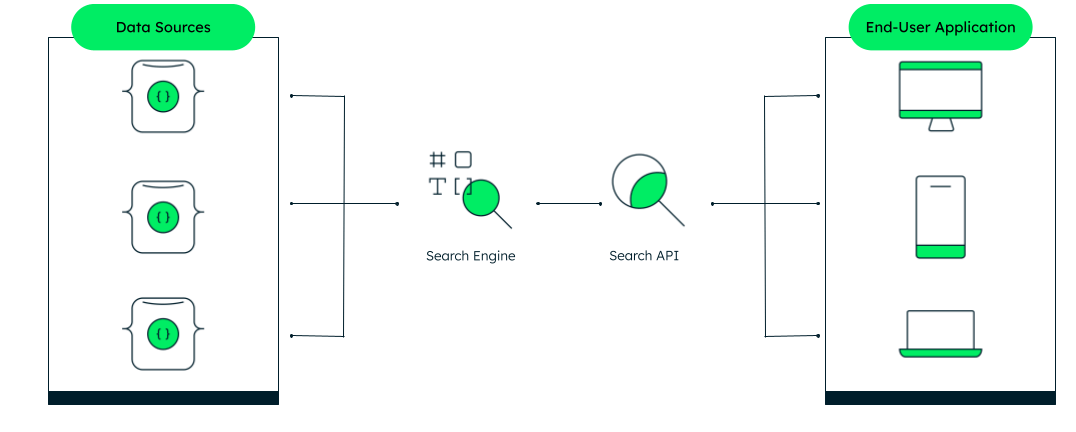
A search application programming interface (API) is a tool applications use to connect to a search engine and return search results based on a user query. The search engine behind the API takes care of web search aspects such as web crawling, indexing, algorithm development, and processing data, allowing an engineer to use the API to connect their application to that engine and retrieve the relevant information without developing a search engine of their own. The search API also affords the developer a greater ability to control web search results refinement when those results are returned.

How do search APIs work?

A search API streamlines the process of submitting a user query, retrieving relevant content, and formatting those search results for end-users.

There are several steps in this communication process.

What is a search API? What is the search engine communication process?

Query submission

Client applications send their search queries to the search API, providing their search criteria (e.g., keywords, filters) as well as results preferences such as sorting and format. This is accomplished by the API sending a request to a specific endpoint using HTTP (e.g., GET, POST). Each request sent from the client to the API server is considered a single API call, making it easy for developers to integrate search capabilities without maintaining complex back-end systems.

Query processing

Once the search API receives the search query from the client application, it parses the query to identify relevant keywords and filters. Some preprocessing may also take place at this time, including text normalization, spell checks, and stemming (e.g., reducing a word to its root) to improve search accuracy.

Query translation

The search API then translates the client application's web search query into a format that the underlying search engine can understand. This process includes converting queries into a specific programming language or adjusting the format of the queries into a format supported by the search engine (e.g., SQL, MongoDB query language, Lucene Query Syntax, JSON).

Query execution

Once translated, the search API then sends the web search query to the search engine for execution. The query is then processed against the search engine's index, where relevant search results are retrieved and ranked based on content relevance, website popularity, posting date, etc.

Results aggregation

After execution, the search results are returned to the search API in such formats as JSON or XML, allowing developers to refine web search outcomes into relevant information for their applications.

Response communication

The formatted, filtered, sorted search results are then sent back to the client application that created the query by the search API. The API also manages any exceptions that may happen during this process, including system errors.

Customization

Search APIs allow developers to tailor queries using custom scoring, sorting, and indexing.

Authentication and authorization

The search API may enforce authentication to protect sensitive data using various authorization tools such as an API key, authentication token, or other credentials to authenticate and authorize their API requests.
How are search APIs used?

Search APIs are used in virtually every industry and market, providing developers ways to utilize powerful search engines while customizing web search results and enhancing the search experience for their users. Better yet, even a simple API can deliver robust web search and search capabilities, enabling developers to tailor the search experience to the needs of their users.

  • E-commerce: Search APIs help customers quickly find desired products on e-commerce platforms using features such as hierarchical search (e.g., filtering attributes such as brand, price, product type), sorting options (e.g., by customer profile favorite attributes), and such aides as auto-complete and suggested product feature search terms.
  • Social media: Search APIs help users to find friends and relatives, special interest groups, photos, and hashtags of interest. Search filters, sorting, and auto-complete functionality also help users find relevant content as well as discover new types of content which they may enjoy.

What should I look for when choosing a search API?

There are quite a few search APIs available that will have benefits over an in-house solution in terms of functionality, development time, and cost. However, each search API has relative strengths and weaknesses when compared to others, so it's important to carefully evaluate them, including free options, against your own requirements to find the right fit.

Here are a few factors to consider when choosing your search API.

Data integration

To have the best developer experience possible, seamless integration with all data sources is essential to avoid configuration issues. In addition to gathering the appropriate data, ensuring that data sources are always synchronized to have the latest possible information is of paramount importance.

Developer-friendly

A search API is, before anything else, a tool that should make software engineers more productive. Having a tool with a syntax that is familiar to developers makes the search experience and resulting adoption rate better. This ultimately will translate into a better search experience for users as well.

Speed and performance

Most modern applications provide auto-completion and suggestions for the end-user as they type in search terms. However, the differentiation is speed. The search solution selected will need to be blazing fast to deliver user suggestions quickly from the backend to the frontend application.

Flexibility

Returning relevant results is not necessarily the same as returning the first search engine results page (SERP). For example, sponsored content might be bumped to the top or results could be prioritized based on a specific attribute such as geographic location. For this reason, the search API selected will need custom scoring options to return the most relevant answers and results for your organization and user base.

MongoDB Atlas Search is best-in-class when it comes to search APIs, offering everything to support developers while fueling relevant search for end users.

Next steps

MongoDB Atlas Search delivers advanced search capabilities and an excellent developer experience. Get started, fast, with our quick start guide.

FAQ

Get started with Atlas today

Get started in seconds. Our free clusters come with 512 MB of storage so you can play around with sample data and get oriented with our platform.
Try FreeContact sales
GET STARTED WITH:
  • 125+ regions worldwide
  • Sample data sets
  • Always-on authentication
  • End-to-end encryption
  • Command line tools