WEBINARHow to build smarter AI apps with Python and MongoDB. Register now >
NEWLearn MongoDB with expert tutorials and tips on our new Developer YouTube channel. Subscribe >
Blog home
arrow-left

How MongoDB Atlas Powers Agentic AI for Semiconductor Yield Optimization

March 5, 2026 ・ 5 min read

The global semiconductor industry is expanding rapidly. Annual sales are expected to reach $975 billion in 2026 and $2 trillion by 2036, according to Deloitte.1

To meet this demand, SEMI reports organizations will spend over $156 billion on semiconductor manufacturing equipment in 2027 to accelerate the construction of next-generation fabrication facilities.2 These investments target today's major technology shifts: AI, high-performance computing, and the automotive sector.

However, legacy data infrastructure cannot manage this complexity. Minutes spent identifying root causes put yield at risk, while hours spent correlating sensors to defects increase costs.

McKinsey reports that manufacturing is the semiconductor industry's largest cost driver. AI and ML use cases deliver about 40% of this value.3 However, capturing this value requires more than point solutions. Organizations need a unified data backbone to power real-time detection, semantic search, and autonomous AI agents.

The hidden cost of fragmented data

When an excursion occurs, engineers stitch together context from 5 different systems. Engineers end up wasting hours searching documents with keywords that do not match how another individual described the same failure 3 years ago. Ultimately, the problem is solved through experience and intuition.

This approach functioned at a smaller scale. However, when unplanned downtime costs $1 million per hour and a single leading-edge wafer is worth $17,000, the organization cannot wait for a human to spot the pattern. With hundreds of tools running 24/7, thousands of wafers per day, and process windows measured in angstroms, manual correlation does not scale.

The primary challenge is not a single system, but rather the integration between them. Every query that crosses system boundaries adds latency. IBM reports that 82% of enterprises state data silos disrupt critical workflows. Every sync job introduces drift. Every new data source requires months of integration effort. McKinsey found that 80% of semiconductor development projects do not meet their initial schedules due to underestimated complexity.

When organizations deploy an AI agent to reason across this data, the agent requires real-time access to sensors, defect images, historical knowledge, and conversation memory simultaneously. Gartner research indicates that while 61% of leaders are deploying AI agents, fragmented data silos undermine ROI. Fifteen percent automation is expected by 2028. Fragmented architectures cannot deliver the requirements of these agents.

The agentic data layer: A new architecture for smart fabs

Modern AI agents require more than a database. Agents require a converged data layer that serves as their memory, search engine, and event trigger simultaneously. 

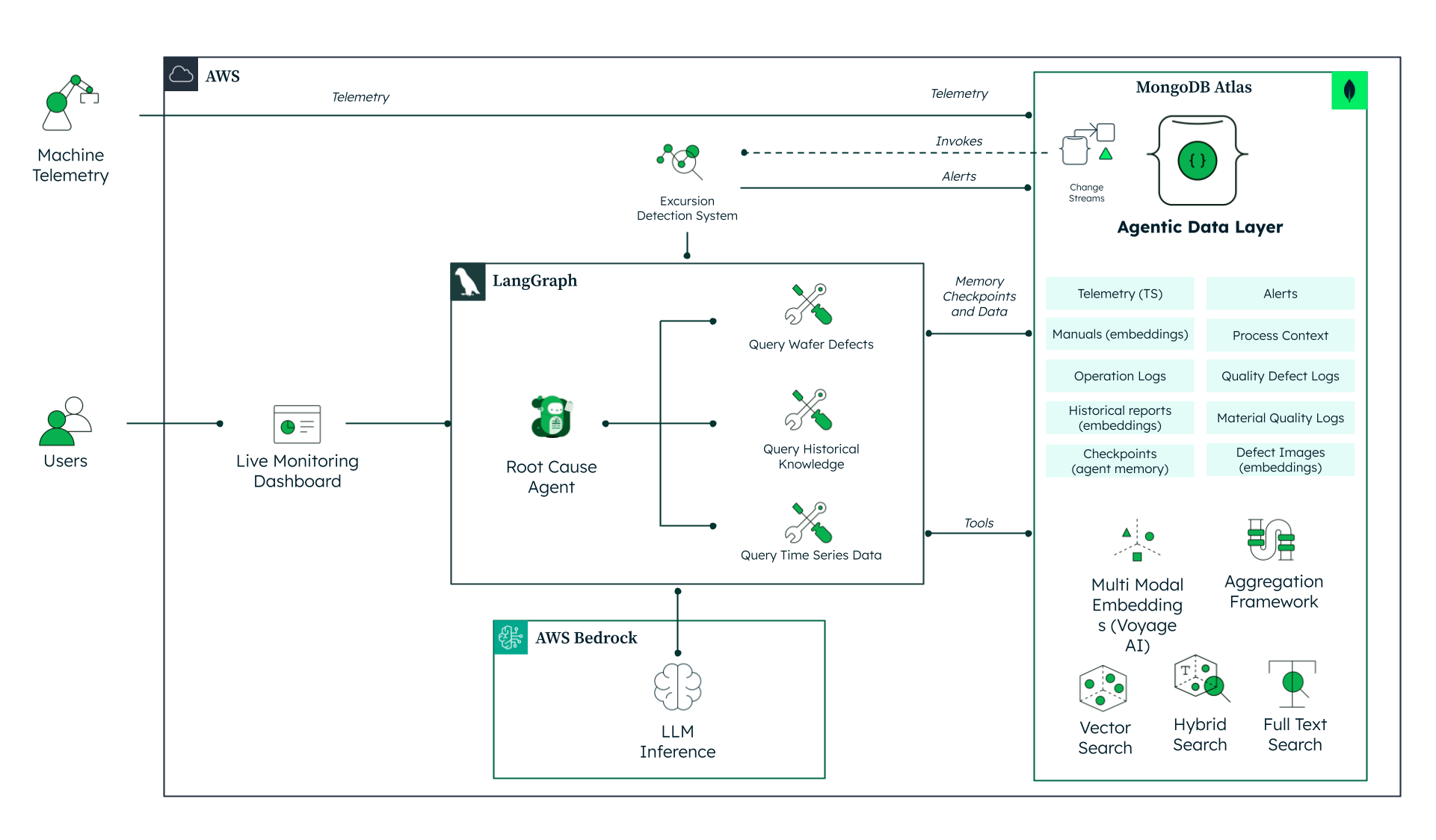
MongoDB Atlas delivers this foundation. As both a document database and a vector database, Atlas supports the varied data formats that agents require: structured telemetry, unstructured images, semantic embeddings, and conversation state. With Change Streams for event-driven architectures, agents can perceive data changes and act without human prompting, making systems proactive rather than reactive.

Figure 1. The complete agentic architecture.

What makes this architecture different

Most fab data stacks are composed of single-purpose tools. Each is best-in-class for one job, but collectively they're a nightmare to integrate, secure, and keep in sync.


Traditional stackMongoDB Atlas unified approach
Niche time-series databaseTime Series Collections
Relational DB for alerts/MESFlexible document model
Standalone vector store Atlas Vector Search
Dedicated search engine Atlas Search
Stream analytics for events + Processing Atlas Stream Processing
In-memory cache for agent stateLangGraph Checkpointing
6 systems to integrate One platform


By consolidating all data into a single platform, agents can reason over complete context in real time. This approach is not about replacing individual databases; it is about eliminating the integration complexity that slows every insight.

Inside the Architecture

Let's trace the complete data flow from a sensor anomaly to an AI-generated root cause analysis.

Layer 1: Real-Time Excursion Detection

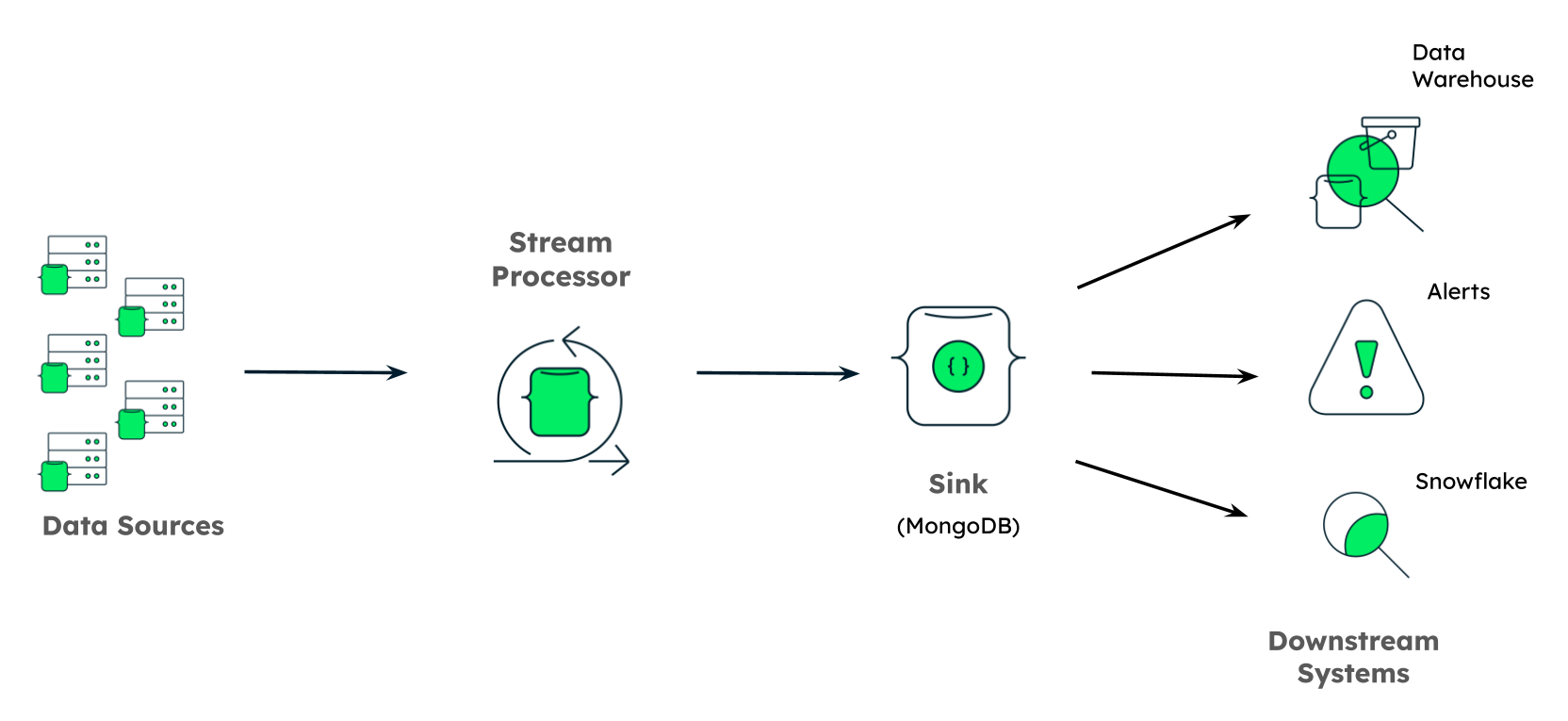
Figure 2. Atlas Stream Processing in action.

Sensor telemetry flows through Atlas Stream Processing, the fully managed stream processing service from MongoDB. Continuous aggregation pipelines within the stream processors evaluate incoming data against thresholds in real-time. Using tumbling windows, the system enables the detection of sustained anomalies, such as temperature averaging above limits over 30 seconds or particle counts spiking across multiple readings. 

When a threshold violation occurs, the stream processor routes processed data to MongoDB Atlas as a sink, writing alert documents for immediate WebSocket broadcast to dashboards, and it writes the processed telemetry to a Time Series Collection for historical analysis. Time Series Collections provide automatic compression and efficient time-range queries, preserving data for trend analysis and agent investigations without impacting detection latency.
Industry research indicates that fabs using closed-loop AI feedback maintain more stable outputs, with defect densities staying within tight control limits despite upstream variations. Leading manufacturers have demonstrated significant reductions in process variability through real-time AI-driven process control. Real-time detection serves as the foundation for these improvements.

Layer 2: Multimodal similarity search

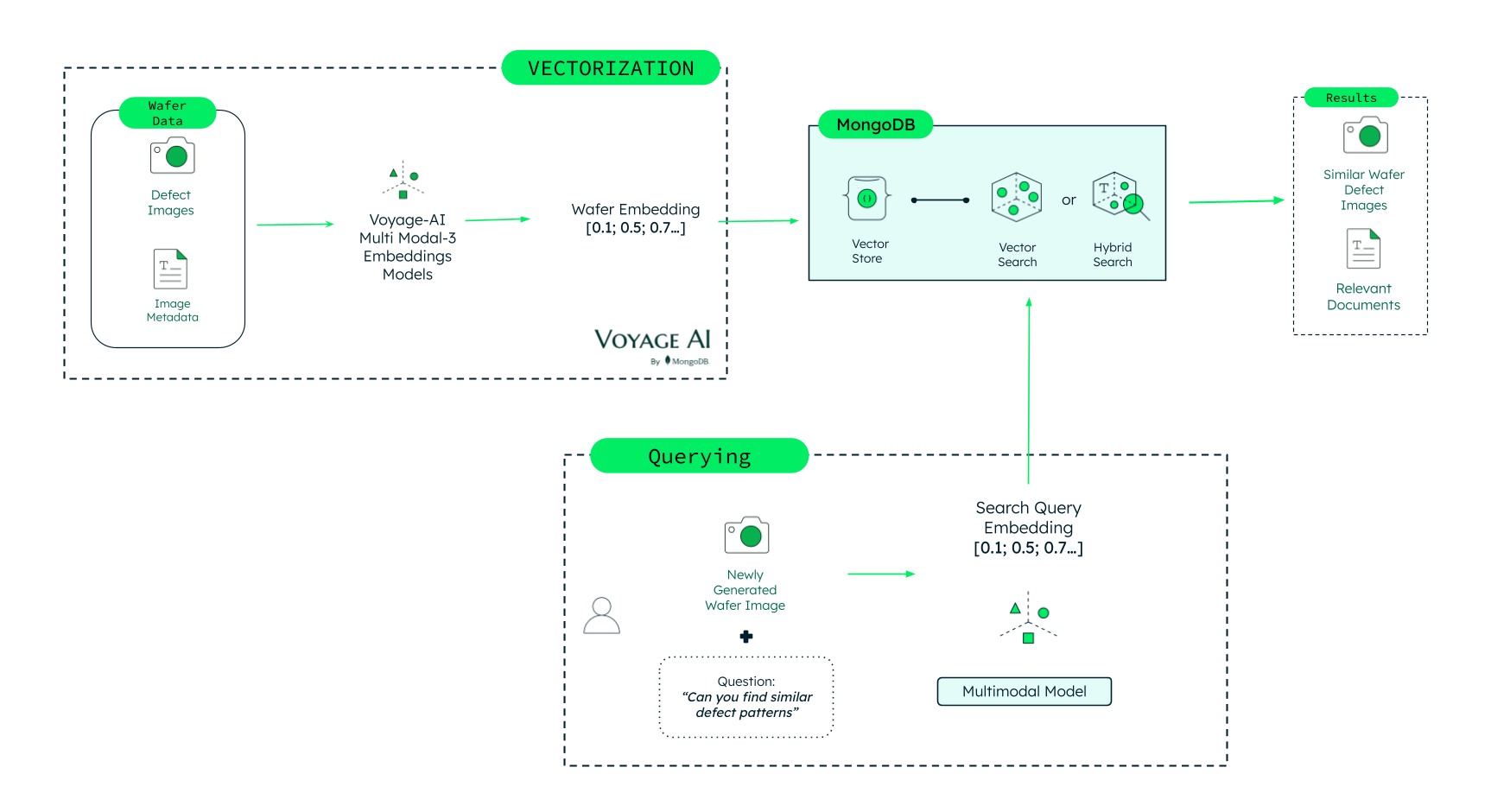
Figure 3. Multi-Modal Embedding Generation with Voyage-AI.

Traditional keyword search fails when the signal is a pattern on a wafer map described inconsistently across teams and time. For example, teams may label the same event as edge failures versus peripheral die failures, or a chiller malfunction versus a cooling issue.

This is resolved through multimodal embeddings. Using Voyage AI's voyage-multimodal-3 model, the system encodes wafer images and their textual context into a single dense vector. The model fuses "what this failure looks like" with "what was happening when it occurred."

Recent research validates this approach. FabGPT, a large multimodal model for semiconductor fabrication, demonstrated that combining Scanning Electron Microscope (SEM) images with textual context enables both defect detection and root cause analysis within a single framework. Similarly, SEM-CLIP applies contrastive learning to project semiconductor defect images and natural language descriptions into a shared embedding space.

The primary challenge involves defect patterns described inconsistently across teams and time. For instance, edge failures versus peripheral die loss often represent the same underlying issue. Traditional keyword search fails in these scenarios. MongoDB Atlas utilizes Vector embeddings to capture semantic meaning. This approach enables similarity search across wafer maps to identify true look-alikes, regardless of how engineers originally described the defect.

Content-based image retrieval (CBIR) research indicates that combining convolutional neural network (CNN)-extracted visual features with semantic search significantly improves defect pattern classification. This is critical when training data is limited—a common constraint in semiconductor manufacturing where novel defect types emerge continuously.

The integrated architecture enables engineers to pivot quickly from identifying an anomaly, such as this looks wrong, to accessing the five most similar historical failures.

Layer 3: The agentic root cause analysis

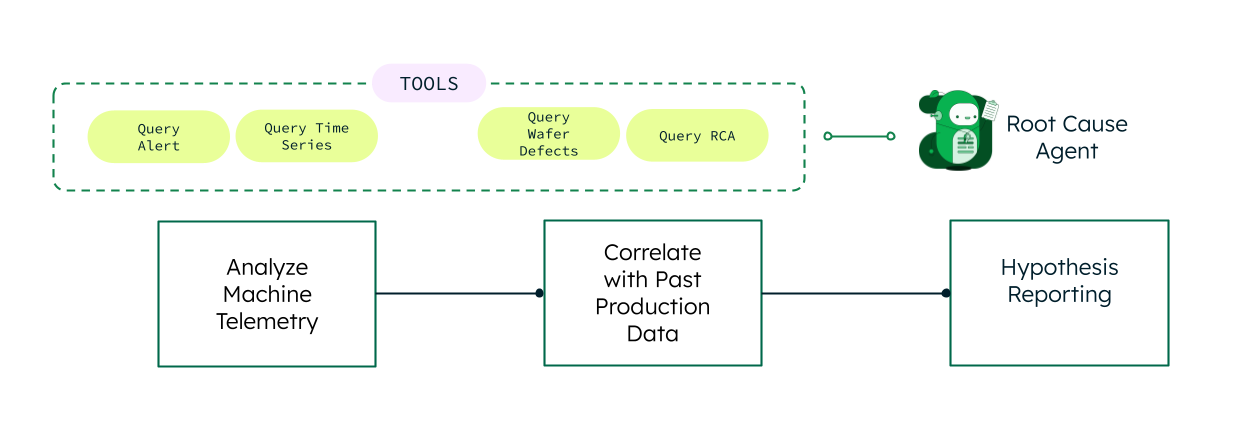
The architecture differentiates itself by deploying a LangGraph ReAct agent. This AI agent enables reasoning, multi-step investigation planning, and autonomous actions.
Figure 4. Root Cause Agent with Multiple Tools.

The agent has four MongoDB-powered tools:


ToolPurposeMongoDB feature
query_alertsFind recent excursions and contextAggregation pipeline
query_wafer_infoGet defect data and similar historical patternsVector Search
query_time_series_dataCompute sensor stats around failure windowTime Series and Aggregation
vector_search_knowledge_baseRetrieve similar RCA reports and proceduresVector Search

The ReAct pattern

Reason, then Act allows the agent to plan its own investigation:


StepThoughtActionObservation
1I need to find the alert details for CMP_TOOL_01query_alerts(equipment_id="CMP_TOOL_01")Found alert ALT-001 particle excursion at 10:30 linked to wafer W_004_16
2Get wafer defect details and find similar patternsquery_wafer_info(wafer_id="W_004_16")Clustered edge defects yield 65.9%. Multimodal search found 3 similar historical wafers
3Need sensor data around alert time for correlationquery_time_series_data(center_timestamp="10:30:12Z")Temperature spike (65°C → 68.5°C) 5 seconds before particle surge
4Search knowledge base for similar RCA reportsvector_search_knowledge_base(query="CMP temperature particle excursion cooling")RCA-2024-015 matches cooling system failure
Final--Structured RCA report with evidence chain


The conversation memory of the agent persists in MongoDB. With LangGraph's MongoDB checkpointing, each investigation thread is stored with full context.

Engineers can resume investigations. Auditors can trace how conclusions were reached. Follow-up questions resolve instantly without re-querying.

What changes for teams

The transition impacts the entire organization.

Operations teams shift from polling dashboards and reacting to end-of-shift reports to responding to events in real-time. Exceptions become actionable the moment they occur.

Process engineers no longer require searching through five different systems with keywords that might not match. They search once, using two methods: exact matching for known IDs and semantic search for everything else.

RCA teams replace hours of manual correlation and tribal knowledge with agent-driven, evidence-based investigations that conclude in seconds and provide a full audit trail.

Data teams go from multiquarter migrations to onboard new sources to same-day integrations that become queryable immediately.

megaphone
Next Steps

View the tutorial to implement this solution. To learn more about the role of MongoDB in the manufacturing industry, visit the MongoDB manufacturing and automotive webpage.

1 Source: Deloitte (Feb 2026)

2 Source: SEMI (Dec 2025)

3 Source: McKinsey (April 2021)

MongoDB Resources
Atlas Learning Hub|Customer Case Studies|AI Learning Hub|Documentation|MongoDB University