Imagine finishing a purchase, checking your loyalty balance moments later, and finding it unchanged. No confirmation, no reward, no sense that the transaction even registered. For millions of shoppers across the world's largest loyalty programs, this isn't hypothetical; it's the norm. Some balances take up to 72 hours to post. Others can take upwards of 10 business days after checkout. These delays aren't edge cases. They represent how most retail loyalty platforms operate today, revealing a widening gap between what customers expect and what legacy architecture can deliver.
Loyalty programs exist to reward behavior the moment it happens. When the reward gets delayed, the emotional connection between purchase and payoff whittles, and with it, the retailer's best opportunity to keep the customer engaged. Closing that gap isn't a matter of better marketing. It's a data architecture problem, something MongoDB can uniquely solve.
Batch processing is a loyalty liability
Most retail loyalty systems run on relational databases that credit points through nightly batch jobs. After a customer completes a transaction, it sits in a queue until an overnight process reconciles it against their account. During that window—sometimes hours, sometimes over a week—the customer has no idea whether their purchase was recognized or accounted for. This erodes trust and forfeits the single highest-intent moment in the customer journey: the moments immediately following checkout.
The market data underscores how costly this delay has become. Nearly 75% of customers say they're more likely to engage with loyalty programs offering instant rewards, and 82% of Gen Z and Millennial shoppers now expect real-time responsiveness from the brands they support (1). Instant gratification is no longer a differentiator; it's the baseline expectation. Retailers that fail to meet that actively train customers to disengage. Every point of friction increases the risk of a customer walking away from the program entirely. It should be a slam dunk in the customer relationship cycle, but many times it becomes the moment you lose that customer.
The business case is equally compelling. Customers who redeem loyalty rewards spend 2.5 times more than non-members, and instant credit has been shown to increase basket size by as much as 36% (2). Starbucks' Rewards program, which contributes nearly 60% of total revenue, is built around real-time visibility into balances and progress. The lesson? Real-time loyalty isn't a nice-to-have. It's a proven revenue driver.
The root of the problem lies in how relational systems get built. Crediting points instantly requires writing across multiple tables, transactions, customer profiles, balances, and tier status, all in a single atomic operation. On a normalized relational schema, this kind of cross-system write is expensive and difficult to scale, which is exactly why retailers fall back on nightly batch processing. Layering microservices on top doesn't solve this either; it simply distributes the same fragmented data across more systems, adding latency instead of removing it.
A data foundation built for the instant reward
MongoDB's flexible document model addresses this rewards lag challenge at its source. Rather than distributing a customer's transaction history, loyalty balance, tier status, and multiplier eligibility across separate relational tables, MongoDB stores the complete loyalty profile within a single, unified document. When a purchase completes, one atomic write updates that entire profile simultaneously. No joins to resolve. No waiting for batch windows. The balance simply updates as soon as the transaction closes.
Figure 1. Real-time loyalty engine: from purchase to instant rewards.
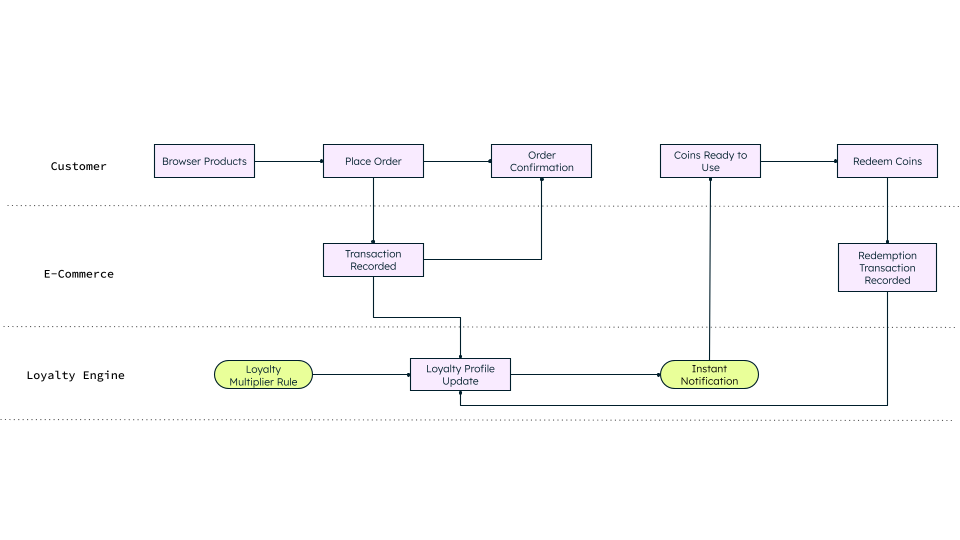
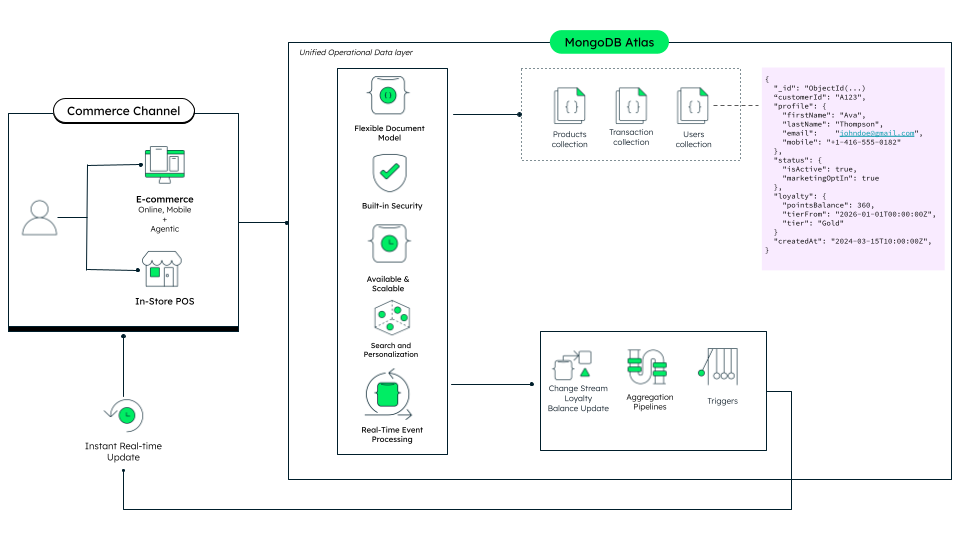
This same model extends naturally to the rest of the retailer's operational data. Instead of maintaining separate databases for transactions, customer profiles, loyalty balances, and product catalogs, all of it can live within a single MongoDB Atlas cluster without any synchronization delays. This is the operational data layer in practice: One platform supports both the sub-millisecond queries required for real-time crediting and the personalized, post-checkout recommendations that keep customers engaged post-sale.
Real-time behavior is only half of the equation. Retailers also need the ability to change promotional rules on the fly, which is where MongoDB Triggers and MongoDB Change Streams become essential. Triggers fire the instant a transaction is written, applying multiplier logic—1x, 2x, or more—without any separate batch recalculation. This means shifting a promotion from a standard rate to a double-point weekend becomes a single rule update rather than a redeployment.
Change Streams then push the updated balance directly to the customer's app in real time, eliminating the need for constant polling. Aggregation pipelines round out the architecture, computing multiplier eligibility and fraud checks, such as confirming a customer hasn't already claimed a bonus in the same session, without ever leaving the database layer.
Where a relational approach would normally require a separate ETL layer, a dedicated recommendation engine, an external event broker, and a standalone search index, MongoDB consolidates all of these capabilities into one platform. This is the difference between a loyalty program that reacts overnight and one that reacts in the moment. Why would you choose the former?
Figure 2. Atlas unifies customer, transaction, and product data with a flexible schema, while Change Streams, Aggregation Pipelines, and Triggers drive real-time updates to balances and tiers.
One platform means great benefits for retailers
For retailers, the shift to real-time crediting turns a known point of friction into a durable competitive advantage. Capturing the post-purchase moment matters because it's the highest-intent window in the customer journey, and real-time rewards convert that moment before it closes.
Real-time architecture also gives retailers a level of promotional agility that batch systems can't match. Multiplier events that once required engineering support, testing windows, and coordinated releases can now be adjusted live. It’s a single rule change in MongoDB Triggers with no redeployment or batch recalculation. Marketing and merchandising teams can respond to real-time demand signals, a slow Tuesday afternoon, an inventory surplus, or a competitor promotion by quickly launching or adjusting a points event. This frees up IT teams from being a bottleneck for every promotional change.
Retailers also benefit from consolidation. Replacing fragmented loyalty, transaction, and catalog databases with a single Atlas cluster reduces infrastructure overhead, simplifies data governance, and lowers the total cost of maintaining the loyalty platform. Fewer systems means fewer integration points and fewer points of failure. This ultimately creates a faster path to launching new loyalty mechanics, tiered rewards, cross-brand redemption, or partner integrations, as the program matures. Finally, eliminating delayed-crediting confusion directly lowers customer support volume, since accurate, real-time balances remove one of the most common sources of loyalty-related service inquiries.
What customers have been waiting for
For customers, the benefit is immediate, visible, and emotionally resonant. Points appear in their balance within milliseconds of a purchase, visible before they've even left the app or put away their card. There's no ambiguous waiting period, no wondering whether the transaction was registered, and no need to contact support to confirm a reward was earned. The moment of purchase and the moment of reward happen together, reinforcing that the loyalty program is responsive and trustworthy rather than an afterthought bolted onto checkout.
That immediacy also changes how customers use their rewards. Rather than earning points that sit dormant for days, customers can act on them immediately by:
- Applying points toward a new purchase directly within their digital receipt.
- Browsing AI-powered recommendations priced in both cash and points equivalents.
- Completing a hybrid payment if their balance doesn't cover the full amount.
This all turns the loyalty program into an active part of the shopping experience rather than a static rewards ledger.
Transparency compounds the effect. Real-time banners communicate active multiplier promotions the moment they go live so customers know what they're earning before they buy, not after. Visible tier progression—moving from silver to gold to platinum—gives customers an ongoing sense of momentum tied directly to their purchase history. Together, these elements replace the passive, often confusing experience of legacy loyalty programs with one more modern that feels responsive, transparent, and genuinely rewarding in the moment it matters most.
Ready to make loyalty instant?
Real-time loyalty is fast becoming the baseline expectation for how any modern loyalty program should function. Retailers still running on nightly batch cycles are training their most engaged customers to expect less and eventually to disengage. Those who move first to modernize will set the standard others are measured against, capturing the post-purchase moment before competitors realize what they’re losing.
MongoDB Atlas gives IT leaders the architectural foundation to make that shift without rebuilding their entire technology stack. By unifying transactions, customer profiles, and loyalty balances into a single, atomically updated document—and using Triggers and Change Streams to drive instant crediting and live promotional agility—retailers can eliminate the delay that has quietly undermined loyalty programs for years. The result: A program that rewards customers the instant they earn it, and a retailer positioned to compete on an increasingly non-negotiable experience.
Next Steps
Discover how MongoDB Atlas can help you deliver real-time personalized loyalty experiences across every channel through our solutions page.
Learn more about the MongoDB document model, change streams, and triggers.
Ready to start building? Register for MongoDB Atlas for free today.
References
Real-Time Rewards: Leveraging AI for Instant Gratification in Loyalty Programs https://www.novus-loyalty.com/blog/real-time-rewards-leveraging-ai-for-instant-gratification-in-loyalty-programs/
68 statistics about customer loyalty programs — and what you can learn from them in 2026
https://loyaltylion.com/blog/35-loyalty-stats-and-benchmarks-for-2022-and-beyond