The global payments landscape is a complex web of independent systems enabling international trade. According to Juniper Research, the market reached a value of $187 trillion in 2025 and is projected to hit $224 trillion by 2030. However, operational friction undermines this scale. Failed payments drain the global economy of over $100 billion annually, according to a study by LexisNexis.
The industry reached a critical turning point on November 22, 2025, with the end of the SWIFT MT/MX coexistence period. This transition mandates that all SWIFT messages use the ISO 20022 standard, moving the industry from unstructured text to granular, structured data.
However, many institutions remain dependent on legacy systems designed for older formats like SWIFT MT or proprietary domestic clearing. Because these legacy cores lack native support for ISO 20022, the resulting data transformations between modern messages and legacy systems often lead to a loss of quality and context, triggering manual interventions and avoidable exceptions.
To unlock true agentic power, institutions should center their modernization strategy on a unified canonical payment model. MongoDB’s flexible document model provides the ideal foundation to preserve complex payment contexts. Rather than treating data as a series of isolated, context-blind messages, this approach builds a reliable foundation for governed, agentic AI. By shifting to intelligent automation, systems can minimize fees, restore data context, and select optimal settlement routes in real-time to drive measurable results.
From fragmented messaging to canonical clarity
Before institutions can fully realize the power of agentic AI in global payments, they must address the structural factors currently holding the industry back. The primary hurdle is the proliferation of messaging standards. Institutions are currently forced to manage a diverse range of formats, including ISO 20022 and ISO 8583 to legacy SWIFT MT and local real-time APIs. In traditional table-centric systems, each of these "rails" typically requires its own schema and translation layer. This approach drives up integration costs and creates fragile, siloed development environments where logic is easily broken.
The path forward requires a shift toward a canonical payment model. This model can represent every payment type within a single, unified document. By storing the original message payload alongside a normalized representation, institutions can use AI-assisted mapping tools to propose and test field mappings across standards. This reduces the burden of manual rule creation while ensuring that humans remain in the loop for critical oversight.
Preserving context in a complex world
Even when modern standards such as ISO 20022 are used, many systems experience data loss during ingestion. ISO 20022 carries rich, nested structures—such as complex invoice references—that are often lost when forced into rigid relational tables. When this context is scattered across multiple database joins, the resulting loss of meaning leads to operational exceptions.
To prevent this, the architecture must preserve the full nested hierarchy in a single document. Unifying data from different messaging standards into a canonical format ensures that compliance, reconciliation, and analytics operate with complete context. This unified view is essential for agentic AI to accurately suggest repairs when fields are missing or inconsistent.
Navigating local dialects
Institutions must account for localized ISO 20022 dialects. Despite the goal of standardization, the flexibility of ISO 20022 means that market practices and optional elements vary between regions. A fully compliant message may be rejected because a receiving institution enforces a specific local profile, causing rework and delays.
Rather than relying on hard-coded rules, institutions should maintain configuration-driven processing profiles tailored to specific corridors and counterparts. By deploying AI-assisted reasoning to propose conversions between these optional structures and surfacing likely acceptance criteria—all while keeping humans in the loop—banks can maintain payment flows and strict governance.
Bridging the gap between legacy and modern rails
Interoperability remains a significant hurdle because, while ISO 20022 is the standard for SWIFT, many end-to-end flows still traverse rails that are not natively ISO-compatible. This creates two distinct risks:
Rich-to-constrained scenarios: Moving complex data from ISO 20022 to legacy networks—such as ACHs still on proprietary formats or ISO 8583—often requires truncating or omitting structured data to fit limited capacity.
Sparse-to-rich scenarios: These occur when a payment starts at a point of sale (POS) using the bandwidth-optimized ISO 8583 format. By the time this reaches downstream clearing systems that mandate ISO 20022, the message lacks the granular data required for compliance.
To solve this, Institutions can maintain a unified document model in MongoDB that stores the original native payloads alongside a normalized view. This approach decouples the payment's storage from the technical limitations of any specific rail. Agentic AI acts as a proactive exception handler: it can flag fields at risk of truncation for optimized mapping or enrich documents with missing data from internal profiles. AI can even transform semi-structured data into the structured formats required by ISO 20022.
The Next frontier: Hybrid corridors
As the industry moves toward hybrid corridors—where fiat currency converts to digital assets and back—the complexity increases. While these corridors offer 24/7 settlement and programmable efficiency, they involve dynamic variables such as fluctuating on-chain gas fees and exchange spreads. Without a unified data backbone, operations teams cannot compare the "true cost" of these routes against traditional ones in real time.
By treating routing as a dynamic decision powered by a unified data backbone, institutions can capture live telemetry in a time-series data structure. Policy-aware AI agents can analyze this dataset to recommend the optimal path for every transaction.
Modernizing at the agentic data layer
Implementing these strategies requires a shift to a flexible data backbone. Using the MongoDB document model enables institutions to unify complex, nested payment data and multiple message standards into a single canonical document. This document serves as the foundation for agentic AI. By focusing on augmentation over replacement, financial institutions maintain control through human-in-the-loop governance. This architecture rests on three core pillars:
Unified Canonical Data Foundation
The bedrock of a modern global payments architecture is the ability to handle data without the constraints of traditional rigidity. By using a single, unified canonical payment document, institutions can store participants, amounts, original payloads, and normalized fields.
This approach stores the native payload—the original message context—alongside normalized fields. This ensures that even as disparate message types, such as SWIFT MT, ISO 20022, ISO 8583, are mapped into the canonical document, the forensic evidence of the original instruction remains preserved. Furthermore, by storing the mapping provenance, the system provides an auditable trace of every rule, human, or agent that performed a conversion.Consistency and Control
The underlying building blocks must ensure that operational flexibility does not compromise institutional control. Transaction integrity is maintained through MongoDB’s multi-document ACID support. This support guarantees that agent-driven updates, such as ledger entries, are always reliable and atomic.
This architecture enforces strict data governance and security by using schema validation and encryption to ensure the AI operates within defined policy controls. By persisting all AI inputs and outputs and linking automated actions to specific approvals, the system maintains auditability. Global clusters and zone-based sharding provide the low latency and data residency compliance necessary for international corridors.Agentic Intelligence
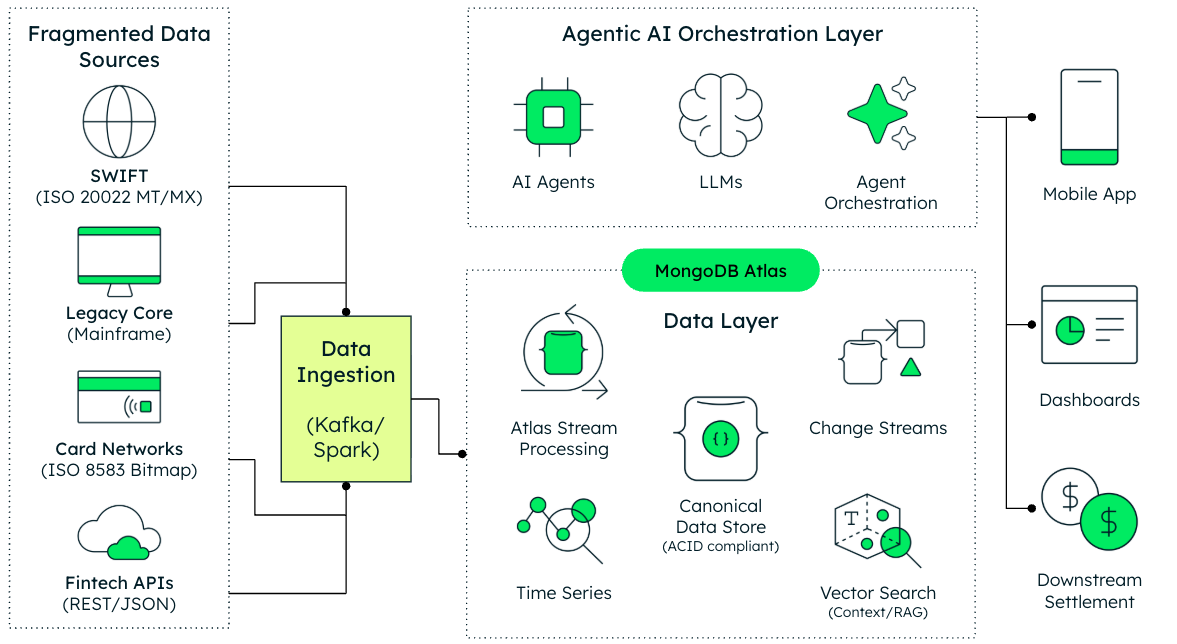
This involves transitioning from simple scripts to AI agents capable of human-like reasoning. Financial institutions can use Voyage AI to generate high-fidelity vector embeddings from unstructured data, such as investigation notes. By storing these in MongoDB Atlas and using Atlas Vector Search, agents can perform repairs by identifying past exceptions based on conceptual meaning rather than just keywords.
This intelligence is supported by live telemetry from time-series metrics, such as FX rates. These metrics enable policy-aware agents to recommend optimal routing in near real-time.
Lastly, event-driven payment automation triggers via Atlas Stream Processing and MongoDB Change Streams ensure that workflows are instantiated the instant a payment changes state. This creates a responsive processing environment.
Figure 1. Agentic architecture for global payments.
Implementing a modern system
Moving from legacy rigidity to an AI-enabled architecture does not require a complex replacement. Institutions can use the domain expertise of Icon Solutions and the Icon Payments Framework (IPF) to execute this architecture in a gradual, component-based manner. Success relies on defining a comprehensive set of guidelines to steer the evolution.
Handling the scale of global payments requires attention to non-functional requirements. For example, the payments data store (PDS) uses separate read and write operations (CQRS design pattern) to accommodate billions of entries and comfortably sustains 10,000 write actions per second (to support 1,000 payments per second).
Modernization strategic imperatives
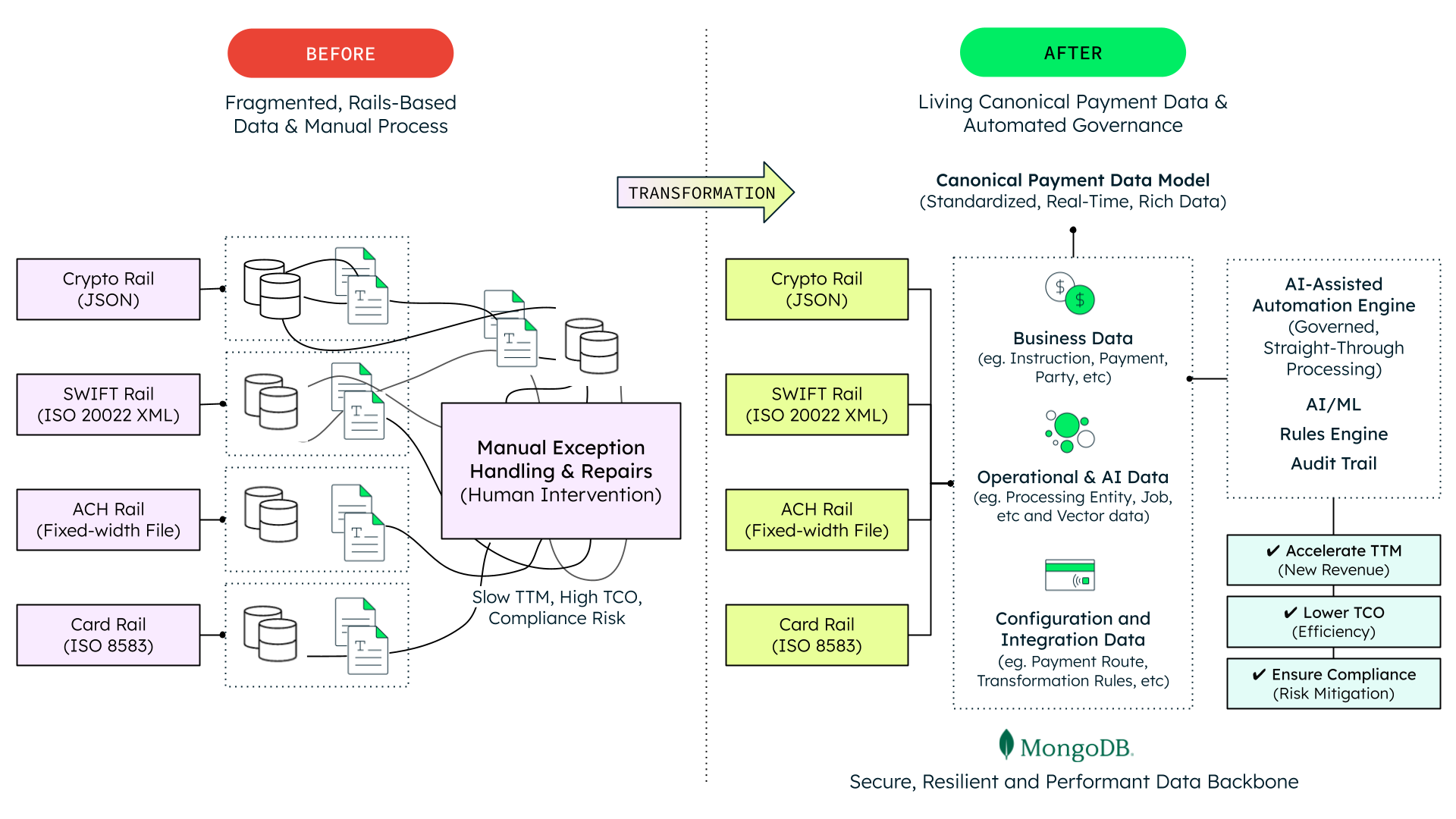
By moving from fragmented, rails-based data to living canonical payment data, institutions can modernize global payments without compromising control. The following table identifies the strategic benefits of this approach.
Figure 2. From legacy rail sprawl to a canonical, agentic payment platform
With MongoDB as the resilient data backbone and leading payments solutions, such as Icon Solutions, providing the domain-intelligent framework, payments can operate with the speed and context required by the modern economy. Financial institutions can now engineer a transparent and efficient processing environment.