Artificial intelligence (AI) is everywhere, but its power comes from something most of us never see: a compound AI system orchestrating every move. Behind the scenes, interconnected components like data pipelines, neural networks, decision-making algorithms, and inference engines work in harmony to gather and analyze information and produce results we rely on.
Large language models (LLMs) act as the central communicator in the compound system. They take user requests and pass them along to other components to retrieve or process the necessary information, and return a clear, natural-sounding response. This collaboration between the LLM and the supporting components is why interactions with AI systems feel seamless and intuitive.
Table of contents
- LLM as part of a larger framework of compound AI systems
- How do individual pieces within compound AI systems work together?
- The versatility of compound AI systems
- Beyond bigger language models: The case for modular compound AI systems
- Challenges of compound AI systems
- Conclusion
LLM as part of a larger framework of compound AI systems
While LLMs may seem like they handle everything when you interact with an app like ChatGPT, they need compound AI systems to get the job done. On its own, an LLM is like a car engine sitting on a garage floor—powerful but incomplete without the surrounding systems to make it functional. To become fully operational, the "engine" needs additional components like wheels, a transmission, and a chassis, all working together to make a usable vehicle. Once this basic foundation is in place, automotive manufacturers can customize cars to meet specific needs or preferences.
Similarly, companies are developing compound systems built with modular and diverse components, allowing them to grow, adapt, and provide tailored solutions to complex problems. ChatGPT is a prime example of a compound AI system. While the LLM generates responses, it relies on additional components like preprocessing pipelines to structure input, memory systems to manage conversation context, and APIs to connect with user-facing applications. These systems work together to transform the LLM into a scalable and interactive tool for real-world use.
How do individual pieces within compound AI systems work together?
When you interact with a chatbot online, it might seem like a standalone AI application where one system is handling everything, including understanding your question, finding the answer, and delivering a response. But in compound AI systems, what’s happening behind the scenes is more like a group project where each component in the system has a specific role, combining the strengths of its parts to create a smarter, more capable tool.
The LLM is the "communicator" responsible for understanding user input and crafting natural-sounding responses. However, it depends on other parts of the compound AI system to locate accurate information, make decisions, and deliver the correct output.
Below is an example of how compound AI systems can bring these components together, using the tools of AI development.
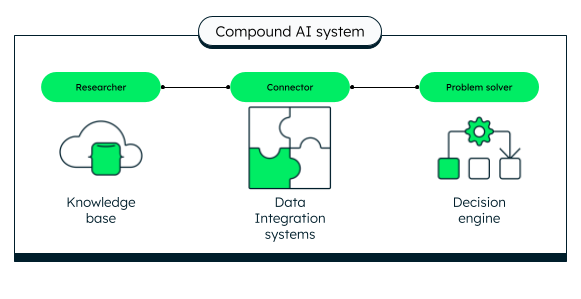
Knowledge base search: The researcher
When you ask a chatbot, “How do I reset my password?” the LLM doesn’t have this information memorized. Instead, it relies on a knowledge base search component to act as the system’s researcher. This part scans FAQs, user guides, and support documents to find the best match. The LLM then transforms this raw data into a clear, user-friendly response tailored to your question.
Data integration systems: The connector
While knowledge base search works with static resources like FAQs, data integration systems connect the chatbot to live data sources for real-time answers. For example, if you ask an AI model, “Where’s my order?” the compound system taps into your order history and responds, “Your package was shipped yesterday and is expected to arrive tomorrow.” These connectors bridge the gap between the LLM and dynamic, constantly updating data.
Decision engines: The problem-solver
After compound AI systems gather information, decision engines determine the next step:
Rule-based engines stick to predefined rules, such as flagging certain keywords to route complex queries to human support.
Automated decision-making systems rely on AI to assess the tone and urgency of the query, ensuring the system responds appropriately, even in nuanced to complex situations.
Decision engines ensure that your request is handled efficiently and accurately. For more specialized tasks, the system might rely on external tools, such as a weather app to provide a real-time forecast or a logistics API to check delivery statuses.
Together, these components form a cohesive and highly capable system, far more powerful than any single part of what compound AI systems represent. This interconnected design enables compound AI systems to provide the advanced functionality we rely on every day.
The versatility of compound AI systems
Compound AI systems are used in many industries. Whether it’s streamlining customer service, improving healthcare, or helping autonomous vehicles navigate the road, these systems show how a combination of single models and their interconnected parts can handle a wide range of challenges.
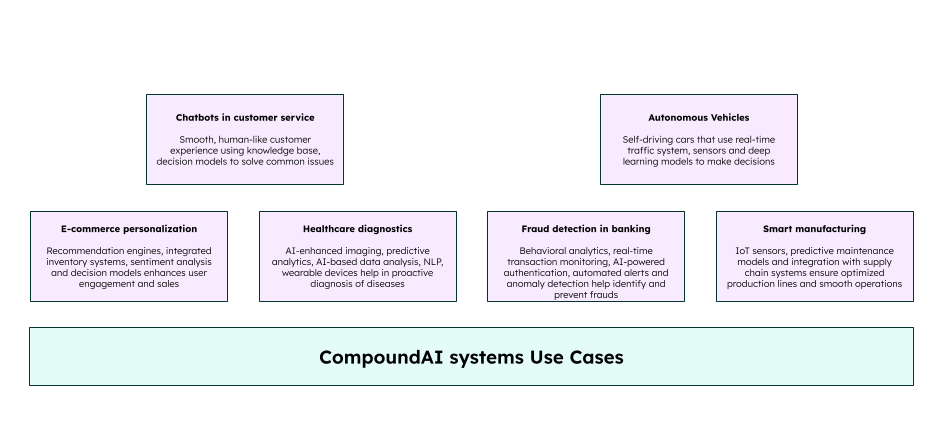
Chatbots in customer service: Compound AI systems help chatbots provide smooth and efficient customer interactions. Knowledge base searches retrieve static information, data integration systems access live account details, and decision engines prioritize urgent requests or escalate complex issues to human agents. Working together, these components create a smooth, human-like customer experience.
Autonomous vehicles: Self-driving cars use compound AI systems to navigate and react quickly to their surroundings. Sensors collect data about the environment, machine learning models identify obstacles, and decision engines make choices like when to brake or turn. Real-time traffic updates from navigation tools keep the journey safe and efficient
Smart manufacturing: In manufacturing, compound AI systems streamline operations and optimize production lines. IoT sensors monitor equipment performance, predictive maintenance models analyze data to prevent breakdowns and downtime, and decision engines adjust workflows to maximize efficiency. Integration with supply chain systems ensures that resources arrive just in time.
E-commerce personalization: Online retailers use compound AI systems to create personalized user experiences. Specialized recommendation engines suggest products based on browsing history, data integration systems check real-time inventory, and decision engines tailor offers based on user behavior. This combination drives higher engagement and boosts sales.
Healthcare diagnostics: In healthcare, compound AI systems are making it easier to get accurate diagnoses. For example, in radiology, sophisticated systems can analyze scans, pull in patient records for extra context, and suggest what to do next. It’s helping doctors work more efficiently and give better care.
Fraud detection in banking: Banks use compound AI systems to stay ahead of fraud. They can track what’s happening in your account 24/7, instantly flag anything suspicious, and quickly decide whether to block a transaction or send an alert. This multi-step process helps keep customers' money safe and provides peace of mind.
Beyond bigger language models: The case for modular compound AI systems
Compound AI systems are compelling because of how their different components work together, but it’s important to consider how these systems are built. A common misconception is that creating larger and more complex LLMs will solve all challenges. In reality, this approach is not only expensive but also has its limits. That’s why many organizations are turning to modular compound AI systems. By combining a strong LLM with task-specific tools, modular systems provide a scalable, flexible, and cost-effective solution.
Key benefits of modular systems
Cost-effectiveness: Massive LLMs demand substantial financial and computational resources to develop and maintain. In contrast, modular AI systems leverage individual models with task-specific tools, reducing overall costs by avoiding the need for a single, all-encompassing model.
Specialized functionality: LLMs are great generalists, but they cannot complete every task. Adding specialized components to AI models, like calculators, databases, or web APIs, allows the system to tackle AI tasks and complete specific challenges more effectively than a single large model.
Flexibility and scalability: With modular systems, you can update, replace, or expand individual components without disrupting the entire setup. This flexibility makes it easier for organizations to adapt to changing needs and scale up when required.
Ease of maintenance: Individual modules can be updated without shutting down the entire system, ensuring uninterrupted operation and minimizing downtime.
Customization and experimentation: Modular systems allow organizations to easily add or remove components from different models, making it simpler to address unique challenges or experiment with new models and tools. This flexibility fosters innovation and encourages continuous improvement.
By integrating multiple interacting components with a foundation of multiple diverse models and leveraging the modular nature of AI systems, organizations can create smarter, more adaptable solutions while avoiding the high costs and limitations of relying solely on single models or massive LLMs.
Challenges of compound AI systems
Integration complexity
Integrating multiple components and specialized tools into a cohesive AI system is no easy feat. Each part must work seamlessly with the others, which demands careful design, reliable APIs, and smooth data flow to ensure optimal performance and prevent breakdowns.
Cost of development and maintenance
While modular systems can save costs in the long run, the initial investment in developing and building compound AI systems is often significant. Additionally, building and maintaining a compound AI system requires ongoing resources to monitor, update, and optimize its many parts.
Scalability challenges
Modularity simplifies scaling, but adding too many modules can lead to unnecessary complexity. Striking the right balance between simplicity, computational power, and functionality is essential to prevent inefficiencies and minimize troubleshooting challenges.
Latency and performance bottlenecks
Delays can creep in when multiple components of a compound system are working together, especially for real-time applications. For instance, relying on external APIs or databases to perform specific tasks can slow response times if the system isn’t properly optimized.
Security and privacy risks
The more components exchange data, the greater the risk of breaches or leaks. Each module must meet strict security standards to ensure the entire system remains secure and compliant with privacy regulations.
Dependency on specialized expertise
Compound AI systems often require expertise across multiple fields, from machine learning and data engineering to API development and cybersecurity. Locating and retaining qualified employees to manage these complex systems can be a challenge.
Version compatibility and upgrades
Because modular systems rely on individual components, upgrades can introduce compatibility issues. Updating one component or one module may create conflicts with others, requiring extensive testing and validation to maintain AI systems stability.
Organizations can overcome the hurdles and fully harness the flexibility, efficiency, and scalability of compound AI systems by addressing challenges with strategic planning and a strong technical foundation.
Conclusion
In this article, you learned that AI’s seamless performance relies on the collaboration of compound AI systems. With LLMs as the communicators and components like data pipelines and decision engines working in harmony, these systems efficiently deliver the results we depend on. For businesses, this orchestration offers a powerful advantage—flexibility, scalability, and the ability to innovate in a fast-changing world.