The first version of the MongoDB database shipped in August 2009. The 1.0 release and those that followed shortly after were focused on validating a new and largely unproven approach to database design — built on a JSON-like document data model and layered onto an elastic and distributed systems foundation. Those early MongoDB releases attracted adoption across startups and enterprises alike.
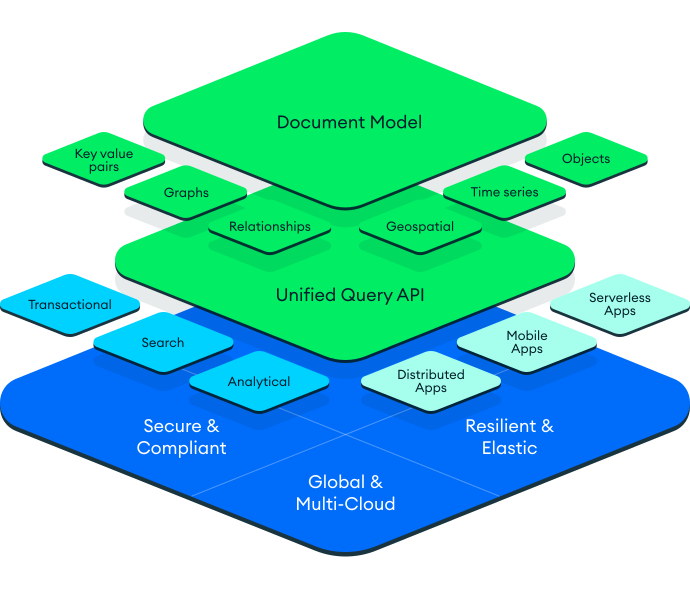
With early usage validating product-developer fit, the MongoDB engineering team’s focus shifted to expanding the system beyond a niche NoSQL database into the industry’s first data platform. From operational and transactional workloads with integrated full-text search to real-time analytics and mobile computing at the network edge, MongoDB Atlas data platform accelerates and simplifies how developers build with data for any class of modern application, all accessed via a unified API.
Developers have downloaded MongoDB more than 265 million times.
MongoDB 9.0 introduces major advances across performance, scalability, resilience, observability, security, and developer productivity. It addresses demanding enterprise and AI-native workloads, helping organizations support more users, transactions, and AI-driven activity before adding infrastructure or rearchitecting applications.
Higher performance for demanding applications
MongoDB 9.0 gives applications more room to grow with up to 35% faster find-one queries, up to 30% faster update-one queries, up to 20% higher transactional throughput, and nearly 2x higher throughput for large deployments, and improved price-performance with Gen 2 compute for Atlas dedicated clusters.
Security that protects data without limiting how it is used
MongoDB Queryable Encryption expands support for prefix, suffix, and substring queries while keeping data encrypted end-to-end. Expanded private networking capabilities in Atlas help organizations integrate MongoDB into complex network and security environments.
Resilience under pressure
Intelligent Workload Management, enabled by default for Atlas dedicated clusters at no additional cost, helps protect critical operations during overload conditions. MongoDB 9.0 also adds more targeted restore capabilities, backup improvements for Enterprise Advanced, and safe-sequence maintenance controls to reduce operational risk.
Clearer operational insight
A redesigned Atlas Metrics UI, enhanced native OpenTelemetry metrics integration, and Query Shape metrics across inserts, updates, deletes, and reads help teams diagnose issues faster and connect database behavior to the observability tools they already use.
A more familiar path to modernization
The MongoDB extension for Hibernate ORM lets Java developers use familiar Hibernate APIs and HQL while working with MongoDB. Schema constraints allow data rules and application expectations to be enforced directly within the database, helping teams modernize without rebuilding application logic or retraining developers on entirely new programming models.
2024 — MongoDB 8.0
MongoDB 8.0 is built for the needs of development teams so they can focus on building capabilities more efficiently. With a design emphasis on enterprise-grade security, resilience, availability, and performance—including more than 45 architectural improvements and new features — MongoDB 8.0 delivers exciting new capabilities for developers.
Optimized performance for a wide variety of applications. MongoDB 8.0 significantly improves performance by allowing applications to more quickly and efficiently query and transform data with up to 32% better throughput. Architectural optimizations in MongoDB 8.0 have reduced memory usage and query times. A combination of more efficient batch processing capabilities for inserts, updates, and deletes, coupled with other optimizations has enabled 56% faster bulk writes and 20% faster concurrent writes during data replication. Additional optimizations enable MongoDB 8.0 to handle higher volumes of time series data and perform operations more than 200% faster with lower resource usage and costs.
Innovative encryption that unlocks new use cases. MongoDB Queryable Encryption is an industry-first innovation developed by MongoDB’s Cryptography Research Group that allows customers to encrypt sensitive application data, store it securely as fully randomized encrypted data in the MongoDB database, and run expressive queries on the encrypted data for processing. MongoDB 8.0 now includes support for range queries—in addition to equality queries—to expand secure data retrieval with more flexibility for common searches. For example, customers can perform range-based searches on fully encrypted financial data, such as assessing the distribution of creditworthiness by finding applicants with credit scores within a specific range. With Queryable Encryption, the required data remains encrypted until it reaches an authorized end user using a customer-controlled decryption key. Now with range queries, Queryable Encryption helps reduce the risk of inadvertent data exposure and exfiltration by malicious actors with applications that store and process highly sensitive data by keeping it encrypted throughout its lifecycle, with no cryptography expertise required.
Fast horizontal scaling for global high availability. With MongoDB 8.0, horizontal scaling is now faster and easier at a lower cost. With horizontal scaling, applications can scale beyond the limits of traditional database resources by splitting data across multiple servers known as shards—without having to pre-provision increasing amounts of compute resources for a single server. New sharding capabilities in MongoDB 8.0 distribute data across shards up to 50x faster and at up to 50% lower cost to get started.
Resilience for unexpected application demand. MongoDB 8.0 now provides greater control for teams to optimize database performance for unpredictable spikes in usage and sustained periods of high demand to ensure consistent application behavior. MongoDB 8.0 includes new capabilities to set a default maximum time limit for running queries, reject recurring types of problematic queries, and configure query settings to persist through events like database restarts to help ensure high performance for applications experiencing high demand or experiencing unexpected events.
Together, these new capabilities for MongoDB 8.0 provide the fastest, most durable, secure, and reliable version of MongoDB for building a wide variety of applications.
The easiest way to get started with MongoDB 8.0 is mongodb.com/try where you can sign up for a free Atlas account, download the Community edition and learn more about self-managing MongoDB with an Enterprise Advanced subscription.
2023 — MongoDB 7.0
MongoDB 7.0 introduces major improvements across four key areas: Migrations, security, performance and developer experience.
Migration operations are streamlined with updates to mongosync, providing flexibility for syncing between clusters with unlike topologies, enabling specific subsets of databases and collections to be synced and oplog buffering to keep the source & destination clusters in sync.
Security is reinforced with the general availability of Queryable Encryption which provides customers the ability to encrypt sensitive workloads throughout its lifecycle while additionally are able to query the encrypted data as well
Performance improvements include an advanced query execution strategy becoming the default for find() and prefix of aggregate() queries. Sharded clusters have faster chunk migrations with a new high throughput parameter.Balancer chunk auto-merge ensures linear growth in the number of chunks is not required when scaling a sharded cluster.
MongoDB 6.0 includes more features and optimizations for time series collections; improved support for event-driven architectures; full support for sharded joins and graph traversal; improvements to operational resilience and sharding; and the ability to run expressive queries on fully randomized encrypted data.
General availability of Atlas Serverless instances, Atlas Data API and Atlas CLI which interacts with your Atlas database deployments and Atlas Search from the terminal with short, intuitive commands, so you can accomplish complex database management tasks in seconds.
Atlas Data Lake (in preview), a fully managed storage service for analytical workloads; Atlas Data Federation, which allows you to seamlessly query, transform, and aggregate data from one or more MongoDB Atlas databases, Atlas Data Lakes, or AWS S3 buckets; and SQL Interface with support for popular SQL-based tools.
mongosync, which allows you to continuously synchronize data between MongoDB clusters in the same or hybrid environments, including Atlas, private cloud, on-premises, and at the edge.
MongoDB 5.x with native time series collections optimized for IoT and financial apps; live resharding so you can change your shard key on-demand with no database downtime; distributed cross-shard JOINs and graph traversals for sophisticated analytics against live data, faster initial sync via file copy, new aggregation operators, and more.
The MongoDB Stable API future-proofs your applications. You can upgrade to the latest MongoDB releases without the risk of backward-breaking changes.
Atlas Serverless instances automatically and dynamically scale to meet your workload and you pay only for the resources consumed.
The MongoDB Atlas Data API provides a fully managed, REST-like API for accessing your Atlas data without the need for database drivers.
MongoDB 4.4 offering richer aggregations with UNION; streaming replication reducing data synchronization latency across a distributed database cluster by up to 50% ; hedged and mirrored reads for consistent low latency in the face of infrastructure failures.
MongoDB Atlas Online Archive to automatically tier aged data from your database to fully managed, queryable object storage, optimizing scalability, performance, and cost.
MongoDB Atlas multi-cloud clusters providing the ability to distribute data in a single cluster across multiple public clouds simultaneously, or move workloads seamlessly between them.
MongoDB 4.2 brings distributed, cross-shard ACID transactions for data integrity at global scale; client-side field-level encryption, providing some of the strongest privacy controls anywhere; on-demand materialized views for blazing fast analytics.
MongoDB Atlas Search, combining the power of Apache Lucene with the Atlas platform, making it easy to build fast, relevant, full-text search on top of your data in the cloud.
MongoDB Atlas Data Lake, enabling you to quickly and easily query data in any format on Amazon S3 using the MongoDB Query API.
MongoDB 4.0 offers multi-document ACID transactions, making it even easier to address a complete range of use cases with MongoDB and simplifying legacy database migrations.
MongoDB Atlas Global Clusters, creating fully managed, globally distributed database deployments for low-latency reads and writes, plus data placement controls for regulatory compliance.
MongoDB Atlas enterprise security controls with LDAP integration; bring-your-own KMS for encrypting data at rest; and granular event audit logging.
MongoDB Charts is a modern data visualization and analytics tool that allows you to easily create, share, and embed visualizations from Atlas and Atlas Data Lake.
Fully managed MongoDB Atlas database service is now expanded from AWS to Azure and Google Cloud, providing unmatched data distribution across all of the leading cloud providers.
Change streams to build always-on, real time, reactive applications and retryable writes enabling developers to build more resilient apps with less client-side code.
Further improved data integrity with schema validation to enforce a schema against your data.
Implementation of a global logical clock to enforce consistent time across every operation in a distributed cluster, further improving data integrity and resilience, along with causal consistency guarantees for read-your-own-write consistency.
Fully-managed MongoDB Atlas database service launched on AWS, providing built-in automation for resource and workload optimization and always-on security, backed by a 99.995% uptime SLA.
Native graph processing with $graphLookup to identify patterns in connected data; the decimal data type for high-precision processing of financial and scientific data; and read-only views to filter and mask data.
Zoned sharding to localize data within specific regions and 10x faster data rebalancing across elastically scaled database clusters.
The launch of MongoDB Compass provides a GUI for MongoDB development and administration; the MongoDB Connector for BI exposing MongoDB data for analysis and visualization via SQL.
Higher database resilience with faster failure detection and recovery via the RAFT-based replication consensus protocol.
MongoDB Ops Manager is the self-hosted management platform that enables you to deploy, monitor, back up, and scale MongoDB on your own infrastructure with 95% lower operational overhead.
50-member replica sets, providing global data distribution.